Dual Urban Arts Space exhibitions transcend borders
Though billed as separate exhibitions, ‘Fragmented-Recaptured’ and ‘Cartography’ feel innately connected, both exploring the concept of physical place and the sometimes-catastrophic impacts that geo-political lines can have on those people who dwell within a given land.

A pair of exhibitions opened at Urban Arts Space this week are divided by a border, of sorts, with “Fragmented-Recaptured” staged in the upper gallery space and “Cartography” stretched throughout the lower gallery. And yet, despite this divide, the two shows tread shared ground, exploring the concept of physical place and the sometimes-catastrophic impacts that geo-political lines can have on those people who dwell within a given land, be it Palestine. Kashmir, or Kurdistan.
In that way, even the setup of the dual spaces comes to mirror the ideas explored within, drawing out added complexity in a pair of staggering exhibits that touch on everything from genocide and authoritarian violence to the often-arbitrary borders drawn between countries that can split long-established communities of people and intensify these horrors. (An opening reception for both exhibitions takes place at Urban Arts Space from 6-8 p.m. on Saturday, July 26.)
Sahar Tarighi, a Post-MFA Scholar in the Department of Art at Ohio State University who co-curated “Fragmented-Recaptured” alongside University of Michigan assistant professor Pedram Baldari, traced the roots of the exhibition to her upbringing in Kurdistan, a roughly defined geo-cultural region spread across four countries: Turkey, Iraq, Iran and Syria.
A donation powers the future of local, independent news in Columbus.
Support Matter News
“I have always been dreaming about it, to bring Kurdish artists from all parts of Kurdistan together,” said Tarighi, who accomplishes the feat here, displaying work from seven artists who collectively represent all four regions of Kurdistan. “And with every artist, the main idea was talking about segregation, and about how that land is one body that socio-political fragmentation has been affecting. And everybody has a different approach … but through art, we are trying to reimagine the future, in a way.”
To reimagine the future, though, one must first deal with the past – and a number of the artists on display, including Tarighi, have included works that confront decades-old atrocities to heart-rending effect. In the “Against Forgetting: Anfal Genocide,” which combines video and sculptural elements, Tarighi reconciles with the Anfal genocide carried out by Iraq in the late 1980s – a brutal campaign marked by chemical warfare, mass executions, and forced displacement in which more than 180,000 Kurdish civilians were killed, according to some estimates.
Every element of the instillation is carefully plotted out and layered with meaning, from the process used to fire the grotesquely twisted ceramic faces then embedded in an oil-black, resin-like substance (fired using the Raku technique, which deprived the piece of oxygen and was meant to mirror the suffocation experience by the murdered civilians) to the wooden pallets on which the piece rests, representative of the shipping containers that could have stored the chemical weapons deployed by Iraq on the people. An accompanying video presentation underscores this idea, Tarighi activating dry ice within the sculpture as a means to evoke clouds of mustard gas, which cloud and smother the ceramic faces left frozen in the mass grave displayed below.
Elsewhere, Huner Emin creates a series of large-scale fingerprints that on closer inspection are revealed to be the written names of those who died in Iraqi civil wars between 2003 and 2017, while co-curator Pedram Baldari presents a series of portraits of Kurdish political, social, and public figures who lost their lives at the hands of those states occupying the Kurdish homeland.
“As an artist, I am seeking healing,” said Tarighi, who traced her first memory of the Anfal genocide to the refugee family who her parents took into their home in Rojhelat (Eastern Kurdistan) for more than a year in the late 1980s, extending their meager resources out of a sense of shared communal responsibility. “It’s all about a memory and a body and a language that is wounded, and how we can repair it through sharing, through talking.”
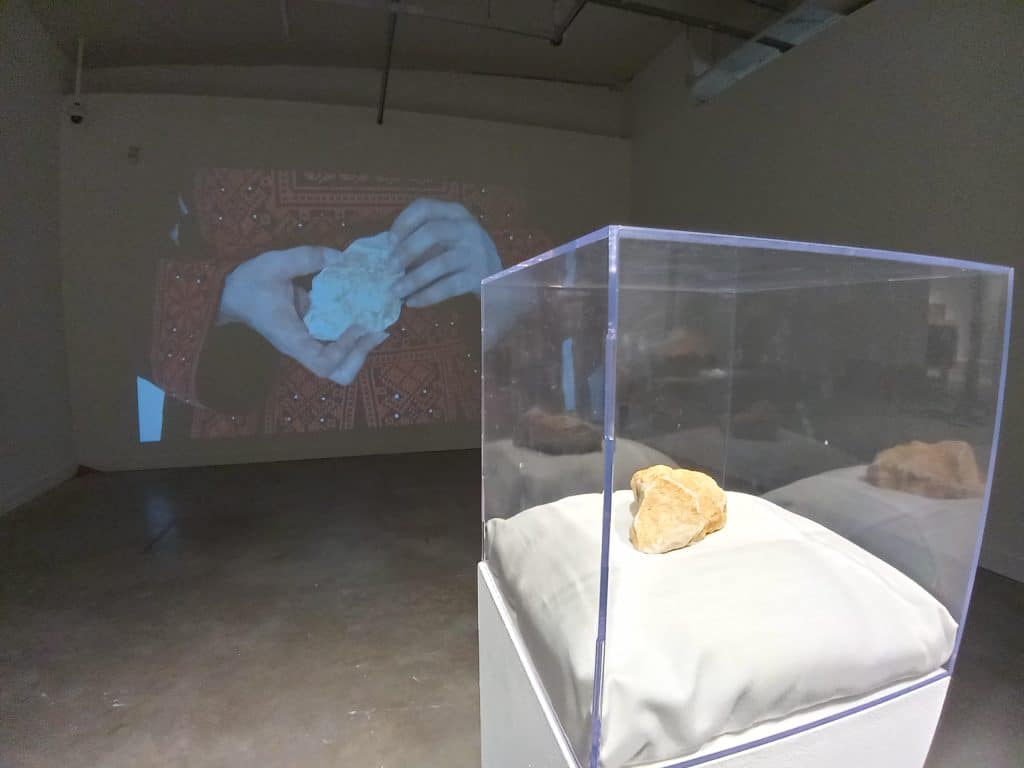
Similar wounds exist within “Cartography,” curated by Mona Gazala and existing just a few steps away. This is particularly true of Gazala’s “Disarticulated,” which includes a short film showing the aftermath of the Israeli destruction of a Palestinian home and stands as a metaphor for the purposeful disassembling of the Palestinian people. The film is accompanied by a stone rescued from the site in 2018 and transported to Gazala via a series of handoffs, beginning with Palestinian artist and filmmaker Emily Jacir and ending in Chicago, where Gazala traveled to receive the artifact from Iraqi American artist Michael Rakowitz. Even now, Gazala has difficulty discussing the impact of the exchange, recalling how the emotional trauma embedded within the object left her briefly confined to her bed.
“For me, artifacts are an important part of who I am, and they’re an important part of my practice,” Gazala said. “Things, to me, are iconic. They symbolize something. So, yeah, it was rough just having that [stone] in my possession.”
Palestine is represented throughout “Cartography,” present in everything from the colorful yet oppressively walled-off paintings by Micheal Hambouz to a series of arresting works by Gazala. In “Place and Power,” the artist utilizes a series of concrete chunks rescued from a demolished Franklinton building to reflect the ongoing destruction of Palestine, whose people are currently experiencing mass starvation as Israel limits the amount of food entering Gaza. This sits across from a mechanical instillation in which the reflective warning signs tacked to the rear of slow-moving vehicles such as the horse-drawn buggies that routinely pass through the streets of Gazala’s home in Gettysburg, Ohio, are inverted to represent the red triangle adopted as a symbol by the pro-Palestine movement.
As suggested by its name, “Cartography” also explores other far-flung regions of the map, setting thought-provoking works by Kashmiri artists Numair Qadri and Tabeena Wani alongside pieces by the Cleveland-raised, Columbus-based Ray Perez, whose large-scale, water-themed installations are rooted in his Dominican heritage and the concept of migration.
“My family is originally from the Caribbean, and though I was born in the United States, my eldest sister always said my home was the most Dominican house you could live in,” Perez said. “So, having that experience as a child and then growing up and going through this process of becoming ‘Americanized,’ for lack of a better term, I really struggled with this idea of identity, right? Like, I don’t belong here, but I also don’t belong there.”
In exploring these gaps, Perez more recently hit on the works displayed here, which serve as “astral projections,” as he termed them, linking his family’s ancestry in the Dominican Republic with the shores of Lake Erie where his parents eventually landed in Cleveland. “In the last five years I’ve really become interested in that idea of how my body ended up in this place, and specifically Ohio,” said Perez, whose works incorporate life-size boats, massive water-evoking painted tarps, and sculptural fish netting. “And that wasn’t necessarily a trip through land, but a migration through water, which ebbs and flows, following a path that is not as linear as on land.”
Visitors to Urban Arts Space would be wise to adopt a similar approach in taking in these dual exhibitions, carving a winding path as a means to better experience the myriad purposeful and accidental connections possible within the space, which have a way of transcending borders both within the gallery and far, far beyond.
Author

Related Articles
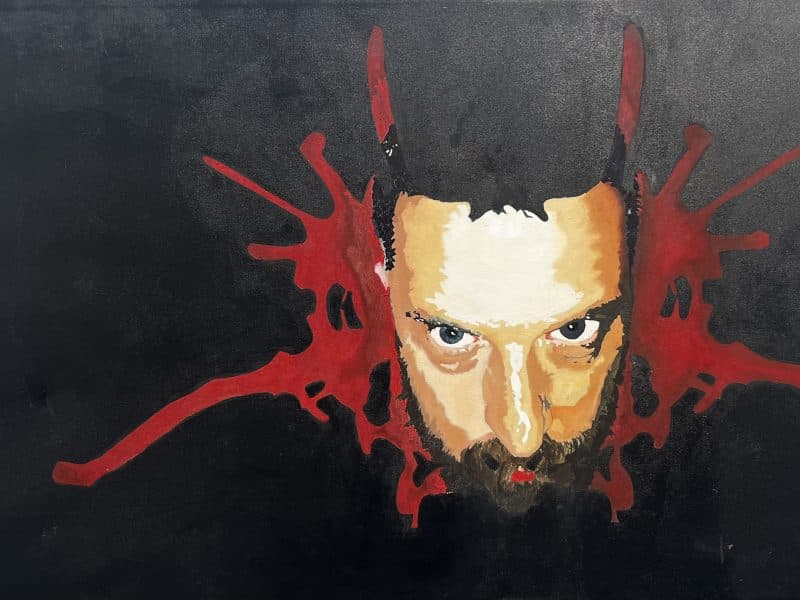
Matt Yoho finds his way back with ‘Alright So Far’
The Columbus artist’s new solo exhibition – his first in nearly 15 years – kicks off with an opening reception at Awesome Gallery from 1-3 p.m. on Saturday, April 11.
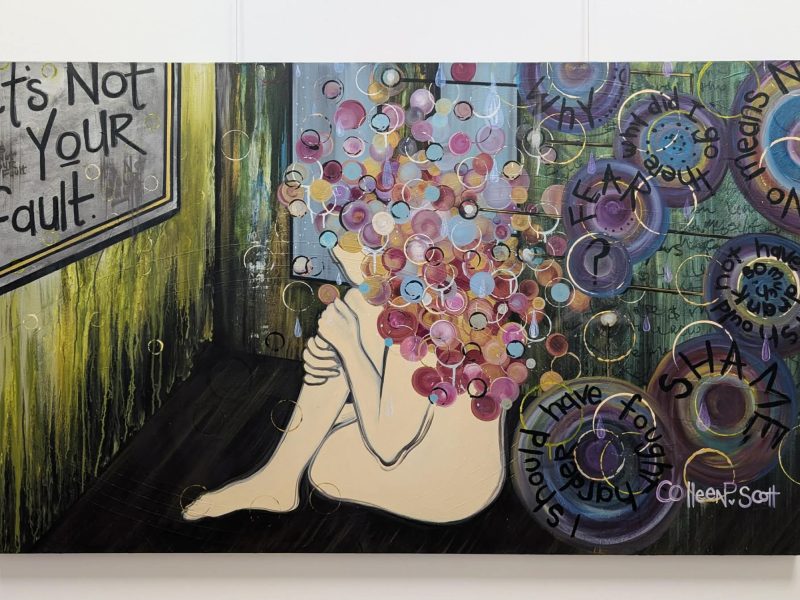
Columbus artist Colleen Scott learns how to love herself again
‘Redirected Pathways,’ which kicks off with an opening reception at the Franklin County Coroner’s Office on Thursday, April 2, centers on work created both pre- and post-sobriety, capturing a personal evolution that speaks to a range of universal concepts.
Emily Morgan and Hannah Maltry rely on instinct for ‘We Did It Wrong’
The two artists will host an opening reception for their exhibition at High Road Gallery & Studios from 6-8 p.m. on Saturday, March 28.