
The unpredictable work of artist Leah Wong
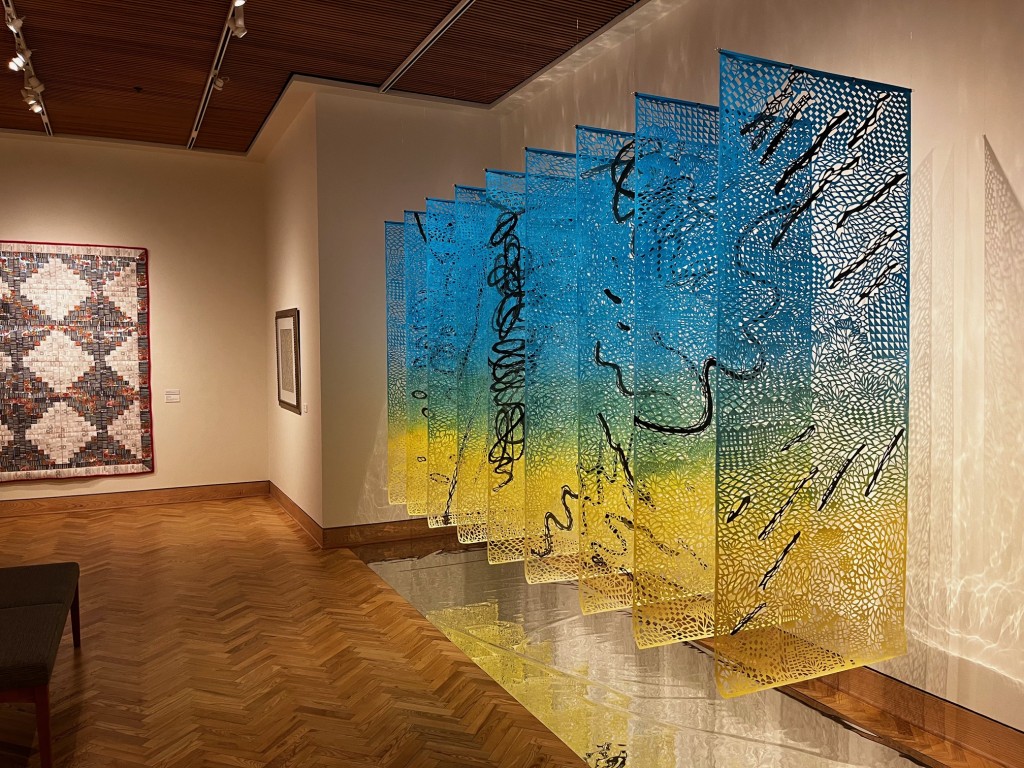
The Columbus artist, whose ‘Moving with Skylight’ is currently on view in the 2025 Biennial Juried Exhibition at the Riffe Gallery, continues to embrace the element of surprise in crafting her three-dimensional installations.
Leah Wong grew up in China a short walk to the sea, recalling how as a child she would get her daily exercise by jogging through tree-covered hills to the waterside and back.
“And there were a lot of pine trees, and my memories always smell of pine trees,” said the Columbus-based artist, who routinely embeds these recollections within her installation work, including “Moving with Skylight,” an eye-catching piece created last year for a show at the McConnell Arts Center and now on display in the 2025 Biennial Juried Exhibition at the Riffe Gallery, which features work by 61 Ohio artists and will remain on view through Jan. 9. “I grew up surrounded by hills – it’s a rocky, very rocky place – and then the trees and the flowers. We were very close to a cherry tree park, and, oh, God, in May, June, it was always so colorful.”
Crafted from nine large paper panels, Wong began to paint “Moving with Skylight” with these memories in mind, incorporating watery blues, various earthtones, and warm yellows that evoked the sensations she experienced jogging to the coast as a child. The palette also reflected the room in which Wong first assembled the piece at the McConnell, a tall-ceilinged lobby with large windows and an overhead skylight. “My show was in May [2024], and I thought, wow, it would be interesting to bring the energy from outside inside, kind of like communication,” said the artist, who has created these kinds of site-specific, three-dimensional works since around 2012, prior to which she focused largely on figurative paintings.
A donation powers the future of local, independent news in Columbus.
Support Matter News
For Wong, the process of creating each work is both time consuming and filled with surprise. Each piece begins by considering the space in which it will live and then progresses to what the artist termed “an imagination sketch,” in that it springs wholly from her mind and gives her something to work toward. From there, she’ll paint both sides of each sheet, add lines, and the cut hundreds of shapes that are frequently pulled from her day-to-day adventures. “Moving With Skylight,” for instance, includes cutouts reminiscent of everything from houses to more organic forms such as flower petals and water droplets. “And all of these little elements come from my every day,” she said. “I just observe everything, like, ooh, this is interesting. So, there are all these little doodles and things pulled from where I’m living now.”
In that way, Wong’s creations also have a way of collapsing time, her childhood memories and present-day existence combining in a swirl in each panel. “I realize I’ve always thought about time not in lines but where it zigzags and loops around and it’s not very logical,” the artist said. “I kind of draw a lot from the past and then relate it to the present. They feel close, really close. I don’t have that distance. … Maybe I don’t have that dimensional thinking. Maybe I just flatten everything.”
If the process of creation is about flattening everything from time to her experiences to the form itself, the act of installation brings about dimensionality and introduces the fluid, unpredictable nature of Wong’s art. When installed within the McConnell, for instance, “Moving with Skylight” incorporated a slight curve, the pages spaced out and hung in a row like a valley nestled between two gently climbing hills. In the Riffe, which has a lower ceiling, the pages were installed in a straight line, giving the form a more architectural presence.
Indeed, there are aspects to each site that Wong said allowed her to see the work in radically different lights, including the angles from which it could be viewed (the McConnell enabled visitors to walk around the piece while in the Riffe it butts up against a wall) and especially the nature of how the spaces are lit.
“[The McConnell] has that reflective floor and the light from all the windows. … And I went three or four times – with the sunlight, on a cloudy day, and at night – and each time it looked different,” said Wong, who noted that the steady gallery lighting in the Riffe introduced an element of consistency.
By its nature, though, the installation still shifts in numerous subtle ways as a viewer moves through the downtown space in which it currently rests, new windows and perspectives opening with something as simple as an upward tilt of the head or the way a person’s eye might catch a shadow dancing on the adjacent wall.
“You’re creating this very layered, very rich work. But I didn’t do it. The air, the space did it for me. And then viewers see it, and they form the shape themselves, right?” Wong said. “Even me, as I look, it’s like, oh, this is different. And I like that. I like that I sort of know 80 percent of my work and then 20 percent of it is funny or surprising. … Sometimes if you know too much it’s not good. Too predictable.”
Author

Related Articles
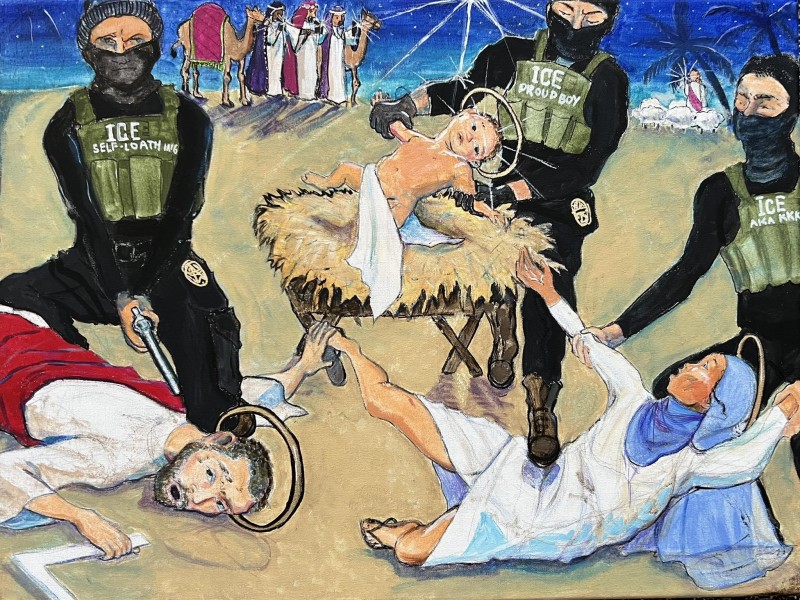
Gaye Reissland leaves no doubt about the circumstances shaping her work
The Columbus artist, who will take part in Aminah Day at the King Arts Complex this weekend, has taken to writing on the back of each canvas, explaining in detail the circumstances that gave rise to her paintings.
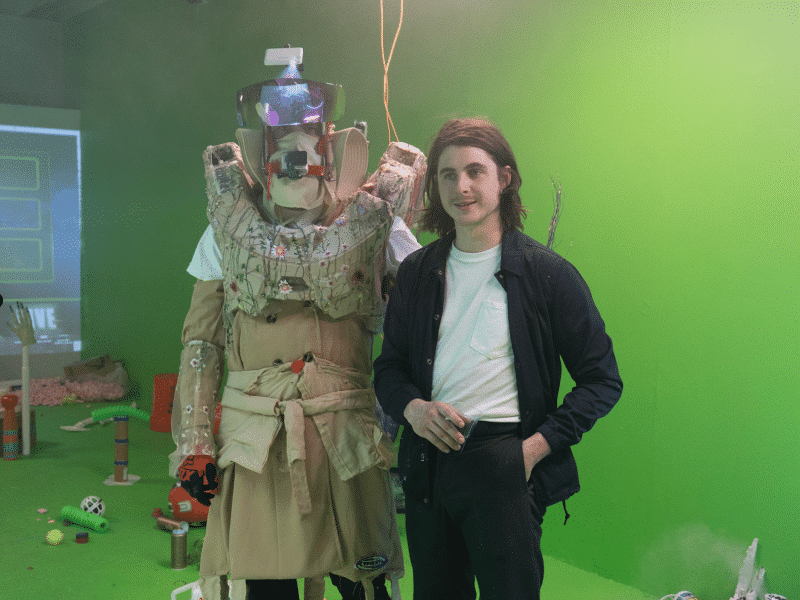
No Place Gallery turns 10
‘Between Fields and What Isn’t: A Decade Inside No Place’ will take over a pair of galleries beginning on Thursday, Feb. 12, with an opening reception running from 4-7 p.m. at Beeler Gallery and then continuing at No Place from 7-9 p.m.
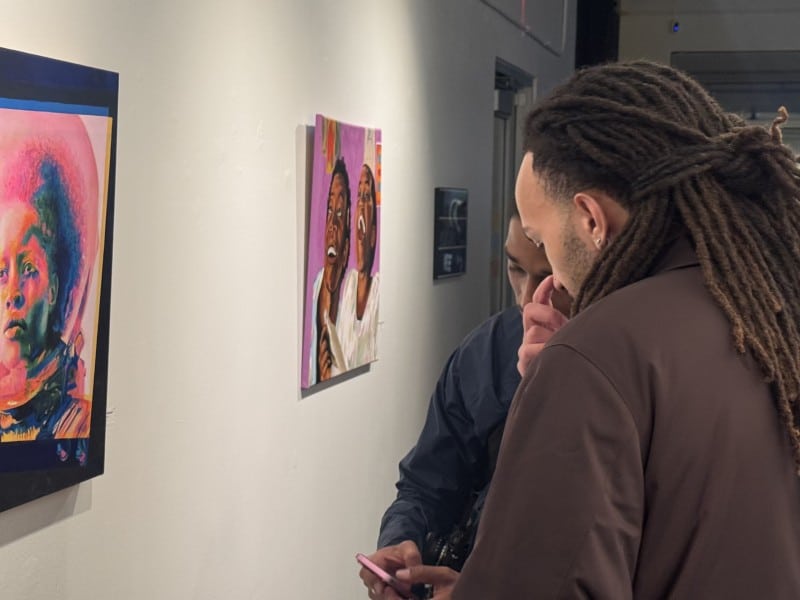
David Butler finds big screen escape in ‘F’Reel’
The Columbus artist curated the new group exhibition, on display at All People Arts through April, in part to create a place of joy and healing coming out of an emotionally heavy time.