Yoosef Mohamadi preserves a collective memory at Blockfort Gallery
The Kurdish artist’s staggering new exhibition, ‘In(Out)Side,’ will remain on display at the downtown gallery through Feb. 21.
In developing “The Depth of Memory,” a mechanical installation that serves as one highlight in Yoosef Mohamadi’s staggering new exhibition at Blockfort, dubbed “In(Out)Side” and on display at the downtown gallery through February 21, the Kurdish artist said he considered a number of complex ideas. Consisting of a wood-and-plexiglass square filled with black sand, a mechanical digging arm attached to a small motor, and a series of electronic switchboards programmed by Mohamadi, the piece confronts everything from displacement to the meaning of power and who gets to dictate the fates of those people who occupy a land.
First conceived around 2023, Mohamadi said the installation has gone through a series of evolutions as he worked to better capture the myriad ideas that motivated his thinking, rooted in his experiences with displacement having grown up in Kurdistan, a roughly defined geo-cultural region spread across four countries: Turkey, Iraq, Iran and Syria.
“And all of a sudden, it occurred to me to use movement,” Mohamadi said in a mid-January interview at Blockfort, going on to detail how incorporating a power source and a series of modular triggers began to pull forward some of those larger themes. “There’s a DC motor, and I used Arduino [software] to program the whole thing, so the work moves forward, and then sometimes it stops and reverses. And the concept is about power, and about how power uses ideology in carving and excavating some lands. And I’m a Kurdish artist, right? And we’ve been faced with this kind of displacement, this kind of occupation for more than 100 years, and still we are faced with it.”
A donation powers the future of local, independent news in Columbus.
Support Matter News
Further adding to the work’s complexity, there’s a stone hidden in the sand, buried both out of sight of the viewer and at such depth that the mechanical arm could not hope to reach it. “And I was thinking about occupation, and how power occupies other ethnicities and tries to displace them, tries to change their lands,” said Mohamadi. “But there is always a piece of memory here that the power cannot reach. So, it’s a constant effort from power, and also a constant resistance from the land.”
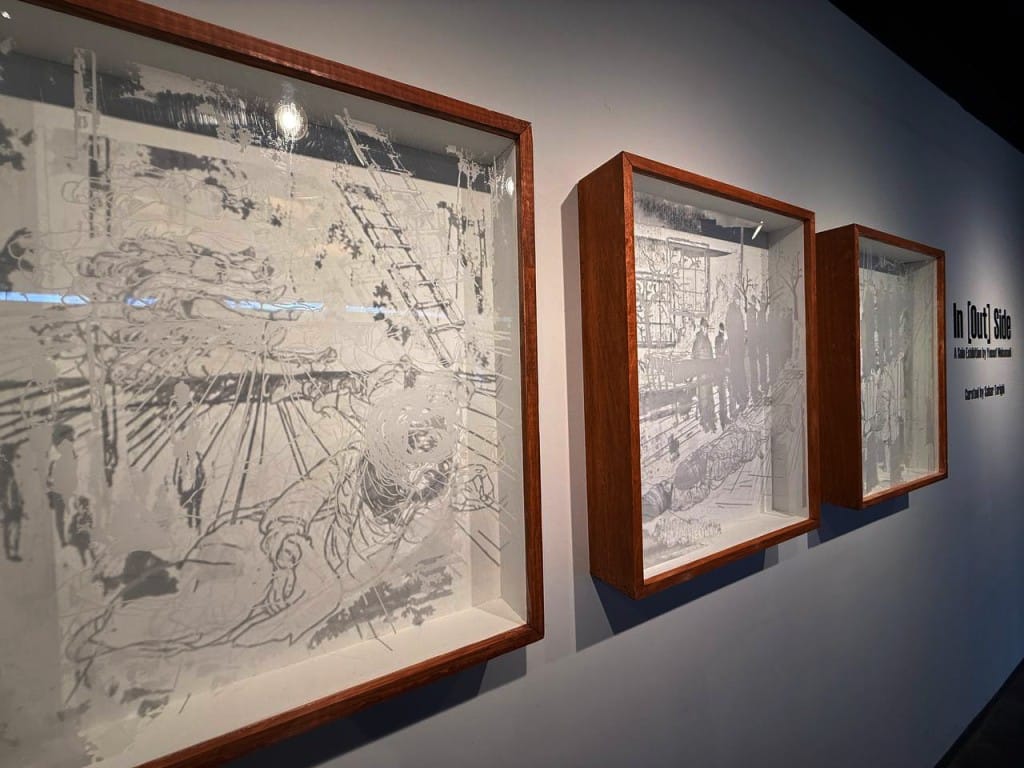
Similar thought and care imbue every piece on display within the exhibition, curated by Sahar Tarighi, who also curated “Surface as Sentence,” now on display in Blockfort’s lower gallery. Witness a striking collection of in-progress newer works by Mohamadi displayed on the gallery’s west wall, which collectively address the genocide of the Kurdish people. While the pieces read as graphite drawings at first glance, the images are actually created from shadows, Mohamadi layering white paint on plexiglass, which casts a shadow inside the box when illuminated. The meaning is clear: It’s the duty of the artist to shine a light on even the darkest parts of history.
In doing so, Mohamadi took great care, utilizing historical images of firing squads, for instance, but excising the gunmen, who exist somewhere out of scene. “I don’t like to represent the shooters,” the artist said. “I try to delete that part and stick with character. … I want to highlight the dignity [and] the braveness of the [Kurdish] people.”
Describing these works as existing in a state of evolution, Mohamadi said he wants to continue to experiment with illuminating the frames with different colored bulbs or perhaps adding a mechanical element that would allow the light source to pan back and forth, teasing out different angles and dimensions as the shadows bend and shift.
Collectively, Mohamadi said the exhibition serves as an assemblage of memories, which is why so many of the displayed works are constructed in or from boxes – a shape the artist has long associated with the idea of remembering. “I see memory as a storage, as a box. And it’s not a single box,” he explained. “I feel like I have a lot of different boxes in my mind, and each of them stores a different experience. … And it’s not just my own memory and my own personal experience, but a collective memory. As a Kurd, we’ve been faced with different challenges throughout history – with displacement, with assimilation, with genocide. And, personally, I’ve been witness to some of these, while others passed through me in music and history books, and in speaking with my parents and grandparents.”
Absent state support, Mohamadi said it is incumbent on him and others like him, including Tarighi, to collect and share these memories so “they are preserved and not allowed to be forgotten.”
“When you look at these works, all of them are about Kurdistan, all of them are about being stateless,” the artist continued. “Living here in the U.S., I want to be a voice for other people in Kurdistan, like in Rojava, where they’re currently under attack from extremists and the regime in Syria. … I try not to be silenced, and to be a voice for them by keeping alive these incidents, this history, and these cultural materials. I’ve grown up like this, and I cannot think of other things. I cannot think of making something just for fun. I need to have a concept, and what is better than my culture as a concept?”
Author

Related Articles
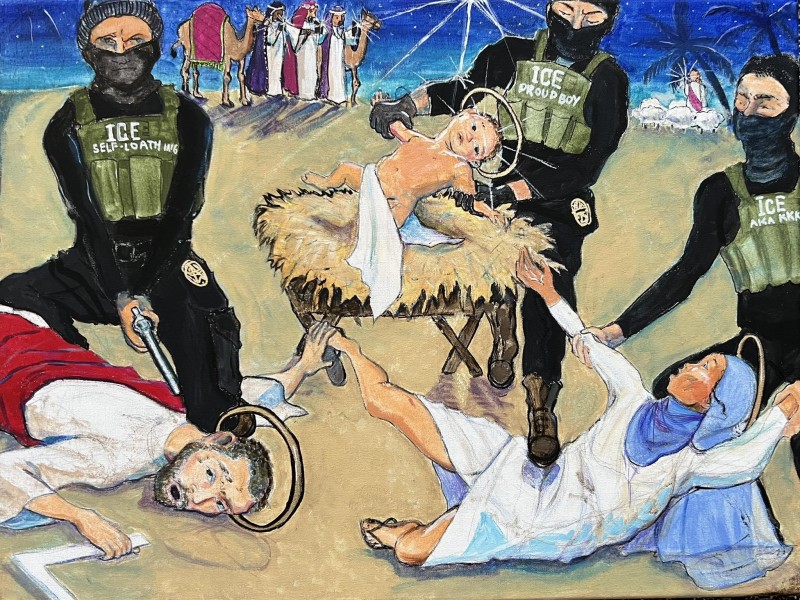
Gaye Reissland leaves no doubt about the circumstances shaping her work
The Columbus artist, who will take part in Aminah Day at the King Arts Complex this weekend, has taken to writing on the back of each canvas, explaining in detail the circumstances that gave rise to her paintings.
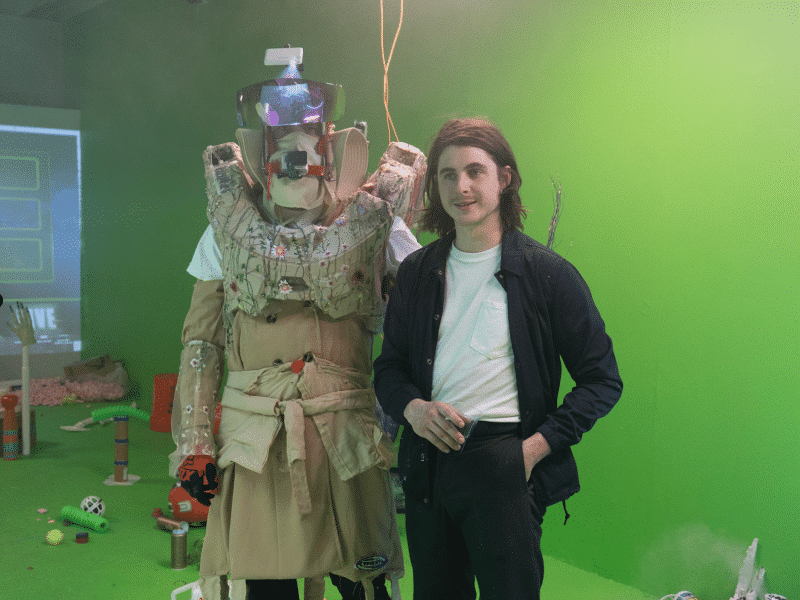
No Place Gallery turns 10
‘Between Fields and What Isn’t: A Decade Inside No Place’ will take over a pair of galleries beginning on Thursday, Feb. 12, with an opening reception running from 4-7 p.m. at Beeler Gallery and then continuing at No Place from 7-9 p.m.
David Butler finds big screen escape in ‘F’Reel’
The Columbus artist curated the new group exhibition, on display at All People Arts through April, in part to create a place of joy and healing coming out of an emotionally heavy time.