‘You can’t just take a knee’: Artist Emily Morgan remains resolute amid GCAC funding cuts
In late July, GCAC announced it was ending a pair of 2025 artist grant programs along with other organizational cuts, attributing the decision to a combination of factors that included lower than anticipated income from the ticket tax and a decision by Franklin County officials not to advance an expected $4 million in funding.

Earlier this year, collage artist Emily Morgan, who creates under the name Lovely But Dead, received word that Urban Arts Space had approved her exhibition proposal. Titled “Pulp Stiction: Collage as an Act of Resistance,” the exhibition is due to run for five weeks at Hopkins Hall Gallery beginning in October 2026, complete with a full slate of workshops, panels, community events, and a keynote.
In sketching out the proposal, Morgan planned to fund the associated programming via a GCAC Artist Projects grant, the bulk of which she intended to use to pay any participating artists. But in late July, in the days before she was set to submit her grant proposal, GCAC announced an immediate halt to its 2025 Funds for Artists and Artist Project grants, later attributing the freeze in large part to a decision made by Franklin County to withhold $4 million in anticipated county funding to GCAC.
“And it was just heartbreak at first. It felt like hitting a brick wall” said Morgan, whose disappointment mirrored that of myriad Columbus artists and musicians, whose collective posts across social media platforms expressed equal parts dismay and understanding – the majority aware of the challenges faced by arts organizations in a political era where the Trump administration has moved to gut everything from U.S.A.I.D. to the Corporation for Public Broadcasting of public funding. “I mean, at first there was some anger, but … obviously GCAC wants to fund artists, and I don’t think they made the decision willy-nilly. … It was like all of the national news about funding cuts hit my living room.”
A donation powers the future of local, independent news in Columbus.
Support Matter News
In a late July interview, GCAC president and CEO Tom Katzenmeyer and chief creative officer Jami Goldstein said the news that Franklin County would not be advancing the anticipated $4 million hit unexpectedly the day before the arts organization was preparing to open submissions for its next round of Artist Projects grants on July 24. (GCAC had already started to recruit community members to review the incoming proposals.) Combined with lower-than-anticipated 2025 city ticket fee receipts, this forced the organization to make immediate reductions to its remaining budget, which Goldstein described as a unique challenge landing more than seven months into the year.
Not wanting to claw back any grants that had already been approved, Katzenmeyer said staff members were forced to look forward to find potential savings. “We had already done our big grant programs early in the year. Those were reviewed on an April, May, June timeline and then our board approved them at our June meeting,” he said. “So, we kind of had to look at what was still open, which was our Funds for Artists program, and what was going to open – the Artist Projects grants, which were set to open the next day.”
The reductions were absorbed by a combination of cuts to operations and grant offerings, GCAC said, with 52 percent of the reduction distributed across five organizational grant programs (GCAC provides operational support to everyone from CAPA to the Columbus Museum of Art). The closure of Funds for Artists and Artist Projects grant programs represented 23 percent of the funding reduction, with the remaining 25 percent coming from staff and administration, public art, marketing and events.
Included in these administrative cuts were a staff traveling freeze, the restructuring of the yearly Big Arts Night forum, which is expected to take place this year in significantly scaled down form (GCAC’s contract with the city requires it to host a yearly public forum), and a reduction in the marketing budget by roughly $225,000, Goldstein said.
That a majority of the needed reductions came from organizational grants falls in line with financial realities. Of the $28.57 million spent on community funding in 2024, more than $20.1 million went to funding for organizations, including $6.5 million in capital expenses and $12.1 million in operating support, with the largest amounts going to COSI ($1.25 million), CAPA ($1.19 million) and the Columbus Museum of Art ($1.08 million), according to GCAC’s 2024 annual report. In contrast, last year GCAC spent $1.2 million on 101 Artist Projects grants, with the largest awards topping out at $25,000, along with $750,000 on 1,503 Funds for Artist grants, each in the amount of $500.
Goldstein said GCAC has been able to invest more in artist grants in recent years owing to income generated by the ticket tax, which was implemented in July 2019 and levies a 5 percent fee on tickets to all cultural and sporting events in the city staged at venues with a capacity exceeding 400 where the admission is priced higher than $10. In GCAC’s 2019 annual report – the last year for which it reported no income from the ticket tax – the organization recorded a total of $7.82 million in community funding, with $6.67 million of that amount allocated for grants and services. (In 2024, these numbers ballooned to $28.57 million and $24.95 million, respectively.)
The growth in GCAC’s budget can be linked with the income created by the ticket tax, which has increased each year coming out of the pandemic, generating $1.52 million in 2020 and $2.79 million in 2021 before expanding to $7.75 million in 2022, $10.79 million in 2023, and $13.52 million in 2024. Still, save for 2024, these revenues fall short of the early predictions made by GCAC, which in 2018 estimated the tax would generate $14 million a year for local artists.
“We really only have two solid years of revenue from it coming out of the pandemic,” Goldstein said. “Couple that with the fact that it’s always going to be a volatile source of income. Did we have Buckeye Country Super Fest or not? Did the Crew make the playoffs or not? ‘Hamilton’ is here, ‘Hamilton’ is not here. We’ll probably never be able to predict it accurately, but once we have five years of ticket fee revenue, we can start to get a better sense of the average annual ticket intake.”
In the wake of the losing the county money, Katzenmeyer said GCAC has continued to engage in conversation with Franklin County officials, who could reconsider the $4 million in the final quarter of 2024 (too late to resuscitate the grants for this year but a way to buoy those programs for 2025). He also said that the funding loss experienced by GCAC is endemic of the realities government officials are currently navigating across the board, with the impact of federal cuts leading to increased belt-tightening on the local level. “Jami and I, the board, the staff here, we all understand the pressure these government units are under because of what’s happening in Washington,” said Katzenmeyer, who added that GCAC’s mission would remain unaltered for 2025 should the county money not return, though the structure of its grant program might need to be reevaluated. “It’s not just about the arts. It’s about libraries. It’s about food banks. It’s about Medicaid.”
In a way, these are the same concepts underpinning Emily Morgan’s planned 2026 exhibition. “One of the underlying themes of ‘Pulp Stiction’ is that when your systems fail, you sort of have to lean back on your community,” said the artist, who embraced this reality in launching a crowdfunding campaign with the aim of raising $15,000 to stage the exhibition and its attendant programming. “I think it’s dangerous to lean too far into that rugged individualism and try to do it all yourself. There is a community here in place, and we need to work to solidify it … so it can help you, again, when our systems break.”
In the past, Morgan has been the recipient of two rounds of Funds for Artist grants, the most recent of which enabled her to frame the works she displayed in a May show at the McConnell Arts Center. So, while the artist might have been briefly dismayed by the abrupt cancellation of the remaining 2025 grants, she said she wouldn’t hesitate to apply for GCAC funding in the future – albeit with a more robust contingency plan in place.
“I just think maybe I got my expectations a little too high with this one,” Morgan said. “The whole situation is going to make me have a Plan B for any large project like this, so I know I’ll be able to get it completed. … You can’t just take a knee.”
Author

Related Articles
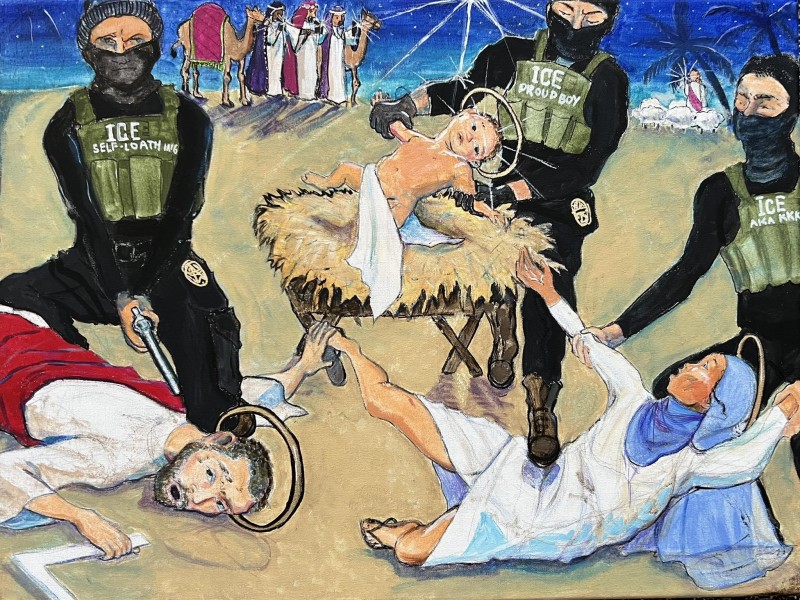
Gaye Reissland leaves no doubt about the circumstances shaping her work
The Columbus artist, who will take part in Aminah Day at the King Arts Complex this weekend, has taken to writing on the back of each canvas, explaining in detail the circumstances that gave rise to her paintings.
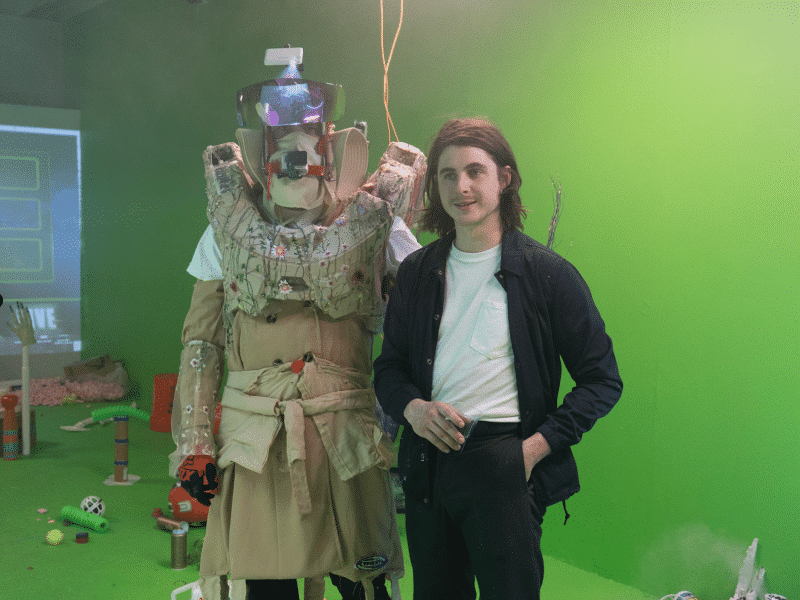
No Place Gallery turns 10
‘Between Fields and What Isn’t: A Decade Inside No Place’ will take over a pair of galleries beginning on Thursday, Feb. 12, with an opening reception running from 4-7 p.m. at Beeler Gallery and then continuing at No Place from 7-9 p.m.
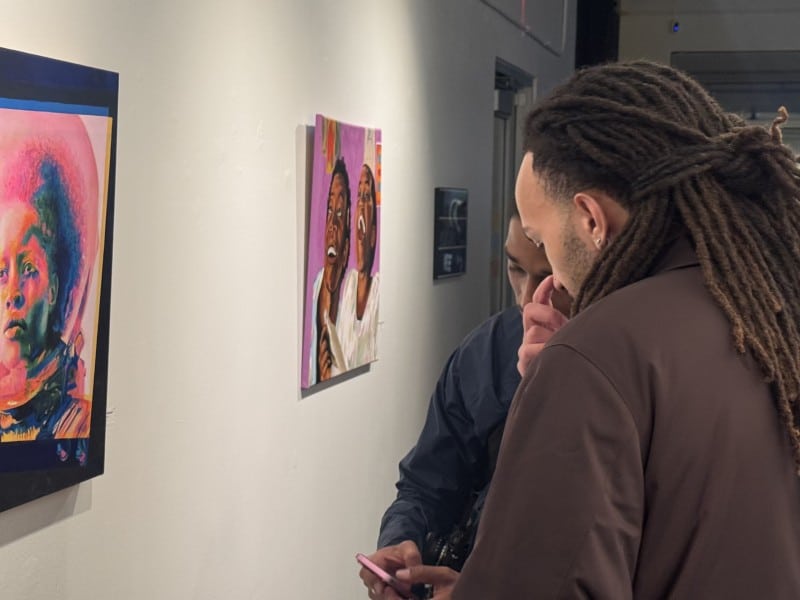
David Butler finds big screen escape in ‘F’Reel’
The Columbus artist curated the new group exhibition, on display at All People Arts through April, in part to create a place of joy and healing coming out of an emotionally heavy time.