
Lo-Pan prepares to release ‘Get Well Soon,’ abandons hope things actually will
“This is not a record about moving forward,” said Jeff Martin, who will join the Columbus heavy rock band for a record release show at Ace of Cups on Friday, April 4. “For me, it’s more about acknowledging the moment that we sit in. … The battle for hearts and minds and your soul, I guess, has been lost.”
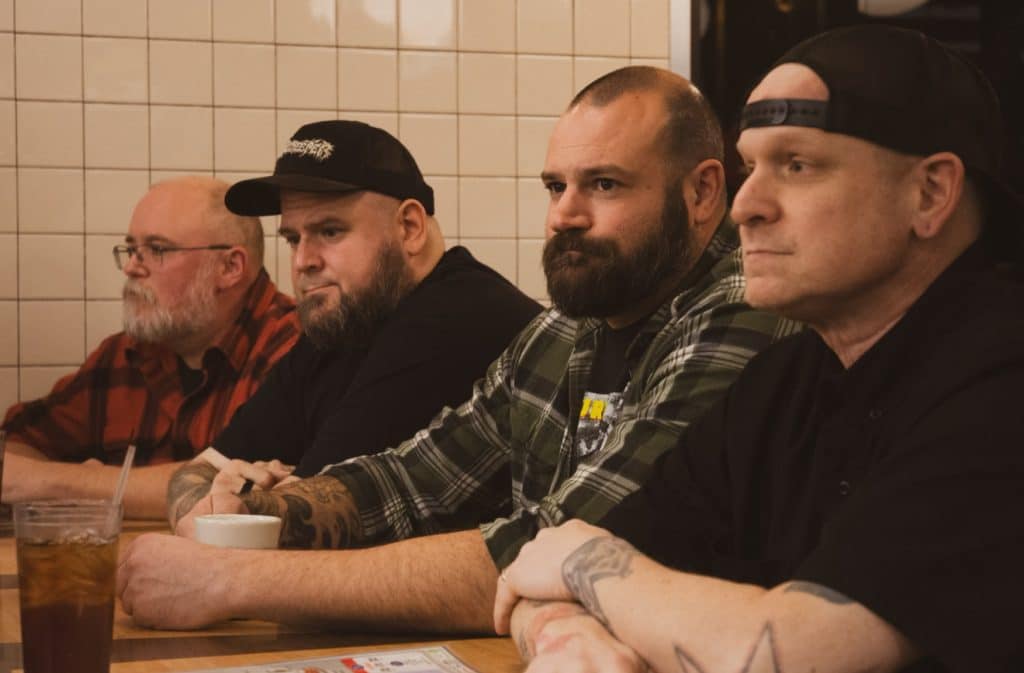
For Lo-Pan singer Jeff Martin, the Columbus heavy rock band’s 2019 album, Subtle, served as a societal fork in the road. “The last record was a turning point moment,” he said, “where if you don’t do something, then something bad is going to happen.”
Get Well Soon (Magnetic Eye Records), releasing Friday, April 4, serves then as a reckoning of our subsequent inaction, Martin and Co. turning a collective eye on an unredeemable world gripped by fascism, greed, and genocidal bloodlust. Hard-charging opener “The Good Fight,” which surges forth on battering ram drums, guitars that scrape the landscape like flash flood waters, and Martin’s richly emotive voice, nearly suggests the battle has not yet been lost – “Keep on going another day,” Martin sings – a persistence that evaporates completely by track two, at which point the frontman is ready to set fire to it all.
“This is not a record about moving forward,” said Martin, who will join guitarist Chris Thompson, bassist Scott Thompson, and drummer Jesse Bartz for a record release show at Ace of Cups on Friday, April 4, joined by Brian Damage, Skin Diet and Server. “For me, it’s more about acknowledging the moment that we sit in. … The battle for hearts and minds and your soul, I guess, has been lost.”
A donation powers the future of local, independent news in Columbus.
Support Matter News
When the band started work on the album more than five years ago, a world existed in which the music could have taken an entirely different tract. Instead, a confluence of factors both personal (family deaths and Bartz’s 2022 cancer diagnosis included) and societal (a global pandemic, the tightening fascist grip, and multiple genocides, including one that continues unabated in Palestine and helped give rise to album track “God’s Favorite Victim”) combined to push the songs in a more depressive direction.
“Before the pandemic, I think I was a lot more carefree. And I think I kind of felt like an adult for the first time after the pandemic, because I had gone through some adult shit,” said Martin, who included in this larger reckoning the death of his father, the challenge of watching a close friend struggle with pandemic-heightened mental health issues to a point where the singer didn’t know if this person would be okay on the other side, his bandmate’s cancer diagnosis (Bartz is now in remission), and the more general and increasingly rapid crumbling of our political and social institutions. “Politics is something I engage in a lot, and it’s like watching the promise of failure finally get delivered on. For years and years, it was like, everyone in Washington is a lunatic, but it’s confined to Washington by and large. And now it’s lashing out at the general populace and it’s not taking any prisoners. You’re watching people be hurt in real time.”
The increased callousness Martin sees displayed globally runs counter to a larger softening that has taken place within the band. When Lo-Pan started 20 years ago, the music was often driven by the friction existent between its members, who the singer collectively described as “individualist, my-way-or-the-highway-type people.” Part of this shift can be attributed to Bartz’s cancer diagnosis and subsequent recovery, which had a subtle but profound impact on how the musicians approach things such as disagreement. “If we had different viewpoints, it used to be like, ‘You’re wrong and fuck you,’” Martin said. “And now we can have these different viewpoints and exist in the same space and it’s okay. And that’s something I value very much, and something that adds to the creative process.”
Then there’s the addition of Chris Thompson, a bear of a man with a teddy bear’s presence who joined the fold seven or eight years ago and continues to shift internal dynamics in ways Martin once thought unthinkable. “Chris is this very even-handed, genuinely nice person, and I think that informed all of us to become a little bit softer,” said Martin, who previously played with the guitarist in the short-lived Akula. “And so, I told Jesse and Scott flat out that if Chris was going to join the band, we were going to have to communicate better, because I would rather him lift us up than us drag him down. And he really did. Watching his effect on Scott, for example. … Scott is a force of nature, and he’s a force to be reckoned with who has never really suffered fools. And watching him interact with Chris is fun for me, because they’ve become so close. And instead of Scott changing Chris, it’s been the other way around, where Scott has become a much, much softer person, and a much more interpersonally motivated person.”
This newfound softness is nowhere to be heard on Get Well Soon, of course, a relentlessly heavy, intricately melodic record filled with songs that explore weighty ideas such as mortality and the way events can blindside people and leave them emotionally shattered (“Rogue Wave”), the folly of pride (“Ozymandias”; “Stay With the Boat”), and the human costs that comes with funding another country’s genocidal war (“No mercy for the innocent,” Martin sings pointedly on “God’s Favorite Victim.” “Your children can’t be saved.”).
Martin equated the lyric-writing process with vomiting, in that it’s generally unpleasant but releases within him a tension that could otherwise consume, acknowledging that it’s often he doesn’t grasp what he was actually wrestling with until he has the benefit of distance from that initial purge. “I don’t sit down with an idea, like, ‘I’m going to write a song about Palestine,’” he said. “It’s just whatever happens to be on my mind at that time and how that manifests on the page.”
Other times, songs might take root in one idea and then breach containment, taking on new dimensions when released into the wild. Witness the album-closing “Six Bells,” which Martin wrote at a point in time when he was questioning everything from the future of Lo-Pan – “Jesse was sick and he’s always been the band leader and the driving force,” he said – to the futility of his own words, recalling one show the band played where he was so sick that he literally couldn’t sing, after which one concertgoer came up to him and told him how awesome he sounded onstage
“And I was like, cool, I could stand up here and fart into the microphone and nobody would care,” said Martin, who wrestles with this idea explicitly on “Six Bells,” singing, “No one hears the words I say.”
Amid the rest of Get Well Soon, however, the admission reads somehow darker, reflecting the reality that in time all of us will give way to ash, and even empires once thought great are destined to fall.
“It’s sometimes laughable to me that I’m living and working in a world where people are trying to pretend that the things that are happening right now are not happening, and I’m wondering how much things have to disintegrate before people are like, ‘Don’t come into work,’” Martin said. “Like, I’ll be sitting on a meeting … where any day now Trump is probably going to fire a missile into Canada. And it’s like, what am I doing? And it’s entertaining, but it’s also true.”
Author

Related Articles
How a Columbus trio ended up backing Tenacious D’s Kyle Gass
Mt. Air teamed with Gass for a string of Midwest dates that includes a stop at Rumba Cafe on Saturday, April 4.

Wednesday speaks for the people on the fringes at King of Clubs
Performing in Columbus on Monday, the North Carolina band displayed a knack for giving three-dimensional life to those out-of-sight folks who are often victims of circumstance.

Following extended layover, Paper Airplane again takes flight
The Columbus indie-rock quintet will celebrate the release of new album ‘In a Great Big Field’ in concert at Rambling House on Friday, March 27.