
Manic Splits channel self-doubt, anxiety into confident garage-punk rippers
The Columbus four-piece, which released its self-titled debut in July, hits Spacebar for a concert on Wednesday, Sept. 18.
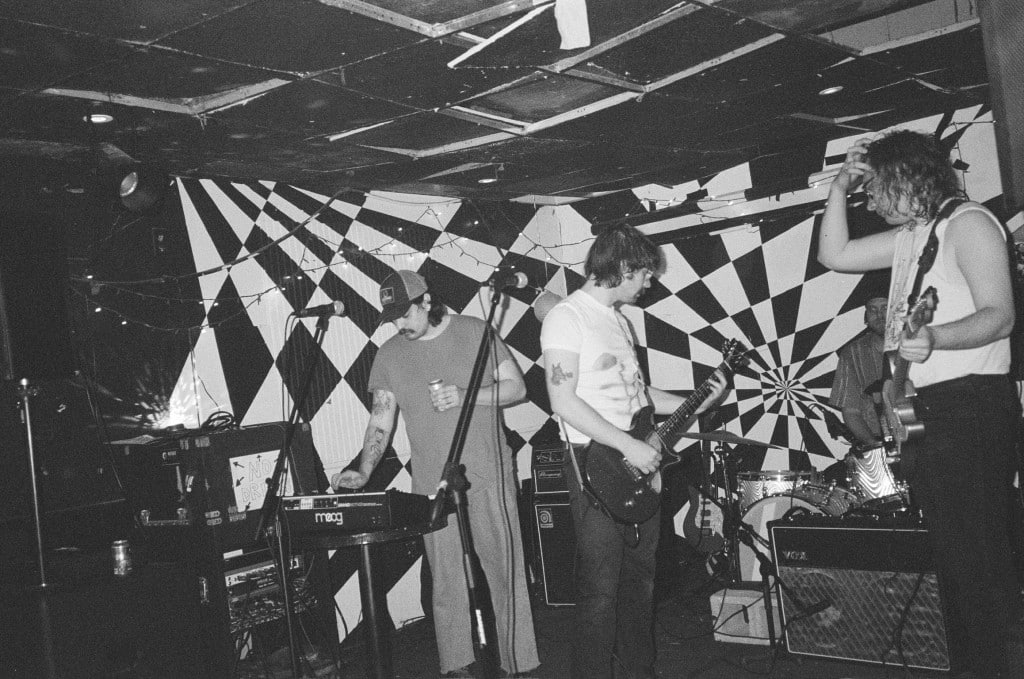
There was a brief stretch as a teenager when Joseph Bilinski wanted to rebel against his parents’ music, but he eventually relented, forced to concede that the two of them actually had fairly exceptional taste.
“They were definitely scenesters back in the day, and my dad will always bring it up, like, ‘There’s a picture of Richard Hell in our backyard smoking a cigarette!’” said Bilinski, who grew up in Cleveland, raised by a mom who played bass in the band Venus Envy and a guitarist father who made him mix CDs featuring songs by obscure local rock bands. “It was funny growing up, because you always want to be rebellious, and there are certain parts of you that want to hate the music your parents like. But they’ve always kind of been in tune.”
The scruffy garage-punk records Bilinski first absorbed via his folks served as loose inspiration for the songs the singer and guitarist started writing in collaboration with drummer Nathan Gepper last winter for Manic Splits, which released its excellent self-titled debut in late July and will visit Spacebar for a concert on Wednesday, Sept. 18, opening for Louisville’s Fotocrime.
A donation powers the future of local, independent news in Columbus.
Support Matter News
Initially, Manic Splits started as a way for the two musicians to kill time between primary projects (Bilinski also plays in Mezclado), gradually taking on a more central role as the lineup expanded with the additions of guitarist John Kompier and synth player Nico Aguirre. “It really started with me being like, ‘Does anybody give a shit [about these songs]?’” said Bilinski, whose self-deprecation and struggles with anxiety and low self-confidence gave shape to some of the band’s earliest lyrics. “And then one person was like, ‘Yeah, let’s play.’ And then two more. And I think I was the last person to be totally convinced. But it doesn’t matter if you have 100 people telling you something is good. Sometimes it’s hard to shake that self-doubt to be like, ‘This is okay. This will work.’”
This idea surfaces in “Pretty Freak,” a scruffy, urgent guitar burner that captures Bilinski’s self-depreciative tendencies (“I’m a nobody”) and mirrors the chest-compressing feeling of a panic attack. “The walls might be closer than they seem,” Bilinski drawls near the song’s midpoint as the twin guitars race with pulse-quickening speed.
“I think anxiety, especially, is a theme throughout the whole album. And that [song] was definitely one where there was some self-reflection, and where I was struggling with the idea of my self-worth,” Bilinski said. “It’s actually come to have a deeper meaning the more I’ve sat with the lyrics. Sometimes I’ll write something and in two months’ time it’ll mean something completely different. That line, ‘I’m a nobody,’ I remember I wrote that in practice, and I liked the self-deprecating aspect of it. But since I’ve had more time to sit with it, I’ve been able to look at it and [ask], ‘Why am I saying that?’ … And so, it’s really evolved from there into an exploration of why I feel that way.”
Other songs take a more comparatively outward stance, particularly “Yuppie Masochist,” a five-minute-plus, multipart garage-punk epic on which the musicians tackle the sense of disillusionment that has crept steadily into the national groundwater. “It’s like, really, what is the American dream anymore?” Bilinski said. “Is it to own your own house? Is that happiness? Or is it just a cheaply constructed loft on High Street? I don’t know. And to each their own. It’s just weird and hard and it’s something I grapple with every day.”
Bilinski traced the roots of “Yuppie Masochist” in part to the sense of guilt he experienced in relocating from Cleveland to Columbus six years ago, concerned that by moving into a new neighborhood he was contributing to a system that causes harm by displacement. “Growing up, my parents would always say, ‘Oh, the yuppies are moving in,’” said the musician, who at the time thought little of the term beyond believing it to be “a funny word.” “Then as I got older, I began to wrestle with it, and it was like, man, that word is not as whimsical as it sounds. And then it’s [asking], ‘Who’s a yuppie? Am I? Am I part of the issue?”
Sonically, Manic Splits take inspiration from the garage-punk Bilinski first heard in childhood, though the musicians refuse to adhere disciple-like to the form, breaking up “Yuppie Masochist” with loosely psychedelic, pogoing interludes and letting the ground drop out on “Tunnel Vision,” which lapses into a brief elastic passage that hits like a disorienting dream sequence.
“It’s been fun to push the boundaries of your typical garage-punk,” said Bilinski, who described this urge as an extension of his own creative restlessness. “When something pops in my head, the first thing I always think is, ‘How can I make it not that?’ I’m never content. I always want to do something else.”
Author

Related Articles
Chlorine’s Joseph Mangum lets his memories bleed through the page
The Kentucky band joins a stacked lineup at Rambling House on Thursday, Oct. 15, performing alongside the Dolphins, Son of Dribble, and Calico Boy.

Villagerrr’s Mark Scott would gladly hop off the industry ‘Carousel’
“I was getting a little frustrated with feeling responsible for promoting the album, because putting yourself out there, it’s not the most comfortable thing for a lot of people, and it definitely wasn’t for me.”
Liteweight Champion survives the fire
The Columbus rock band will celebrate the release of new album ‘Geronimo Hardstyle’ in concert at Dick’s Den on Friday, Oct. 9.