
Ugly Stick revisits the past with ‘Absinthe’ reissue
‘We were surrounded by people from the town and people from the college who would talk about, oh, Delaware is so boring. But we always tried to make something happen there.’
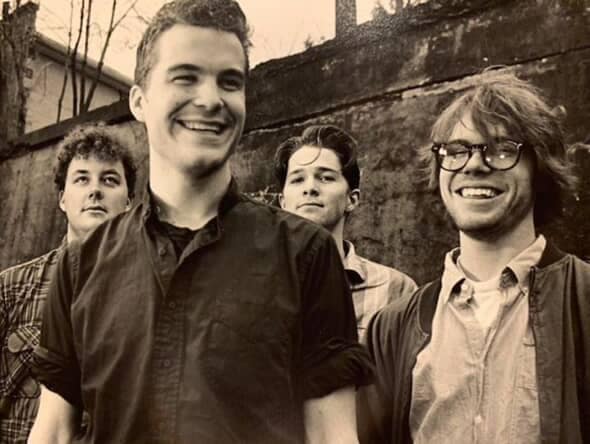
In the early 1990s, David Holm and his Ugly Stick bandmates gathered in the musty basement of a 100-year-old home in Delaware, Ohio, to record Absinthe, an album fueled by an equal mix of youthful energy and a desire to show people that their rural hometown wasn’t as sleepy as outsiders envisioned.
“Part of what we were interested in was creating art out of this small town environment we’d grown up in,” said Holm, who was born and raised in Delaware, where Ugly Stick will celebrate the vinyl reissue of Absinthe in concert on Saturday, Sept. 13, joined by the Dumpies and Golomb, a band that features both Holm’s son and daughter (Hawken Holm and Xenia Shuman), as a well as son in law Mickey Shuman. (The concert kicks off at 8 p.m. to the rear of 59 N. Sandusky St.) “In those days, Delaware was a place that felt very separate from Columbus, so it was about trying to make something out of a place where it felt like nothing was going on. We were surrounded by people from the town and people from the college who would talk about, oh, Delaware is so boring. But we always tried to make something happen there. We wanted to make our own little music scene.”
The town influenced the music in more direct ways, too, with Holm joining bandmates Jeff Clowdus (drums), Al Huckabee (guitar), and Ed Mann (bass) in writing songs that were occasionally informed by the changes they witnessed unfolding in Delaware in the early 90s, when Holm said mom-and-pop shops began to struggle amid the arrival of big box stores. The song “Drive-In Shut Down,” for instance, had its roots in the abandoned theaters Holm witnessed both in Delaware County and in his travels elsewhere in the United States.
A donation powers the future of local, independent news in Columbus.
Support Matter News
“Even then, the Strand Theatre was about to possibly close because it couldn’t keep up with the megaplexes being put in. … I had also been out in Santa Fe for a photography program, and I drove back across the country and kept coming across these dried-up drive-in theaters, where we would go in and explore what had been left behind,” Holm said. “It felt like the world really changed during that period of time, where Walmarts and these megaplex theaters came in, and so much of the world that existed in the ’40s and ’50s really began to die off.”
Holm said the Huckabee- and Mann-penned title track similarly wrestled with “the way the world of our childhood was drying up.” Initially intended as a throwback country number, the song mutated as it took shape. “Al and Ed brought a 4-track and a 12-pack and said, ‘Okay, let’s write a Johnny Cash song,’” Holm said. “And I love it, but it sounds nothing like a Johnny Cash song. It’s more to me like a weird, demented Tom Waits country song.”
The rest of the album can be equally difficult to pin down, the four musicians churning through an array of influences as though they were figuring out on the fly what this band could potentially be. “We wouldn’t shy from any music,” Holm said. “But it was funny that we would try to write a song like the Jam, and then it would end up having this country twang to it that we didn’t intend. And that was just coming out from where we lived, I think.”
The resulting album finds the players flitting between choogling country-rock tunes (“Serpent Mound”), Replacements-esque tumblers (“Wild Men of Borneo”), tear-stained country ballads (“Falter”), and loping, roundabout love songs such as “Crib Death Reel,” written by Holm about his wife, Melanie, in the months after the two met on the job and centered on the good fortune required for their paths to cross.
“I’ve been practicing the songs over and over again, and … ‘Crib Death Reel’ is one where I was playing it by myself in the basement and I could feel the hair rising on my arms. And I realized that song still has a potency for me, which is beautiful,” Holm said. “And that’s something I’ve had to consider as I’ve been playing these songs, where I have to sort of ask myself, ‘Do I still connect with this song now?’ Because I want to be right there in the song really feeling it. So, if it’s one I can’t really get inside, maybe it’s one we shouldn’t be playing. I could play the chords, I could sing it, but I want them to feel like something real.”
Revisiting Absinthe more than three decades on has naturally inspired more reflection in Holm, who recalled with fondness the years he spent making music with friends between his shifts delivering pizza. “And even when I was driving around making deliveries, I had the songs I was working on playing on a cassette tape in the car,” said Holm, who remains in awe of the creative energy he and his bandmates exuded in those earlier days. “When we were younger, there just seemed to be this continual creative flow, which is something that doesn’t last forever.”
The music also served a different purpose in those years than it does these days for Holm, who said he now feels less tied to that youthful need to finish and share his songs. “I remember reading something with Tom Waits where he was saying that having an unfinished song is like having a mouse in your pocket,” he said. “It becomes this little thing you carry around with you that’s just yours.”
Author

Related Articles
‘It was like absolutely nothing changed’: The return of Times New Viking
After nearly a decade away, the Columbus trio headlines a concert at Cafe Bourbon Street on Friday, Feb. 27.

Qamil Wright wraps a trio of slow-cooked EPs with ‘Dessert’
‘At the end of a good meal, you’re satisfied, you’re grateful. And I’m absolutely grateful, in general, to be in the most creative space I’ve ever been in throughout my career.’
Vérité strikes up a connection with the debut of June’s Room
The new bi-monthly music event makes its debut on Friday with a pair of sold-out Ginger Rabbit shows from New York-born musician Kelsey Byrne, aka Vérité.