
Roof Dogs negotiate isolation, alienation on way to ‘Here You Are’
Now settled in Chicago, the Columbus expats return home to celebrate the release of their new album with a concert at Spacebar on Saturday, July 15.
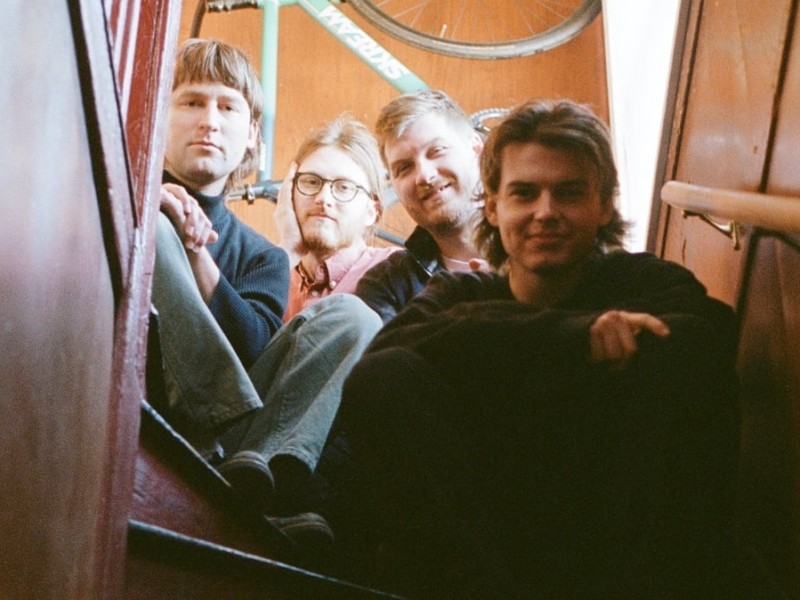
Roof Dogs singer/guitarist Andrew Marczak recently posted a photo to Facebook of the band departing for its first tour seven years ago – a stretch of dates from which details remain hazy, aside from the fact that the promoters at a basement show in Oxford, Ohio, paid the musicians in Canadian currency.
“I do remember being excited,” said singer/guitarist Jesse Cheshire, who joined Marczak for a mid-July Zoom interview. “It was like, ‘Sweet. We’re leaving the city.’”
A similar buzz accompanied the run up to a planned spring 2020 tour – the Columbus expat’s first set of dates since relocating to Chicago late in 2019 – the entire run of which was canceled amid the early coronavirus spread.
The months that followed, to put it mildly, were something of a bummer, with the band members holed up in isolation in a wholly unfamiliar city. “There was a year of occasionally meeting up and being like, ‘Okay, is everybody cool?’” Cheshire said. “And then we’d meet up and practice, and two months later we’d be like, ‘We should do that again.’”
Amid this lull, Cheshire and Marczak continued to write, turning out pandemic-indebted verses informed by isolation and alienation, which have since been collected on Here You Are, the Roof Dogs’ excellent new album, out now on Earth Libraries.
One song, dubbed “Starpower,” captures the sensation of being trapped in a dwelling so long that it begins to feel as if you no longer have the space to so much as relax your limbs. “Your arms and legs are tangled up there in your room,” Cheshire sings. Another song, “All Red,” is rooted in the monotony Cheshire experienced working at a grocery store during COVID, when the days became an endless, repetitive blur of restocking the same products on the same shelves.
“We were a pretty big store in downtown Chicago, and we would literally sell out of everything every single day, so every day the store would be entirely empty,” said Cheshire, who will join his bandmates in celebrating the release of the new full-length with a concert at Spacebar on Saturday, July 15, playing alongside openers Villagerrr and Son of Dribble. “Then at 7 p.m. we would get a new truck in, unload it and refill the entire store. And the next day it would all sell again. It was really a horrifyingly dystopian work environment. … And that song is definitely in part about the sense of redundancy I was feeling at the time.”
A similar disconnect shapes the motorik “Weather,” on which Marczak repeats the refrain “I’ve become subservient to the weather” as the band layers on grungy chords, the song gradually whipping up into a dense sonic storm. “Numbness is part of it, but I’ve always enjoyed bad weather and how it can make you feel insubstantial and small,” Marczak said. “And during the pandemic, a day could really be affected by the weather, where it might be the only change you have in your day. … But then the song also talks about serial killers and things like that, too. I wasn’t super conscious of what it was about when I wrote it, and I’m still not sure. But it feels right.”
Elsewhere, the band members wrestle with religious fanaticism (“Holy Jerks,” a patient, Velvet Underground-esque spoken word number), attempt to wash away accumulated bitterness by standing exposed in the rain (“Mutter”) and drink the blood of mythical beasts on riotous closer “Unicorn,” a rambling country barnburner that harkens to the likes of Jerry Jeff Walker.
While the lyrics frequently center on isolation, the music tends to be both dense and expansive, the bandmates and producer Tristan Huygen (The Bascinets) taking the extra time afforded by the pandemic to layer on thick instrumentation, leaving minimal space in the more stretched-out compositions. “I was obsessed with Stereolab at that time, so it was kind of like, ‘How can we cram fuzz and things into every corner of the song?’” Cheshire said. “There’s not a lot of open-sounding music on this record, I don’t think. It’s all very kind of in your face.”
Though much of the album carries the weight of pandemic existence, it falls away in rainbow cascades with “Unicorns,” a jaunty closer laced with tangles of finger-cramping saloon piano that builds into a full-throated group singalong – the sound of the bandmates reconnecting at the end of a long, drawn-out exile. “Have you ever tasted magic in the tangled dark of dawn?” the musicians sing, eyes delirious, unicorn blood dripping from their teeth.
“It’s like a manic excitement – that manic COVID energy that was running through everything at the time,” Marczak said. “It’s celebratory, but in a chaotic way.”
Author

Related Articles
How a Columbus trio ended up backing Tenacious D’s Kyle Gass
Mt. Air teamed with Gass for a string of Midwest dates that includes a stop at Rumba Cafe on Saturday, April 4.
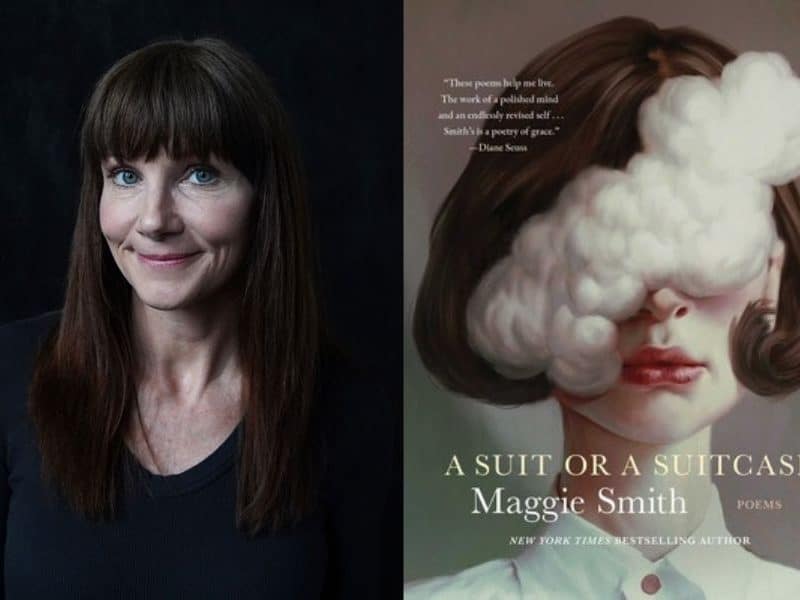
Maggie Smith is content not having all of the answers
The Columbus poet’s new collection, ‘A Suit or a Suitcase,’ confronts more existential concepts such as aging, time, memory, and the durability (or not) of self.
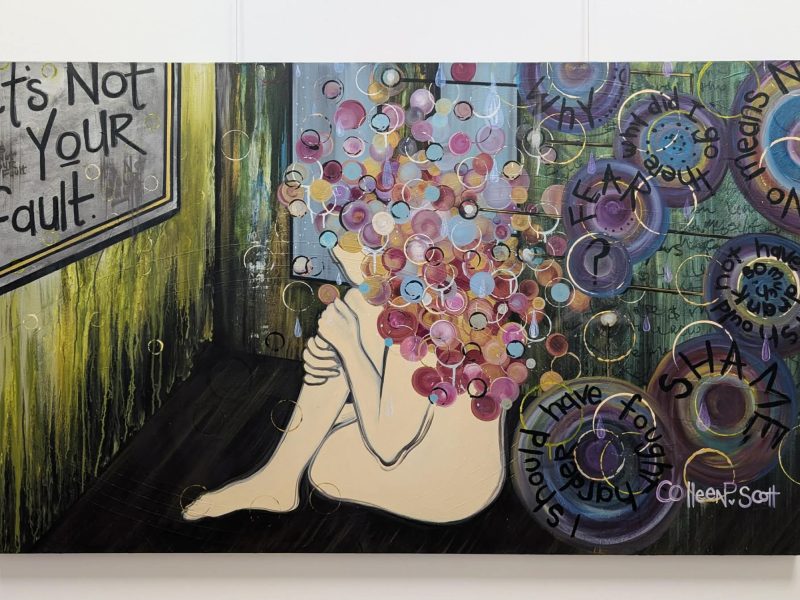
Columbus artist Colleen Scott learns how to love herself again
‘Redirected Pathways,’ which kicks off with an opening reception at the Franklin County Coroner’s Office on Thursday, April 2, centers on work created both pre- and post-sobriety, capturing a personal evolution that speaks to a range of universal concepts.