
Graphic novelist Charles Burns continues to mine the past
The legendary comics creator, who visits town this weekend as part of Cartoon Crossroads Columbus, credited his artistic breakthrough to a willingness to allow more of himself on the page.
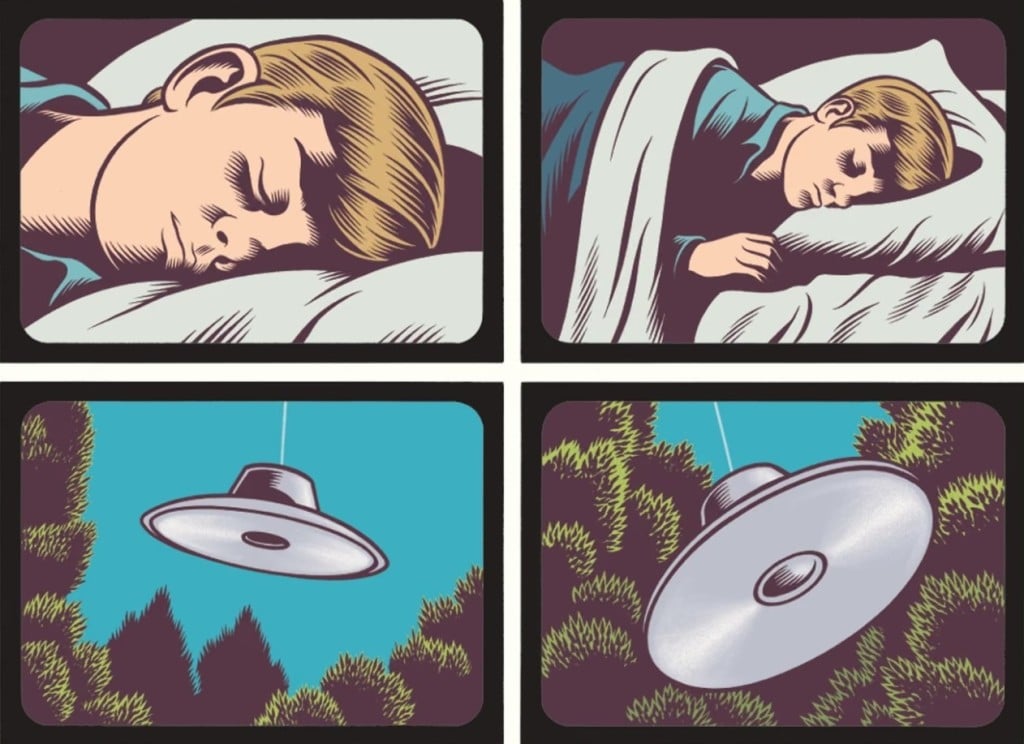
When Charles Burns began work on his 12-chapter comic epic Black Hole, eventually released as a single edition in 2005, he said he experienced a series of false starts where he would get a few pages in, chuck them aside, and begin anew.
“I would start telling the story in the way I always had, or the way I had been working previously, which was with these much more cartoonish, stereotyped characters,” said Burns, who will appear as a keynote at the free comics art and animation festival Cartoon Crossroads Columbus (CXC), joining comics artist and scholar Craig Fischer in conversation at the Wexner Center for the Arts at 4 p.m. on Friday, Sept. 19. (CXC kicks off with an opening reception at Gateway Film Center tonight, Wednesday, Sept. 17, and runs through Sunday, Sept. 21; a full schedule of venues and events can be viewed by clicking here.) “And I realized immediately that was not the way to go, and that I needed to approach it in a much more personal way, which sounds trite, but it was much more rewarding to dive into the characters’ lives that way.”
Increasingly, this has meant mining his own experiences for source material, with Burns, now in his late 60s, relaying how he shook free of the writer’s block that gripped him in the years leading to his 2024 graphic novel Final Cut by recalling a party he attended as a teenager where he spent the evening sitting in a friend’s kitchen, sketching a surreal self-portrait as he stared at his own reflection in a toaster.
A donation powers the future of local, independent news in Columbus.
Support Matter News
“I was between books, really struggling with stories, and there were so many fits and stops where I tried a bunch of things. And finally I said, ‘Look, I’ll just do a seven-page story – something short. And if I can’t do that, maybe I’ll switch to some other medium, some other way of making art,’” Burns said. “And so, I sat down and created this story based on an experience from when I was 18 or 19 where I was … very stoned, looking at a chrome toaster and drawing my reflection as this kind of alien, and I guess, during that period, fantasizing about having some perfect, beautiful, amazing young woman walk in and discover my genius. And once I had four pages, I realized I had a bigger story there based on this idea of someone discovering you through your artwork.”
As with Black Hole – about a group of teens who spread a sexually transmitted disease that transforms them into monsters – Final Cut centers on a group of young people, and in particular childhood friends Brian and Jimmy, polar opposites who grew up together making Super 8 horror films. As the book opens, the two are preparing to begin shooting their new film, an alien invasion flick featuring swarms of brain-like organisms. In developing the characters, Burns leaned heavily on his own experiences. Brian’s depression, for one, is rooted in the depression that gripped the artist for a handful of years, while a scene in which a girl vomits in the toilet after overdoing it at a party has its roots in those regret-filled nights of Burns’ youth.
“She’s drinking too much and acting out and saying inappropriate things, and that was certainly a part of my life at some point, unfortunately,” he said, and laughed. “I mean, my experiences are what I’m drawing on. It’s the material that I have. … I think it was John Updike who talked about the fact he grew up in a small town and how he had enough characters for a lifetime, and that idea makes sense to me.”
While Burns has continued to age, though, his characters generally have not, the artist repeatedly focusing his stories on those transformative years of adolescence where there exists a heightened sense of potential, of something new taking shape. “I think you nailed it. It’s that time when … you’re having all these experiences that help you create an understanding of who you are,” the artist said. “It’s one of those things like, are you ever going to be writing about middle-aged characters or elderly people? And I don’t think I could write a story about raising children or retirement. I find myself going back to things that are very dramatic and intense, and certainly that period of my life was strong emotionally.”
Even the immersive landscapes within Final Cut – densely wooded mountains, chilly lakes, shoreline beaches – have their roots in Burns’ upbringing in Washington State, the artist recalling one hike high into the mountains that revealed a series of alpine lakes and felt akin to discovering a series of alien planets. “It was just intense, and you didn’t see anybody else around, because you had to hike straight up the mountainside for many hours, where not too many people back then were doing that,” Burns said. “I really wanted to show the intensity of that landscape.”
Burns, whose family moved frequently throughout his adolescence, said he first turned to art as a way to entertain himself in those moments when loneliness threatened to overwhelm. It helped, of course, that Burns had a natural talent for the form, developing a graphic heavy style that helped him make a deep impression on the alternative comics scene, where he drew for Raw magazine and created album artwork for early Sub Pop mixtapes. Later, he served as the long-running cover illustrator for The Believer, a literary magazine founded by Dave Eggers.
“It all just started as a kid, being someone who was drawn to visual things, art and comics,” said Burns, who recalled routine trips to the public library with his father, a lover and collector of classic comics. “I wasn’t raised in a household where there was this disdain for comics or art. There was a deep interest in that whole world. … And out of that, I think, there was some kind of early recognition as well, like, oh, this is part of who you are.”
Author

Related Articles

Wali Crowder gets in character for Harlem Renaissance Remix
The Columbus poet will appear in the guise of Harlem Renaissance writer Countee Cullen at Streetlight Guild this weekend.

Namwali Serpell finds expanding resonance in the world of Toni Morrison
The Harvard professor, novelist, and critic will take part in a pair of Morrison-themed Columbus events this week, beginning with the Wednesday kickoff of ‘Beloved: Ohio Celebrates Toni Morrison,’ where she’ll appear in conversation with Hanif Abdurraqib.
‘People of Agency’ traces the history of USPS and finds lessons for today
Aileen Day and cohost Maia Warner-Langenbahn launched the podcast out of a belief that it’s easier to advocate for our institutions once you know their history.