
Words live in the air for poet Cynthia Amoah
Amoah will appear as part of ‘Rhapsody & Refrain,’ a two-week, 30-performer poetry blitz kicking off this weekend at the East Side arts space Streetlight Guild, reading alongside Ajanae Dawkins on Wednesday, Sept. 4.
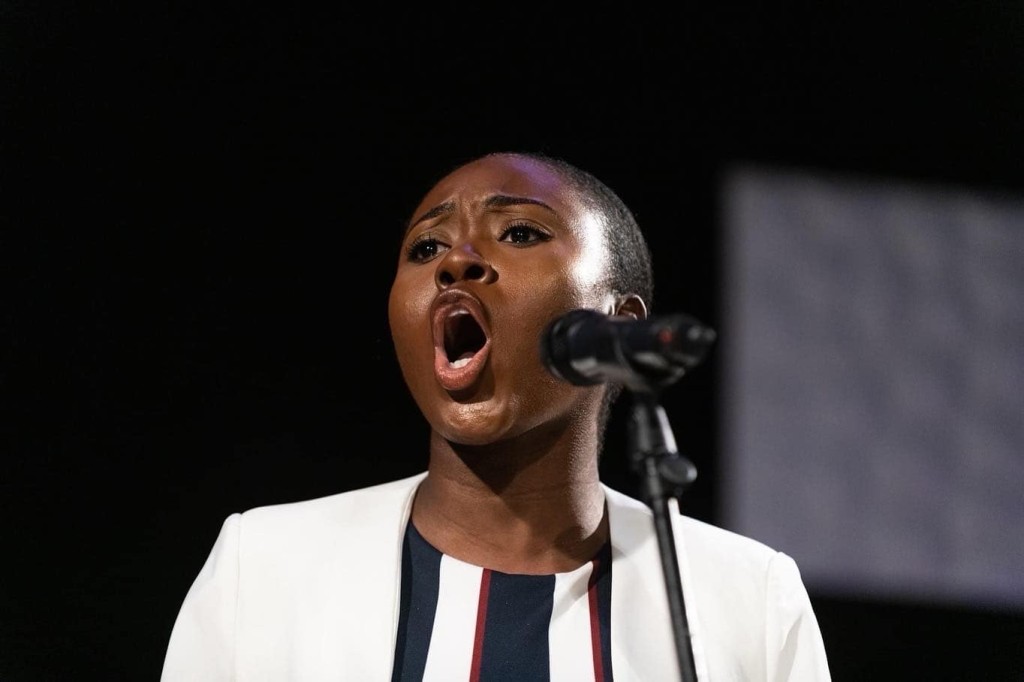
For Cynthia Amoah, poems are most often born in the air, first arriving as sounds that she can bend and shape, and then later sifting out meaning in the singing collection of syllables.
“I need to be convinced of the beauty of the sound of a poem before I can actually write it down,” said Amoah, one of 30 poets set to be featured at Streetlight Guild during the 15-day poetry blitz known as “Rhapsody & Refrain,” which kicks off with Kimberly Brazwell and Sidney Jones Jr. on Sunday, Sept. 1. (Amoah performs alongside Ajanae Dawkins on Wednesday, Sept. 4; a full schedule of poets can be found below.) “So, sometimes I’ll hear language, I’ll hear words, I’ll hear rhythm. And only then will I start to pin it down.”
Amoah attributed this to multiple factors, including the characteristics of her native language. “My native tongue, which is twi or akan, you can say a word, but with the way you say it and the sound you apply to it, it can mean multiple things,” said Amoah, who was born in Ghana, West Africa, and emigrated with her family to the United States at age 2, first settling in the Bronx neighborhood of New York City.
A donation powers the future of local, independent news in Columbus.
Support Matter News
These ideas were further reinforced by Amoah’s introduction to poetry, which occurred when an eighth-grade teacher by the name of Ms. Fitzgerald placed her in the national spoken word poetry competition Poetry Out Loud. And so, when Amoah talks about developing her voice as a poet, her initial inclination is still to center her actual, physical voice, with the evolution of her speech – the volume, tone and cadence – helping to shape everything down to the actual content of her verses.
When Amoah started performing, for instance, she said she was watching a lot of slam poets on YouTube, many of whom were louder and more boisterous, and whose styles she initially started to mimic. “And it wasn’t until I matured and started to explore my own voice that I realized I didn’t have to sound like that, and that I could sound like myself and still be embraced,” said Amoah, pointing to the discovery of Ghanaian poet Ama Ata Aidoo as pivotal. “She read in more of a hushed tone, and she also has an accent to her work, and because I experienced this range of different performance voices and reading voices, I realized I don’t have to be loud and I don’t have to be quiet. I can just be myself and that’s okay.”
These vacillations in volume drew out different dynamics in Amoah as a poet, with her louder recitations leaning into the joy and sense of release she continues to find in the craft. But as she began to explore the quieter dynamics within the performance space, some of the material became more intimate and more emotionally tangled, with recent comparatively hushed poems arriving amid a challenging personal stretch that has included family deaths and the implosion of various personal relationships.
“And as I’ve wrestled with these experiences, the poems have become quieter, and they don’t necessarily sound like performance poems,” said Amoah, who believes these more muted expressions will make up the bulk of her set at Streetlight this coming week. “I have more experience with the roar of performance and the roar of poetry, but I don’t shy away from the inward. … There have been poems that I shared out loud that I swore I would never share.”
While Amoah has evolved considerably in her craft, particularly in the last five years or so, she said there are through lines that have remained consistent in her work, which she has continued to archive, first in piles of spiral notebooks and more recently in digital form, with lines and verses drafted in the Notes app on her phone.
“I do find recurring themes of identity and belonging,” Amoah said. “I’m originally from Ghana, West Africa, but I grew up in the States, and so identity has always been something I’ve explored. Even figuring out what the definition of home means, what language means to me, what family means. And I think because I’m continuously experiencing this personally, it naturally and organically comes out in my work.”
When Amoah returned to Ghana, people would tell her she was not really from there, and that she had become Americanized. And living in America, the poet said she was constantly forced to confront her African identity. “And because of this I couldn’t define home as a place, and it forced me to push the envelope of what that idea meant for me,” said Amoah, who now describes home not as a physical location but rather any space that can provide feelings of safety and comfort.
Chief among these might be the world of poetry, which has always served as a refuge for Amoah to untangle her knottiest emotions. “The page was always a safe place for me to reflect and to explore,” she said. “The page has never judged me.”
“Rhapsody & Refrain” 2024 schedule
(All readings start at 8 p.m., except for Sundays, which kick off at 5 p.m.)
Sept. 1 Kimberly Brazwell & Sidney Jones Jr.
Sept. 2 Hanif Abdurraqib & Tomas Pacheco
Sept. 3 Marcus Jackson & A.D. Detrick
Sept. 4 Ajanae Dawkins & Cynthia Amoah
Sept. 5 Darren C. Demaree & Zach Hannah
Sept. 6 Ruth Awad & Travis McClerking
Sept. 7 Christina Szuch & Sayuri Ayers
Sept. 8 Sara Abou Rashed & Valerie Boyer
Sept. 9 Maggie Smith & Louise Robertson
Sept. 10 Amy Turn Sharp & Su Flatt
Sept. 11 Charlene Fix & Jennifer Hambrick
Sept. 12 Bill Kerwin & Scott Woods
Sept. 13 Stevi DearMsStevi Knighton & Rachael Scott
Sept. 14 Soz Zangana & Karen Scott
Sept. 15 Steve Abbott & Aaron Alsop
Author

Related Articles

Wali Crowder gets in character for Harlem Renaissance Remix
The Columbus poet will appear in the guise of Harlem Renaissance writer Countee Cullen at Streetlight Guild this weekend.
Namwali Serpell finds expanding resonance in the world of Toni Morrison
The Harvard professor, novelist, and critic will take part in a pair of Morrison-themed Columbus events this week, beginning with the Wednesday kickoff of ‘Beloved: Ohio Celebrates Toni Morrison,’ where she’ll appear in conversation with Hanif Abdurraqib.
‘People of Agency’ traces the history of USPS and finds lessons for today
Aileen Day and cohost Maia Warner-Langenbahn launched the podcast out of a belief that it’s easier to advocate for our institutions once you know their history.