
Local Politics: A step away from the status quo
The District 7 City Council race stands as the most progress Columbus has made toward a democratic election in years.
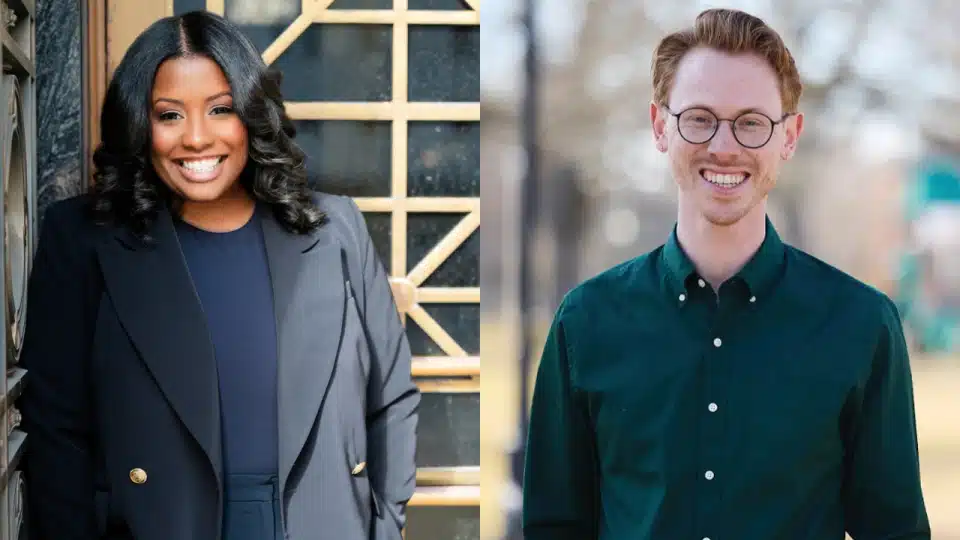
Another election, gone. Another set of races, won or conceded. And somehow, there has been no change at all. Despite all that excitement over the hotly contested District 7 City Council race, this election was a quiet reaffirmation of the status quo. Right?
Don’t be disappointed. That city council seat result was the most progress Columbus has made toward actual democratic elections in years.
As some people writing about this election have noted, the structure of Columbus politics inherently favors establishment candidates.
A donation powers the future of local, independent news in Columbus.
Support Matter News
Look at this year’s election results and you’ll see it immediately. In the District 7 City Council race, establishment candidate Tiara Ross (backed by the Franklin Democratic Party, funded by current city council electeds, and endorsed by Mayor Andrew Ginther) won out over independent candidate Jesse Vogel. The three open seats for the school board election were won by the three Democratic-Party-endorsed candidates; numerous incumbents went unchallenged.
This institutionalism is, in part, historical. When it first developed a city council in the 1800s, Columbus elected representatives in districts. In 1912, voters approved the city’s first charter, which switched the model from ward-based to fully at-large. In order to run a city-wide campaign, candidates would need substantially more resources than what had previously been required to go door-to-door in their neighborhood. Instantly, the new at-large model would have weighted city council elections heavily in favor of those with means.
As the Canton Repository reported in 2016, that theory is supported by journalist Betty Garrett and historian Ed Lentz in their 1980 book, Columbus: America’s Crossroads.
“Many of the poorer ethnic and minority neighborhoods had had representation on the old council simply because candidates could afford to run in a small area like a ward,” Garrett and Lentz wrote. “Now without independent means or the support of a political party, a candidate from one of these segments of the population simply could not get elected.”
Columbus’s current city council system is a bit different from that fully at-large model, because it has districts, or at least in theory. But each candidate still has to compete for votes across the entire city, so the old campaign funding problem still stands.
The other part of this city’s institutionalism is couched in a one-liner from broad campaign reform legislation passed in 2018 and exempting “in-kind” donations from campaign contribution limits. This allows city council candidates to pour money into one another’s campaign coffers pretty much unhindered, and almost every election is really about money. Meanwhile, grassroots candidates rely on donations from voters, so they’re starting from another disadvantage.
You may not have known those details, but based on this year’s election, they shouldn’t surprise you. And yet, those who support non-establishment candidates should still take this year as a win – because in spite of all this, there was a close race.
There were 105,284 votes cast in the District 7 City Council race. Jesse Vogel lost the seat to Tiara Ross by only about 1,500 votes.
Historically, turnout is low for local elections in off-cycle years, because people will only come out to vote if they’re interested in the races or the issues at hand. That means that independent candidates usually have a better shot against establishment ones in off-cycle elections, because the people bothering to show up and vote are interested in their policies and have done their research; they’re less likely to just vote along party lines.
So, with no institutional support, grassroots funding efforts and a reported team of only three staffers, an independent candidate got enough people interested in what he had to say to land within two percentage points of winning a city-wide election. (He also won the district he was running for by more than 60 percent of the vote, but that’s another conversation.)
Vogel told WOSU after conceding the race that he believed other candidates could also do what he did, and that there would likely be more of them in the next round of city elections. “Now we have a playbook,” he said. “We understand more about how voters are going to behave in a race with two candidates going head-to-head in this district system.”
With a trial run this successful – for someone whose campaign manager described him in an interview with The Rooster as running for office “with a no-name ID” – future independent candidates could stand a chance at beating out incumbents and establishmentarians, because they know what worked and maybe what didn’t. And with five city council seats up for re-election in 2027, they’ll have had plenty of prep time.
Related Articles

How Wexner’s desire for a city center led to a more fragmented Columbus
As the central Ohio retail magnate faces a larger public reconciliation owing to his ties with disgraced financier Jeffrey Epstein, a look back at how the Wexner name became so synonymous with the city.

Local Politics: The fallout of serving ICE(d) coffee
A local coffee chain has been under fire for saying it would not refuse to serve ICE agents. But the people who work there say that’s not the full story.

Ohio’s Recovery: The past, present, and future of the overdose crisis
Fewer people are dying from overdose, but the policies and the social determinants of health did not vanish.