
The Other Columbus: Dishing up a Black art gumbo
Black art has historically never gotten its due but following these step-by-step recipe instructions could finally begin to turn the tide.
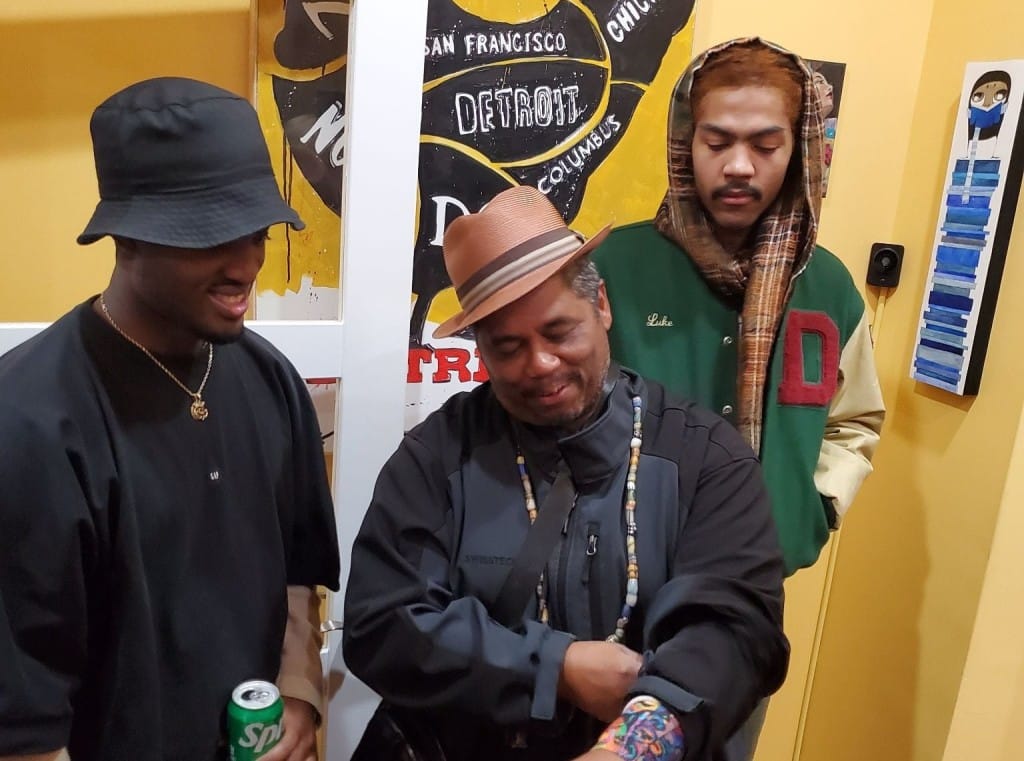
Let’s make a gumbo, an art gumbo. I like my gumbo with a lot of spice, so let’s make a Black art gumbo, a dish fortified with a roux of keeping-it-real sauciness. I’ve been serving some perfectly fine columns up to this point about art, none of it explicitly Black. Considering how much I adore being Black, I’d say we’re overdue for at least one focused on the largest community I serve when I’m not in front of a computer screen. I promise to send you home with a bowl of good stuff by the end.
I was recently being videotaped while hanging art in a gallery when, slumped in a chair during a fit of reflection coupled with exhaustion, I said the following: “Black art does not get its due. It never gets its due. It doesn’t get treated right. It’s not valued as much as other art. It is regularly maligned in pretty much every way an art world can malign itself.”
Hold on to that very well-documented, utterly unassailable observation for a moment while I put some more flour in this roux.
A donation powers the future of local, independent news in Columbus.
Support Matter News
This past weekend, I was in attendance at a communal meeting of Black artists and cultural workers hosted by Maroon Arts Group at its recently acquired theater, The Maroon Culture Lab. It’s the kind of meeting that people have been saying should happen for years, me included. And, as of now, it’s an official thing. There’s a lot to say about a meeting like that (go ahead, ask me), but something that kept being referenced either directly or indirectly was the sentiment I quoted above: Black art does not get its due.
Keep stirring that roux until it’s dark while I get these green peppers chopped up.
You almost don’t need me to tell you about how museums and art organizations across the country – nay, the world – took to creating the perception a few years ago that they cared about Black art, if not actual Black people. I am challenged even now, after all the signs and black square profile pictures have come down, that more has been done. The needle of The Arts has clearly shifted in the direction of Black artists. More establishment money and opportunities have been provided to Black artists than ever before. This has been said out loud enough times that it is clear the goal was to discount whatever remaining criticisms of their efforts might exist. “We have given more money to artists than ever,” they say. “We absolutely respect Black artists. Look at the few we have on hand.” As if they were the ideal arbitrators of when Black art needs have been met.
Brown the sausage up, sauté the shrimp just a touch, and shred the chicken good, but not too much.
There are Black artists who don’t want to be called Black – not because they aren’t, but because white people will treat them and their art differently. The subjects of our work are narrowed. The creative liberties employed by white artists are not available to Black artists. Support for our work is held tightly if the concept cannot be generalized enough for a mainstream audience, which always means white. A Black artist who paints landscapes is left in limbo. A Black artist who paints an American flag made out of red and blue gang bandanas is unattractive to buyers. Where is the market for earnest Black art that also has the resources to acquire their work at its full value and not its slashed, sell-through price? The list of inequities, double standards, and indignities goes on – a spiral of unraveling canvas. None of this is new, and yet it is countered by gatekeepers daily who have increased their budgets in the direction of Black art by fractions. To top it all off, white audiences for Black art think it’s not theirs with which to engage. And since they are not Black art’s target audience, they should bypass it. As if Black people need to keep reminding other Black people what America is. As if we are not also talking to white people, trying to get you to listen in the way that only our hands know.
Prep the rice.
All of this is enough to make the Black artist feel very alone in their struggles to make not just an art life, but a living life. It can be too much to get our arms around. We labor into the night, after our jobs and families have retired for the day, navigating a country that targets us in systemic and historic ways. An art life is solitary by design, and often lonely in execution. And when you are made to feel as if you are the problem – not your skill set, not your medium choice, not your technical background, but you – it can feel like you are the only artist in the world who can see the pit, and only the pit looks back at you.
Now, get your bowl, friend. Hand me that dipping spoon.
Nothing I have written above was about any one artist. Everything I have said could be cosigned by a dozen artists within five minutes of posting an online poll. Even if I just focused on my city, Columbus, I bet I could find 100 Black artists who would tell you the same things I’ve just written. In fact, I know I can, because I have a list with 200 Black Columbus artists on it, and at any point 50 percent of them will agree on anything.
In the summer of last year, I commissioned a list to document 100 Columbus Black artists. I did this in my capacity as director of Streetlight Guild. The work was done by Artist in Residence Tiffany Lawson, who, frankly, had better, more artistic things to do. I have been having conversations for years about Columbus art, but no one could tell me how many Black artists there are beyond the ones they knew. It was hard to get a sense of it because, well, see all of the above. I figured any point I had to make about art (and not just Black art) could be better contextualized by rolling out 100 Black artists at any given moment. Turns out getting to 100 was easy, so we kept going until we hit 200. The list is not comprehensive. No such list could be. It is a living list. It will expand over time.
The list is a snapshot of visual artists across many mediums (painting, sculpture, photography, textiles, etc.) who have produced work in Columbus at some point during the last 50 years. The only stipulations were a) art by the artist be observable or known; b) they be at least 18 years of age; c) they spent some time working as an artist in Columbus in the last 50 years; and d) they present as Black, as far as we know. This list is many things at once: It is a starting point, a research base, a job, a discussion, and a gift. It is a piece of the puzzle about what it means to be a Black artist in Columbus but also has many things to say about art at large.
Digging back through the recipe instructions presented that make up this gumbo, it’s a trip how each scenario shifts when you introduce this new data into it. How it is not a few artists sucking on sour grapes. How small the phrase “not getting their due” becomes. How the resources committed by “caring” institutions in “record breaking” numbers still come up woefully short. How there are enough Black artists to fill an arts festival by themselves. And finally, how profoundly un-alone you are in your struggles. It is that last idea I hope can be demolished most of all.
Related Articles
Opinion: When unionization isn’t enough
Collective bargaining can protect journalists from arbitrary firings, stagnating wages, and unsafe or exploitative working conditions. But a union contract cannot fix a broken funding model.
On Development: Cars can’t take us where we need to go
The billions of dollars of new road improvements cited in MORPC’s analysis 26 years ago have already been spent, and now we’re still looking at the same challenges with more people and more roads.
‘Just regular people’
There’s a long history of underground mutual aid in America that often cuts against laws and norms.