
Opinion: When unionization isn’t enough
Collective bargaining can protect journalists from arbitrary firings, stagnating wages, and unsafe or exploitative working conditions. But a union contract cannot fix a broken funding model.
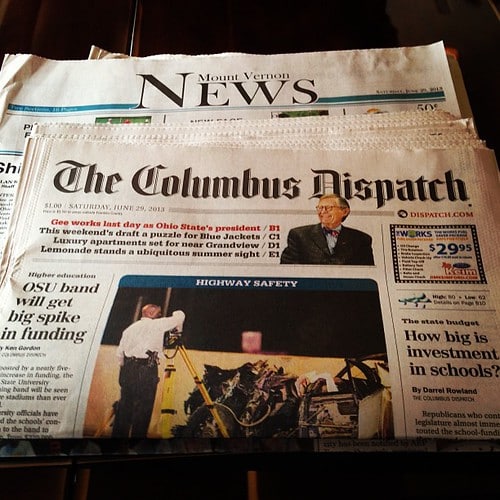
I was genuinely encouraged to hear that staff at The Columbus Dispatch and The Newark Advocate recently chose to unionize, with more than 85 percent of Dispatch journalists recently voting in favor of forming a union. Journalists coming together to assert control over their working conditions, defend fairness, and protect a free press is always good news – especially in an industry that has spent decades shedding jobs, respect, and stability.
But in Columbus, unionization alone will not be enough.
To understand why, it helps to understand the history of local power. For decades, the Dispatch’s longtime owners – the Wolfe family – were deeply hostile to unions, not only within their media holdings but across the broader civic and business ecosystem. Through their leadership role in the Columbus Partnership, a powerful alliance of corporate executives, they helped establish a system of de facto control over city politics that persists to this day.
A donation powers the future of local, independent news in Columbus.
Support Matter News
This influence hasn’t come through overt force. It has come through money: campaign financing, control over endorsements, behind-the-scenes appointments, and an electoral structure designed to limit competition. Columbus remains one of the least competitive large cities in America when it comes to local elections – not by accident, but by design. The result is a kind of “managed democracy,” where outcomes are shaped long before voters cast a ballot – and where dissenting voices, including independent media, struggle to gain traction.
For decades, the local media ecosystem was also owned by – or deeply influenced by – this same network of business interests. Independent outlets were bought up and then shuttered. Many longtime journalists and city insiders have described stories being buried, colleagues punished for reporting that threatened powerful interests, and endorsements of reform candidates quietly discouraged.
The most glaring illustration may be the near-absence of sustained local investigative journalism into Les Wexner – Ohio’s richest man and a central figure in Columbus’s civic and economic life – and his ties to Jeffrey Epstein. The most consequential reporting on the flow of money, access, and property between Wexner and Epstein came from national outlets. Local coverage, when it appeared, too often read like summaries of work done elsewhere. Whether that gap reflects the gutting of local newsrooms, elite influence, or both, the outcome is the same: One of the most significant stories in recent American history unfolded with far less local scrutiny than Columbus deserved.
In recent years, much of our local media has been absorbed into national conglomerates such as Gannett or, in broadcast, groups such as Sinclair. In some respects, that has coincided with less direct interference in daily editorial decisions – and more willingness to challenge city leadership. But consolidation has also meant smaller newsrooms, fewer beats, fewer local stories, and less sustained reporting power.
Unionization is essential. Collective bargaining can protect journalists from arbitrary firings, stagnating wages, and unsafe or exploitative working conditions. It gives reporters a voice inside their workplaces.
But a union contract cannot fix a broken funding model. It cannot stop newsroom consolidation. It cannot replace investigative teams that have been eliminated. It cannot ensure sustained coverage of neighborhoods, culture, or local innovation. And it cannot guarantee a newsroom will still exist five years from now. The Columbus Dispatch had more than 90 employees across all departments in 2019. Dispatch journalists said there are now fewer than 40 non-management employees in the newsroom.
Just last week, Jeff Bezos – one of the world’s richest men and the owner of Amazon and The Washington Post – ordered the layoffs of more than 300 journalists, roughly a third of the paper’s newsroom, including the entire sports desk, the Middle East bureau, and its Ukraine coordinator.
Together, these cuts reflect a broader dismantling of the press ecosystem by media owners, coming at the direct cost of journalism jobs and the public’s access to vital reporting.
For decades, journalism was subsidized by advertising monopolies, classifieds, and regional dominance. That system collapsed. What replaced it – digital ad churn, venture capital, private equity ownership, and relentless consolidation – rewards speed over depth and volume over accountability. Meanwhile, the collapse of local journalism has made it easier for entrenched power to operate without scrutiny. When investigative capacity disappears, corruption goes unnoticed. When arts and culture coverage vanishes, communities lose shared narratives.
This is why unionization, while necessary, is insufficient.
If Columbus wants strong journalism – journalism that reflects the full life of the city – we must pair labor protections with new civic funding structures that treat journalism as public infrastructure. Other communities are already experimenting with solutions: nonprofit newsrooms supported by philanthropy and local giving; cooperative outlets owned by journalists and residents; partnerships with public media; and independent journalism funds – firewalled from political interference – that support investigative reporting, local culture coverage, and experimental models commercial outlets no longer sustain.
We already accept this logic for libraries, parks, schools, and transit. We fund them not because they turn a profit but because they create an informed, connected, and resilient city. Journalism plays the same role.
If the City and County are willing to invest $50 million in renovations to Nationwide Arena and hand out millions more to developers through tax abatements, then we have the capacity to invest in an independent local journalism trust.
Such a trust could offer competitive grants that outlets apply for to expand investigative capacity, deepen neighborhood and culture coverage, and support innovation reporting. Those grants should include guardrails – protections against layoffs, increased compensation standards, and requirements that funding expand reporting rather than replace existing budget lines – so public investment strengthens journalism instead of subsidizing consolidation.
Columbus can afford to fund the stories that keep our democracy honest. The only remaining question is whether we choose to.
Will Klatt is a labor relations consultant, public education advocate, avid gardener, musician, and a member of the Clintonville Area Commission. Those interested in exploring ways to promote and sustain local journalism can reach out to him via email at will.b.klatt@gmail.com.
Related Articles

If you start from a place of love, you can’t go wrong
A vigil for an unhoused community member who recently died in Newark served as a call to not look away.

On Development: Rapid-transit is moving slowly. Maybe we need a new model
Our policies suggest a willingness to spend any amount to add lanes and bigger (towering!) interchanges for major highways, while transit spending is too often regarded as frivolous.

Local Politics: Drain the swampy Municipal Courthouse
Columbus wants to renovate the Franklin County Municipal Courthouse instead of replacing it. The people who work there say this very wet “derelict” building is beyond repair.