
The problem with the CDC prohibiting ‘never use alone’
Officials from the Centers for Disease Control and Prevention reportedly told recipients of overdose prevention funding that they may no longer be allowed to promote the message that has become one of the pillars of harm reduction.
People are more likely to overdose and die if they use drugs alone.
The data is clear.
In about 70 percent of overdose deaths in Ohio, there is no bystander present. A 2024 study by researchers at Case Western found that 75 percent of overdose victims in Cuyahoga County had used alone.
A donation powers the future of local, independent news in Columbus.
Support Matter News
So I was surprised to read a January story in The Guardian that reported officials from the Centers for Disease Control and Prevention had told recipients of overdose prevention funding that they “may no longer be allowed to promote the message to ‘never use alone.’”
When pressed on the issue, “The officials said it was a gray area and would not provide a clear answer.”
The Guardian reported that the purpose of the meeting was to make sure that recipients were in compliance with President Trump’s executive orders, an in particular July’s “Ending Crime and Disorder on America’s Streets.”
If you can make it through the pop-ups on the White House website, you’ll find a document that ignores the root causes of homelessness (lack of housing) and calls for the directing of federal funds away from programs that support “so-called ‘harm reduction’ or ‘safe consumption.’”
I reached out to the CDC, and in response received a statement from Health and Human Services (which oversees the CDC) spokesperson Andrew Nixon, who reiterated that the CDC wants to ensure that federal funding supports activities that “are aligned with Executive Orders and CDC priorities, to the extent permitted by law and any applicable court orders.”
“Federal funds may not be used to support harm reduction efforts that primarily serve to facilitate illegal drug use and its attendant harm,” Nixon wrote.
Instead, those receiving federal funds should focus on distributing naloxone, testing strips, and helping people find treatment.
A close inspection of both the CDC and HHS websites reveals that the messaging has mostly disappeared. Of note, an HHS page on overdose prevention includes nothing about harm reduction.
But how are people to reverse their own overdose? How do they get into treatment if they are dead?
In the harm reduction world, “never use alone” is a bit of a mantra.
There’s even an organization called Never Use Alone, which supports a hotline for people who use drugs. They can call and be connected with someone who will make sure they stay safe. And if need be, call an ambulance.
“When I saw the story, I thought, what did we do to piss off the CDC?” Never Use Alone founder Mike Brown told me.
Then he realized they weren’t talking about the organization, they were talking about the phrase, the mantra, and he was surprised. “It’s one of the basic pillars of harm reduction,” Brown said. “Carry Narcan, use clean syringes, go slow, never use alone.”
Brown is affable, kind, down to earth. But since 2019, when he started Never Use Alone, he has been a fierce life saver. Since it launched, Never Use Alone has received more than 80,000 calls and dispatched ambulances to 250 people.
“That’s 250 different stories,” Brown said. “Callers whose lives we’ve saved because they called us and we were able to call the ambulance. Some of them have found pathways to recovery. Some are married and have kids. I’m Facebook friends with some of them. Just the other day, we got a message from someone whose husband is still alive because he called us.”
When they started, 15 calls would be a busy day. Now it takes about 100 to qualify as busy.
Brown said that the hotline began as a grassroots effort and continues as such. It has grown, mostly, by word of mouth. They network. Harm reduction organizations will share the organization’s business card at distros.
But really, Brown told me, it’s how people are treated when they call. When someone calls, he said, and they’re not being judged or pushed into treatment, they start to trust the person on the other end of the line, believing that they’ll do their best to keep them safe.
One person tells another person. Word spreads.
Never use alone.
The message is clear. Strong. The CDC and HHS might not want folks to say it, but it matters.
Never use alone.
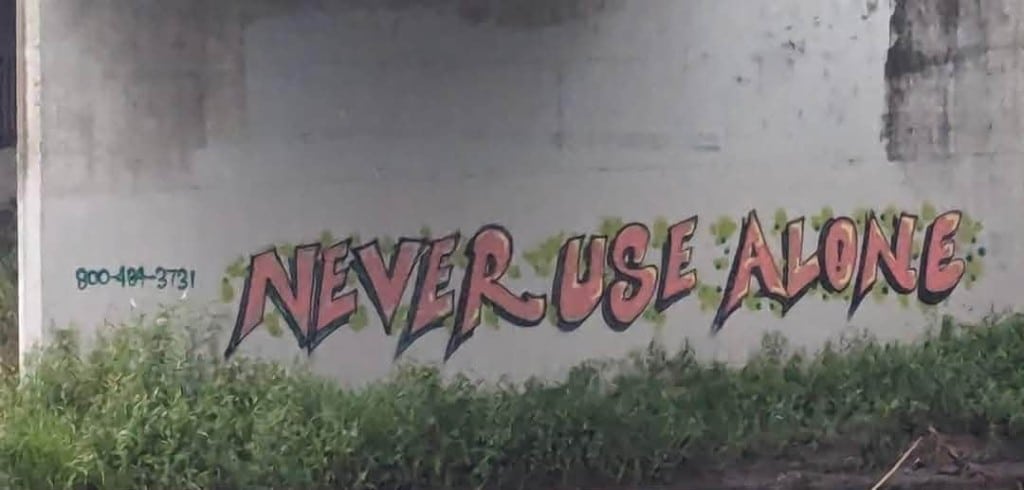
Brown said he’s been sent photos of the organization’s phone number spray-painted beneath a bridge and spelled out on a church sign. I once saw it tagged at a New Jersey rest stop – someone had written it with a green Sharpie on a post.
Never use alone: 800-484-3731 or 877-696-1996.
Author

Related Articles

Local Politics: Proposed trade partnership with Israel draws criticism
A bill to create an Ohio-Israel trade partnership is under review in the State Senate. Reactions in the city have been mixed at best.
‘I am not going to stand before God and say, well, I chickened out’: Reflections on building caring coalitions
More than three years after the City of Columbus bulldozed Camp Shameless, one of the founders of the encampment offers their perspective on the housing crisis and the people working at the grassroots to give aid to those routinely left behind.
On Development: Of salad greens and sensible growth
Many developers and sellers confuse demand for a certain type of housing and a willingness to buy. There are hundreds of thousands of people in central Ohio who prefer older houses and apartments.