
Local Politics: Flock representative leaves halfway through Columbus City Council hearing
Of the 55 Columbus residents who signed up to speak at the hearing, only five voiced support for keeping the cameras in place.
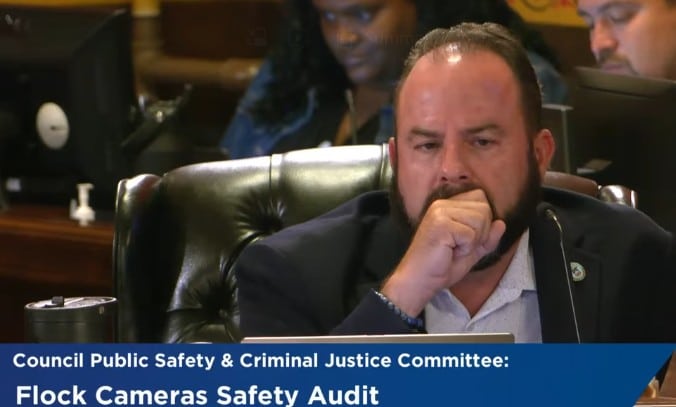
Columbus City Council held a long-awaited hearing last night on the city’s use of Flock, an automatic license plate reading surveillance camera system marketed as a means to help track cars potentially involved in crimes or missing persons cases.
A number of media reports on this hearing said that the city council heard a mixed variety of perspectives on the continued use of Flock. That’s technically true – both Columbus police personnel and Flock government relations director Vaughn Roland, who was repeatedly booed by attendees, gave testimony supporting the use of the tech. Police said Flock is an effective tool for time-sensitive crime-solving that is never used on its own, and that it has helped them solve 54 percent of the city’s homicides this year.
But the public testimony provided last night from actual Columbus residents was overwhelmingly negative. And the Flock representative whose job it is to liaise with governments chose to leave before hearing any of it.
A donation powers the future of local, independent news in Columbus.
Support Matter News
There has been extensive criticism of the surveillance tool, both in Columbus and nationwide, owing to its broad lack of transparency, data storage policies, and its roles in immigration and reproductive care enforcement at both the federal and state levels. Some cities in Ohio, such as Dayton, have even terminated Flock contracts in response to public outcry.
In June, an audit of CPD data found more than 15,000 potentially immigration-related Flock searches run on Columbus networks, which is against Columbus policy to not assist in immigration enforcement. That audit was what triggered last night’s hearing.
First came presentations from CPD on the contents of the audit and newly introduced safety and transparency measures, and from Flock representative Vaughn Roland, about some newly implemented search filters in the platform itself. Then came a five-minute recess before the public testimony.
Of the 55 Columbus residents who signed up to speak at the hearing, only five voiced support for keeping the cameras in place; three of those five said they were cautious, and that they supported its “regulated and transparent use” only with “meaningful oversight.”
Conveniently, Flock representative Roland disappeared from the hearing before any public testimony began. This made a lot of people mad.
“Flock has also stated that data collection, storage, and regulation should be a collaborative process,” one of the speakers, Columbus resident Ella Bowman, said at the hearing. “But where is Flock’s own representative when it’s time to hear from the people they surveil?”
Councilmember Melissa Green of District 6 voiced the same concern just as the hearing was about to close, at around 10 p.m.
“I’m coming away from this hearing with more questions I feel like than I started,” she said. “I’m not even going to go so far as to say that these technologies should never be used anywhere or shouldn’t exist in our community forever until the end of time. But most certainly, we do not have answers to the most important questions that remain out there in the community. The Flock representative left here tonight and didn’t stay to be able to respond to questions that any of our community members had, that spent six hours at this hearing or longer.”
Green has been open about her views on the technology: it’s a useful tool for solving crimes and bringing back missing people, so long as it’s used responsibly and is properly regulated to ensure it doesn’t infringe on civil liberties and privacy. In response to one Hilltop resident – where Green herself also lives – who voiced cautious support for Flock with “strong oversight, transparency, and accountability,” Green said she had heard the same perspective from her own neighbors.
“There are too many questions to continue using [Flock cameras] at this point in time, but I grapple with everything that you’re saying,” Green said.
Councilmember Lourdes Barroso de Padilla of District 8 also voiced similar concerns.
“Technology is run by people and people commit errors,” she said at the opening of the hearing. “And there is too much human error in this system that makes me feel like this is not the right choice for us. …Whenever we have something that we’re using that is supposed to protect people, but at the same time it is a flawed system that also endangers people, then as a person in a position where I can make decisions for people, it makes it very difficult for me to feel secure in what the system looks like.”
CPD has made some effort in the last few months to improve transparency. It stopped nationwide and statewide sharing in July, and now only selectively shares Flock data with specific individual local agencies; it also stopped sharing with 287(g) agencies, a designation that allows local law enforcement to act as federal immigration personnel and execute immigration enforcement tasks. A few weeks ago, it launched a Flock transparency portal and committed to providing monthly audits of Flock searches.
But Kat Finneran, a member of community organization 614 ICE Watch, testified at the hearing that these guardrails are not nearly enough to prevent Columbus data from being used in immigration cases.
“You are only as secure as your weakest link,” Finneran said. “Well, let me show you some of your weakest links just when it comes to immigration. …Five days ago, a mother in Pataskala was pulled over by a Licking County sheriff’s deputy for allegedly going five miles over the speeding limit. The deputy waited on the side of the road for ICE to pick her up. She’s a mother of two daughters under the age of four and is currently sitting in Butler County Jail, about to be deported. We won’t get to hear her testimony. That officer that pulled her over has access to our Flock cameras.”
The CPD transparency portal confirms that the Licking County Sheriff’s Office has access to Columbus Flock data.
“The police unions and public safety departments will push back and say there’s maybe a few bad apples, but the system is good,” Finneran said. “But those bad apples have access to our Flock cameras.”
No decisions were made by the Council at the hearing. The funding and existing contract for Columbus’s access to Flock expires in December. Councilmember Emmanuel Remy, who called the hearing, asked CPD Deputy Chief Tim Myers what would happen if that contract was allowed to lapse.
“Our ability to access Flock would go away,” Myers responded.
The room erupted in raucous cheers.
Related Articles

Local Politics: A rundown of what the Flock is going on
The Columbus City Council is seeking public testimony ahead of an early August hearing on the future of Flock, a license-plate-reading surveillance camera system.

Local Politics: The small-time data center resistance
A petition to ban data centers statewide won’t be going to the ballot this year. So organizers are working locally instead.
Activists push Columbus to join other Ohio cities in cutting ties with Flock
While Cleveland and Dayton have recently taken steps to distance themselves from Flock Safety cameras, Columbus officials continue to adopt more of a wait and see approach.