
Activists push Columbus to join other Ohio cities in cutting ties with Flock
While Cleveland and Dayton have recently taken steps to distance themselves from Flock Safety cameras, Columbus officials continue to adopt more of a wait and see approach.

Liliana Baiman of 614 ICE Watch began to pay closer attention to Flock Safety cameras a couple of years back, after other organizers flagged the automated license plate readers, or ALPRs, concerned the data collected by the company could be used not just by police departments but “other entities,” as she explained it.
“And at the time, a lot of us were thinking of it through the lens of ICE (Immigration and Customs Enforcement),” Baiman said in an early June interview, joined by Kat Finneran. “And we were asking, will they get access to this information?”
These concerns proved prescient. Over the last year, Flock has drawn increased public scrutiny amid reports that ICE is accessing its data as part of the Trump administration’s ongoing mass deportation campaign. In Ohio, Flock data from Cleveland and Dayton appeared in thousands of immigration-related searches conducted by outside entities, leading both cities to take action against the private company.
A donation powers the future of local, independent news in Columbus.
Support Matter News
The Cleveland City Council Safety Committee voted last week against extending the city’s $250,000 Flock contract, which is set to expire on June 29, setting up a showdown with both the mayor and the police department. And in May, the Dayton Police Department announced it would indefinitely suspend the use of ALPRs pending an internal review. In the interim, Dayton officials covered all 72 of the city’s Flock cameras with plastic trash bags, a decision made to alleviate public concerns about the devices that remained in spite of their inoperability.
Here in Columbus, the situation is murkier, with city officials to this point declining to make public the Flock Safety audit logs, which would show those instances in which outside entities accessed the city’s Flock data to conduct searches. In a mid-June interview, City Council member Emmanuel Remy said the council had asked the Department of Public Safety to conduct an audit as a means “to see what information had been taken by other agencies,” including the Department of Homeland Security and ICE, the results of which he said are still pending.
The Columbus Division of Police, meanwhile, paused nationwide sharing of its Flock Safety data on June 3, The Columbus Dispatch reported. CPD also revoked one-to-one sharing with any law enforcement agency that the Department of Homeland Security lists as having a 287(g) agreement to work with ICE, though the department maintained one-to-one sharing with other vetted agencies. And while it paused nationwide sharing, the city continues to make data available to the statewide Flock network, leaving it searchable to any agency with access, even if it has a contract with ICE.
As part of the current research process, Remy acknowledged that the council had requested information about any potential legal repercussions for terminating the city’s contract with Flock, which runs through Dec. 25, though he framed these inquiries in terms of a wider information gathering rather than a determined course of action.
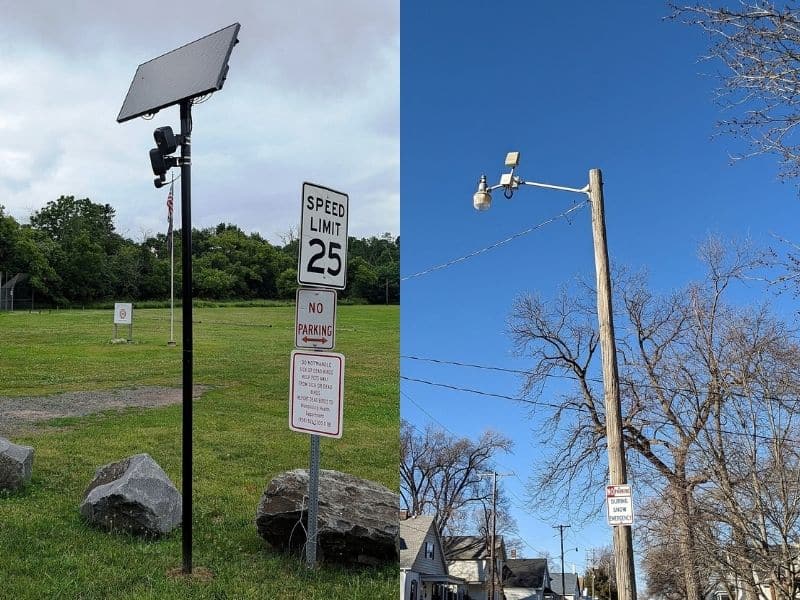
“In total, we think about all the possibilities that could occur. … So, I don’t know that there’s been any serious discussion about pulling out of the [Flock] contract,” said Remy, who shared concerns expressed to him by CPD leadership and chief Elaine Bryant were police to lose access to the 32 fixed cameras and eight solar-powered mobile cameras contracted in late 2024 for $228,000 and funded by a State of Ohio grant. “I trust when the division says this is a tool that’s been helpful to them. And that’s a concern we would have. If this went away, what does that mean to solving crime for the community?”
Flock Safety cameras are one part in an expanding tech surveillance network employed by the city, which also includes the ShotSpotter acoustic gun detection system, a fleet of drones known as the Rapid Aerial Visual Enforcement Network (RAVEN), and a network of Axon ALPR cameras.
In an email obtained by Matter News, the Department of Public Safety wrote that the Flock technology had been deployed over 12.6 miles of the city, including three square miles of area within the Hilltop, Linden, South Side, and the Near East Side, with plans to expand so the Wedgewood Apartment complex is included. The department also wrote of its plans to deploy the Flock cameras within the ShotSpotter coverage areas, “So as to create a technology synergy that will help to identify not only where and when a gunshot was fired (using ShotSpotter) but also help to identify suspects who caused the gunfire (using Flock).”
Gary Daniels of the ACLU of Ohio expressed the organization’s concerns related to these types of surveillance technologies, which he said continue “to get implemented, purchased, adopted, et cetera with really no controls whatsoever.”
“And I always preface this by saying, look, I don’t think anything is ever going to get us comfortable with these types of technologies, but that ship has sailed,” said Daniels, who advocated for more controls on the technology, limiting where and when it can be deployed and how long collected data can be stored. (Flock Safety data is currently preserved for 30 days before deletion.) “Our biggest wish is something at the statewide level regulating these tools, so that we wouldn’t have this patchwork of laws across the state. … Right now, it’s the Wild West here.”
While Flock is not the sole provider of ALPR cameras., it is the largest and fastest growing manufacturer of the technology, with the ACLU estimating more than 90,000 Flock cameras are currently in use across the United States. This makes the company a natural target for pushback as people grow increasingly wary of the spread of mass surveillance. In February, a survey commissioned by the Information Technology & Innovation Foundation found that a majority of Americans (54 percent) believe AI-powered mass surveillance violates privacy and civil liberties.
The core of this Flock pushback could be DeFlock.org, which maintains a crowdsourced map of ALPRs and warns visitors that the cameras “are a serious risk to your privacy and civil liberties.” The site also breaks down how AI-powered ALPRs operate, capturing and analyzing images of all passing vehicles and storing details such as the location, date, and time the image was taken, along with the car’s make, model, color, and identifying features such as dents and bumper stickers, oftentimes turning these into searchable data points.
For its efforts, Flock CEO Garrett Langley called DeFlock “a terroristic organization” in an interview last year. Of course, these types of hyperbolic statements are nothing new for Langley, who claimed in a 2025 Forbes interview that Flock could eliminate nearly all of the crime in the United States within a decade. This in spite of the challenges that exist in connecting drops in local crime rates with the adoption of the technology.
In Columbus, People’s Justice Project (PJP) recently launched a public campaign, collecting signatures for petitions aimed at getting both the city and Ohio State University to cut ties with Flock.
“We want people to be aware that the cameras do not solely target suspected criminal activity, and they in fact collect data on every vehicle that passes,” said Ava Borromeo, a member of the PJP communications team, who called attention to the ways this monitoring could be weaponized against things such as abortion access. “Let’s say someone is going to cross state lines because their state has heavy restrictions on abortion, the cameras could be used for [their prosecution]. And that’s just one piece of it. It could also be used to target different political activists or organizations.”
Daniels of ACLU of Ohio echoed these concerns, which he said should resonate across ideological lines, noting how the technology could be deployed outside of places such as gun shows as readily as abortion clinics, mosques, or political rallies. “There’s really a little bit of something in here for everyone” resistant to these technologies, he said.
Even if Flock’s cameras and data networks do help police solve some crimes, as Remy claimed, critics charge that these successes do not override the costs to privacy or to Fourth Amendment rights guarding people against unreasonable government search and seizure. “At minimum, this dragnet surveillance means warrantless tracking of everyone on the road,” the ACLU of Massachusetts wrote in October. “At worst, it means a digital police state wherein law enforcement officials in far-flung jurisdictions … can track protesters, political opponents, immigrants, patients, and others not suspected of any crime and use the information to hurt them.”
Supporting this idea, 404 Media reported in November that police used Flock to monitor No Kings protests nationwide. And in Kansas, one police chief used Flock cameras hundreds of times to track an ex-girlfriend.
“And because of the way the systems are connected, Columbus’ Flock system is only as strong as the weakest link in Atlanta’s police department, or Detroit’s police department, or the Butler County Sheriff’s Office,” said Finneran of 614 Ice Watch, which will be leading an online information session, dubbed “Flock Cameras 101,” on Monday, June 29.
“I think you’re always questioning whether or not the information is being used in a way that you can be… I don’t want to say proud of,” Remy said. “But where you can be confident that it’s not being misused in a way that would cause concern to you or the residents that you serve.”
Daniels, for his part, allowed that the private-public nature of the partnership between Flock Safety and city governments certainly created a “wrinkle,” as he described it, though he was loath to let elected officials off the hook. “If you have a problem with it, guess what? You don’t have to partner with Flock,” he said. “So, if government officials, elected officials are getting more clued into the types of data Flock gathers and maintains, and if it’s the kind of thing that is giving them pause, then don’t renew the contracts.”
Columbus groups such as PJP, 614 Ice Watch, and People’s Defense Columbus are currently advocating this on dual fronts, pushing both the city and OSU to cut ties with Flock. Ice Watch’s Finneran, for one, called attention to the university’s centralized location and the number of international travelers it draws for both academics and sporting events, which she said could make its data more enticing to outside agencies such as ICE. (The campaign to have OSU terminate its contract with Flock is part of a growing nationwide movement aimed at getting schools to disinvest in companies that work with ICE.)
Reached for comment about the DeFlock campaign, an OSU spokesperson issued a statement stating that ALPR cameras serve as “one layer of a comprehensive safety plan that includes upgraded permanent LED lighting, cameras, 911 call center investments, increased police and security patrols in partnership with the city of Columbus, and educational and transportation resources.”
While DeFlock campaigns have largely focused on the ways the technology is currently being deployed, those interviews expressed concern related to future advancements, wary of how features such as facial recognition could be utilized in updates. “And that’s certainly where we’re heading, and I don’t think anyone would argue that point, because that’s the trajectory of technology,” Daniels said. “It only goes one direction. It gets cheaper, it gets better, and because of those two things, it becomes more widely available.”
Addressing the nationwide expansion of ZeroEyes, AI weapons-detection software that has been increasingly adopted by school districts across the U.S., including in Ohio, company CRO and cofounder Sam Alalmo dismissed privacy concerns by noting how the technology is merely piggybacking on already ubiquitous networks of camera systems. The idea being that if this form of surveillance already exists, what’s the issue in advancing it just one step further?
“And that goes with what we know about surveillance, which is that these tools tend to not stay where they start,” said Hannah Quay-de la Vallee, a computer scientist and senior technologist at the Center for Democracy and Technology. “And once you start doing automated surveillance, it becomes easy to want to do it for a lot of things, and not always with the best of intentions, right?”
Asked if City Council had taken the potential for these technological advancements under consideration in weighing the types of legislative guardrails that might need to be established if Columbus opts to renew its contract with Flock later this year, Remy demurred. Instead, he expressed a desire to wait and see what policies might be developed by CPD, which he said had recently been tasked by council to develop an overall policy as it relates to technology, including the use of ALPRs, ShotSpotter, and drones.
“So, we’ll wait and see what they come up with, and if it’s not enough, we’ll challenge them to include those types of thoughts,” said Remy, who anticipates the policy to be completed sometime this summer. “Because you’re right, new features happen all of the time, and what does that mean, and does it go too far?”
Author

Related Articles

The rapid origination of Andy’s Law
Tensions between guards and the incarcerated at Ross Correctional Institution went from bad to worse following the 2024 murder of corrections officer Andy Lansing. Now, the prison could serve as a restrictive model of what’s to come under consequential House Bill 338.
Flock is on pause. What about all that other surveillance tech we use?
Columbus has had a contract with Shotspotter, an AI-powered gunshot detection microphone system, since 2018.

Opinion: Flock cameras won’t make us safer. Here’s what will
Flock Safety, the company behind the cameras, obstructs any attempt to establish guardrails, accountability, or transparency. Amazon is no one’s model for corporate responsibility, and even it cut ties with Flock.