
Greenhorn breathes new life into old songs with ‘The Dreamer’
Brothers Dan and Mark Spurgeon talk about rerecording a slew of the Columbus rock band’s early songs for their newly released album.
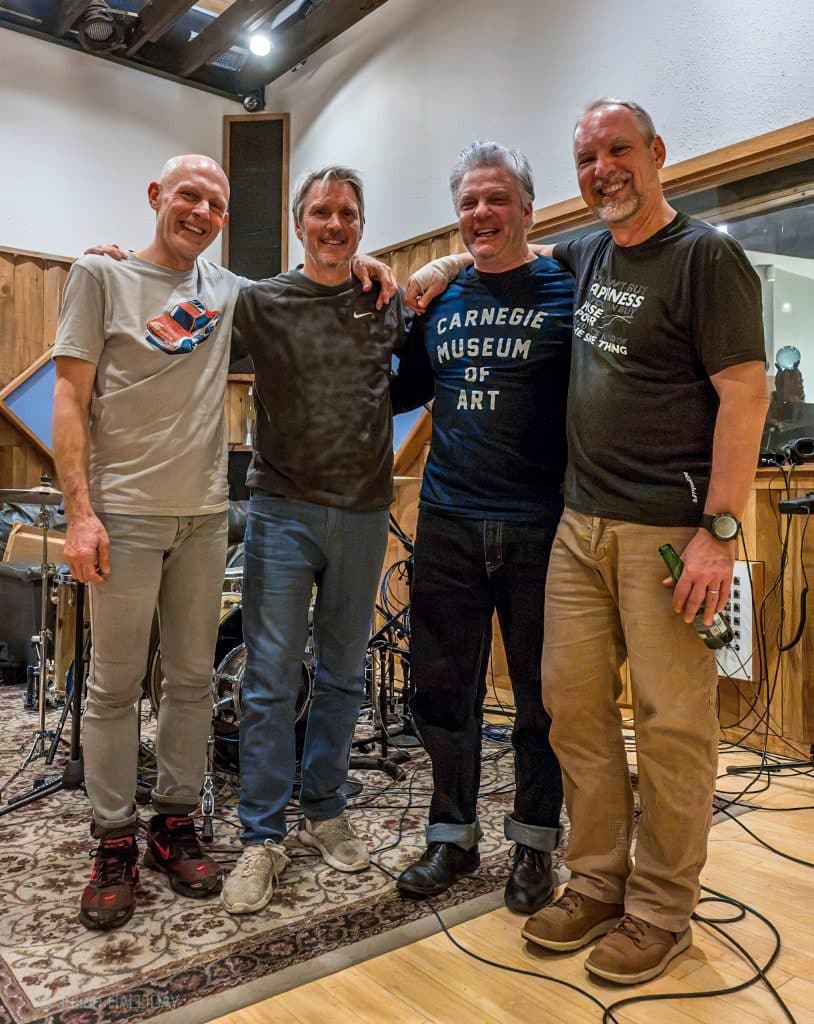
Brothers Dan and Mark Spurgeon said they never intended newly released Greenhorn album The Dreamer to have any sort of thematic throughline, describing the record as an assortment of songs pulled from early singles and long-out-of-print compilations.
“I feel like there’s a group of people who wanted us to make the Greenhorn record that never was,” said Mark Spurgeon, who joined Dan for an early August interview less than a week after The Dreamer surprise-released digitally. “There were these certain songs that were hard to get, because they were never released at the same place or time. And they were on singles or weird, obscure compilations. And folks couldn’t pop that record in and listen to it, and they wanted it to be available. And so, we weren’t approaching it like a greatest hits … but I was kind of thinking about it like we were making a set list.”
Even so, the album carries with it a loose sense of narrative, the earliest, inward-looking songs documenting the confusion, heartache and anxiety that often go hand-in-hand with those early 20s years, the band’s narrators fumbling forward through a series of missteps and self-inflicted hurts. “Things could be worse,” Dan Spurgeon sings on “Conversations with Myself,” “but they could stand to be a whole lot better.”
A donation powers the future of local, independent news in Columbus.
Support Matter News
Relief arrives in a trio of tracks that land at the end of the album, with the craggy ballad “Redefinition” serving as a pronounced turning point, Dan Spurgeon pledging to “tear apart this cheating mind and throw it back together again.” Riff-driven “The Dreamer” and “The Progress” follow and collectively capture the feel of pink clouds moving in after the storm, the latter focused on redemption and the reality that we carry our past scars with us even as we move into comparatively brighter days. “I’m trying to make it feel alright,’ Dan Spurgeon repeats, the music serving as further balm.
Though incidental, the throughline carried within The Dreamer reflects the reality of those years, when the Spurgeons joined with brothers Steve and Pat McGann to crank out intensely loud rock songs that often documented those unspoken inner thoughts. “I think there’s at times a searching, an uncertainty, a melancholy that underpins a lot of the songs from that time, and it was something we were well aware of, even when people wanted to hang that Neil Young influence and Dinosaur Jr. influence on it,” Mark Spurgeon said.
Dan Spurgeon said he absorbed his earliest writing lessons from Written in My Soul, a book in which author Bill Flanagan interviewed a range of music legends about their songwriting processes. Of these, Spurgeon said he was particularly struck by Elvis Costello, who spoke about the challenge of writing happy, uplifting songs compared with the ease of “mining the vein of misery.” “Some people would even accuse musicians of making trouble in their own lives so that they would have fuel for songwriting,” Dan Spurgeon said, and laughed. “And I was definitely in that camp for a minute, for sure.”
Owing to this, the frontman said there were some awkward in-studio moments when the band gathered to revamp this particular batch of songs. “Transparently, these are the words of someone much younger and, hopefully, much less wise, so there were definitely moments when I felt awkward, and where it was like, okay, I guess we’re doing this,” said Dan Spurgeon, who went on to describe the mix of empathy and shame that emerged in reflecting on this younger version of himself. “I feel like some of the worst moments of my life and the worst things I’ve done as a person on this planet are also some of the most instructive things in terms of shaping who I am and how I look at the world. And I feel an incredible amount of shame and embarrassment for some of those things. I also know we’re the sum total of what we’ve done and the people we’ve interacted with, and I do have a strong sense of empathy for [that younger version of me] but mix that with some shame and regret and you might get a fuller picture.”
Mark Spurgeon, for his part, described revisiting these songs in terms of reconnecting years later with someone you first met as a child. “And it’s like … you’ve changed so much. And that’s the experience I had with these songs,” he said. “There was something very innate and very familiar, like I could sing these in my sleep. … But then I would get really emotional at times when I would hear a particular line or verse, and I would remember what it meant to me then and consider what it means to me now, where I was able to connect with young Mark and current Mark at the same time. And I don’t even remember the question anymore, but it was a remarkable experience.”
In considering these formative years, the musicians refused to linger on the paths not taken, shaking off the lack of a major label deal and related global tours, the lone tug of regret coming from having allowed life to pull them away from creating with one another in Greenhorn for indeterminate stretches.
“Because of circumstances we never found a happy medium that allowed us to continue to work together, play, write new things,” Mark Spurgeon said. “Because it’s been the most artistically challenging and fulfilling thing that I’ve been a part of, and it’s really meaningful to me.”
And yet, both allowed that the potential for new music still exists coming off of sessions for The Dreamer. “I always try to leave room for that to happen,” Dan Spurgeon said. “There’s an attachment to the songs, right? We all love playing together. It’s really our shared language. So, while I’m glad people are finally hearing these songs, it was less important to me that this project ever get released. The value is us getting together and rallying around a common cause. … I mean, I’m just talking about four friends, four people who care about each other, getting into a room and doing what we know how to do.”
Author

Related Articles
Kill Gosling rediscovers its joy on the way to ‘Super Plume’
The Columbus rock band will celebrate the release of its excellent new album in concert at Cafe Bourbon Street on Saturday, Sept. 26.

Keith Hanlon takes advantage of an unexpected layover to create ‘Music for Airport Workers’
The Columbus musician will celebrate the release of his new ambient album in concert at Old First Presbyterian Church on Friday, Sept. 25.

‘Obviously, we make songs for the sad folks’: BeachKitty gears up for 934 Fest
Ahead of the release of new album ‘Cool Breeze,’ the shoegaze-indebted Columbus band, led by songwriting duo Milly May and Keano Smith, will feature at the annual art and music festival on Saturday, Sept. 12.