
A Permission to Cruelty: The impact of Trump’s executive orders on the unhoused
An executive order issued in July could affect everything from the types of programs available to the unhoused to how those experiencing homelessness are treated in their own communities.
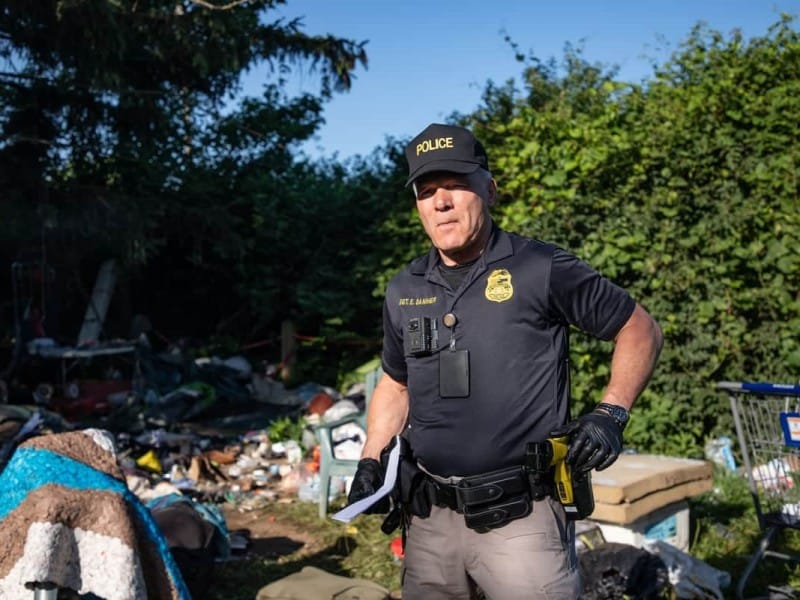
When President Donald Trump released a late-July executive order directed at the unhoused, Dru Batte combed the text, attempting to take in the key points so that she could share them with the other members of Heer to Serve, a local organization that advocates for the unsheltered and those facing housing insecurity.
“I was tempted to highlight it before I sent it to others, but with every sentence it was like, nope, every single word of this is relevant and important for everyone to read in its entirety,” Batte said in an August phone interview. “Each step of the way, it just became more and more devastating. It demonized folks who don’t have a safe place to live, folks experiencing mental health issues, people who use substances. … I can just see this [executive order] going so far and affecting so many people. … And I think it’s a glaring reflection of the extent to which fascism and authoritarianism are here. We’re not barreling toward it anymore.”
In his executive order, titled “Ending Crime and Disorder on America’s Streets,” Trump framed people experiencing homelessness as a near-universal threat to public safety, claiming that “the overwhelming majority of these individuals are addicted to drugs, have a mental health condition, or both.” He also pledged to restore public order “through the appropriate use of civil commitment,” while calling for an end to housing first programs – an approach in which those experiencing homelessness are provided immediate, unconditional shelter, followed by additional support services.
A donation powers the future of local, independent news in Columbus.
Support Matter News
Ben Sears, executive director of the Columbus Coalition for the Homeless, said the impact of Trump’s order could be felt most acutely in future rounds of state and federal funding, which have the potential to drastically reshape the kinds of resources available to the unhoused.
“You look at housing first programs, supportive housing, harm reduction, any kind of support for people who use drugs – all of that type of work that has been funded at federal and state levels now goes against the language [in Trump’s order],” said Sears, who noted that a number of the conversations within the nonprofit world are currently centered on the potential that a new funding round could be initiated incorporating this language, which would require organizations to pivot or risk losing access to state and federal dollars.
Under the new order, for example, organizations assisting those experiencing homelessness would be required to mandate treatment for substance-use disorder as a precondition for housing – an approach shown to be less effective than the housing first model. “If you’ve worked in this space long enough, you know mandating treatment rather than having the individual choose that as the goal, it’s not going to be successful,” said Sears, who added that not only would the individuals be at risk of losing their housing if they were found to be using drugs, but that staff and programs who helped to provide shelter could also be tabbed for criminal prosecution.
Sarah Hatchard, director of guest services for the Open Shelter, said in her first reading of the order she was struck by the language Trump used to describe the unhoused – “It was like, here we go again, criminalizing and demonizing the voiceless, those who are the most vulnerable,” she said – but even more so by the words he chose not to use, including “affordable housing” and “poverty.”
“The top two reasons people are experiencing homelessness in this country are not drug abuse or mental health, it’s affordable housing number one, and poverty number two,” Hatchard said. “To afford the average two-bedroom apartment in Columbus, if you’re earning minimum wage, you would have to work on average 80 hours a week, every week of the year. … And then if you throw in one crisis situation – a major appliance breaking down, a car breaking down, a high medical bill – it becomes [untenable]. … The bottom line is that most of these are people who have done nothing wrong aside from, you know, ‘I’m working the same job I did last year, but my housing [cost] went up this year and my wages didn’t.’”
Everyone interviewed expressed some level of concern with the language deployed by Trump in the order. Hatchard noted how his statements played on people’s most base fears (Trump wrote that we are “surrendering our cities and citizens to disorder”), while Batte called attention to the way he amplified stereotypes of addiction and mental illness within the unhoused community. This othering, Batte said, could serve as a permission to cruelty, granting others free rein to use dehumanizing language and paving the way for more similarly dehumanizing policies.
“I have a bad habit of reading the comment sections, attempting to check in with what the general public is saying. And with the rhetoric I’m seeing, it’s like people have been granted permission to treat these folks like they are not their neighbors,” Batte said. “And you’ll hear me refer to them as neighbors, as residents of Columbus, because that’s what they are. And yet, they’re treated like trash, or they’re treated like they’re a nuisance. And now more and more people have been given permission to treat them as such.”
“There’s a huge difference between neighbor and the homeless,” said Hatchard, who noted that many people will continue to see the unhoused as solely responsible for their own plight – one means of deflecting from the larger conversation about the role our society plays in propagating the issue. “And so, we tell ourselves: ‘Well, it’s okay that person is outside, because they did something wrong’; ‘This is the consequence of their actions’; ‘They need to pull themselves up by their bootstraps.’”
The more people internalize these talking points, the easier it becomes for cities to advance policies such as encampment sweeps, a practice in which established camps of unhoused folks are cleared by force from public or private land. Coming at a high cost to taxpayers, the policy also does nothing to address the issue of homelessness and can lead to higher rates of illness, hospitalization, and death among those impacted.
“One thing I have noticed that has changed a little bit more recently is that local communities – businesses and residents and civic groups – are much more vocal and aggressive not just about removing individuals but also the organizations and people who serve them,” said Sears, who as one example pointed to the conversations swirling around Sanctuary Night, a Franklinton-based nonprofit that serves women escaping sex trafficking and which has recently been subject to neighborhood complaints, as well as a nuisance lawsuit filed by the city. “And it gets complicated. And I know there are real problems. … But I think it should ignite some passion to help serve these people instead of just removing them.”
And yet, the practice of unhoused encampment sweeps has been widely adopted as policy across political lines. Trump championed the practice in his late-July executive order and then set federal forces to work clearing encampments in Washington, D.C. On the other side of the aisle, California Gov. Gavin Newsom, increasingly mentioned in some circles as a would-be Democratic challenger to Trump, has been filmed actively taking part in sweeps and recently launched a new task force aimed at clearing California homeless encampments.
Even in Columbus, with our Democratic mayor and entirely Democratic City Council, sweeps have long been standard practice, occurring with such regularity that they rarely raise as much an eyebrow. The same week Trump called on the National Guard to patrol D.C., for instance, Sears said that Columbus officials “swept something like five camps here in our community, and there was no noise or mention about it.”
“As a community, we’ve been doing things in this same way for 10 years or more,” Sears continued. “So, we’re hearing these verbal things from an administration that we’ve never heard before, but I don’t know if it will lead to any different impact on people than what we’re already seeing.”
“The fact of the matter is, there’s nowhere for people to go,” said Hatchard, who pointed to a city-wide shortage in everything from shelter beds to affordable housing as one reason Columbus is seeing record numbers of people living on the street. “And when a neighbor calls the city and says, ‘I have a homeless camp and I’m mad about that,’ the city’s response has been, ‘Okay, a little to the left. Can you see them now?’ … And it’s not helping anyone.”
These sweeps have continued amid the backdrop of a city-wide rise in homelessness, with the Community Shelter Board’s January point-in-time count landing north of 2,500 unhoused people – a 7.4 percent increase over 2024. And these numbers could fall on the low side, said Batte, who has seen a steady increase in the number of people coming out to Heer to Serve’s weekly South Side serve in need of basic supplies and a hot meal. “We’re seeing families, children, people with disabilities, veterans, the elderly, trans youths,” Batte said. “I’ve absolutely seen this crisis grow firsthand, and it’s devastating.”
But changing policy to address the growing crisis first involves shifting the conversation – headwinds made all the more difficult by a political leader who has chosen to demonize the unhoused as one means of whipping his followers into such a frenzy that they’ll support national guard troops being deployed on the streets of U.S. cities.
“I can’t stress enough that the majority of the folks we serve aren’t struggling with severe mental illness, and they’re not struggling with severe addiction,” said Hatchard, who recalled one of her first jobs working at a West Side food pantry, where she met a man in his 70s who had recently become homeless after exhausting his retirement savings in caring for his cancer-stricken wife. “And he did everything right. He did what we told him to do. He got married, had 2.5 kids, the house. And here he is, homeless. And when people hear those lived experiences and start to understand how close that [reality] could be for any of us, maybe then we can start … to change the conversation.”
Author

Related Articles
Workers say Columbus Metropolitan Library management is union-busting
An Unfair Labor Practice Charge filed last week alleges that the recent termination of a CML employee was “unlawful and retaliatory,” motivated by the worker’s involvement in union organizing.

Meet the Columbus Black-Owned Bookstore Collective
Tracy Ramey of Tastes & Tomes will join fellow collective members Barbara Bailey (Eqstesi by B.E.E.) and Megan Turner (Rooted Books) in a panel discussion at Zora’s House from 6-8 p.m. on Tuesday, April 7, as part of the inaugural National Black Bookstore Day.
On Development: Developing better health care and hospitals
Despite the hospital construction projects all over the state, residents across most of Ohio are no closer to health care – and many are even further removed from hospitals.