
Ohio State development plans fuel concerns about the future of the Wexner Center film theater
In March, the Board of Trustees approved $2.3 million to design a ‘revitalized gateway to campus’ that Wexner Center for the Arts director of film/video David Filipi said could lead to the museum’s theater being ‘demolished’ if executed as planned.
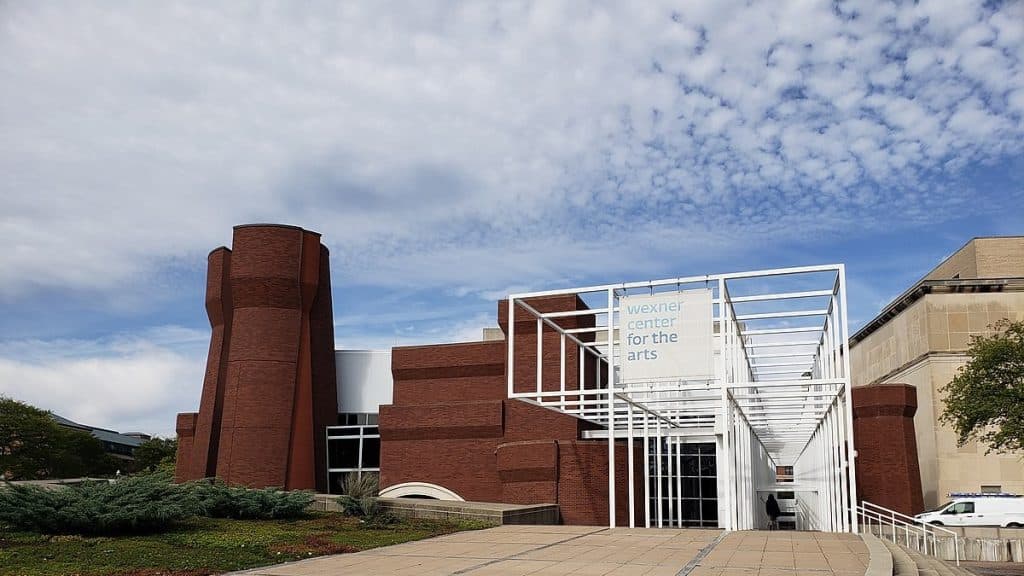
When director Martin Scorsese visited the Wexner Center for the Arts in 1997 to accept the Wexner Prize, he took time out in his speech to call attention to the uniqueness of the museum, recognizing how it enabled film to live under the same roof and on equal footing with visual art, dance, theater, and music.
“I can’t stress how essential it is that a place like the Wexner Center, which exists in the middle of the country, away from these supposed cultural centers, is here to give people an opportunity to study films and to see them in the context of the other arts,” Scorsese said. “And believe me, that’s rare enough. Even in New York, you can’t find these theaters anymore.”
But recent developments have raised concerns that Ohio State University plans for a new gateway connecting High Street to the Thompson Library could lead to the razing of the Wexner Center’s film theater, unraveling the mission on which the Wex has long operated and irrevocably altering the city’s cultural landscape in the process.
A donation powers the future of local, independent news in Columbus.
Support Matter News
At a March 4 meeting, the Board of Trustees approved $2.3 million to design a “revitalized gateway to campus” at 15th Avenue and High Street, with The Columbus Dispatch reporting the plans for a new plaza would “provide a seamless pedestrian connection from East of High Street to Thompson Library.”
The same day the Trustees approved the funding for the gateway design, David Filipi, the Wexner Center director of film/video, attended a meeting where he said he was told that if the new project were executed as planned, “it would mean the theater would be demolished.”
“And that would really run counter to the mission and the original mandate of the place, that all of the arts would be under one roof,” Filipi said. “It’s hard to describe it but being in an environment where all of those things can bounce off each other, it just brings a different energy. … There are so many times when people come for an artist’s talk, and then they leave the talk and they go into the galleries to see the exhibition. Or they hear an author read, and then they walk 20 feet to the [author] signing in the bookstore. And sometimes – and these are my favorite nights at the Center – there will be a performing arts event happening up the ramp at the black box, and a film is going on at the same time, and the galleries are open. And sometimes the events will end at the same time, and you’ll see all these people in the lobby together, and it’s just like, ‘There’s nowhere else in Columbus like this.’”
“And that’s what it should be,” said Cleveland cartoonist and Ohio State alumnus Derf Backderf, who in 2017 premiered the film adaptation of his graphic novel My Friend Dahmer at the Wex, in addition to taking part in multiple readings and book launches at the museum over the years. “Arts is interactive and cross-pollinating, and Dave in particular does a great job with that, pulling in the Billy [Ireland Cartoon Library & Museum], pulling in whatever art exhibit is going on, and setting up complementary programs. That’s why I was just there speaking, because it was the complement to another exhibit.”
In response to a request for comment related to the gateway design and the potential razing of the film theater, OSU spokesman Ben Johnson expressed the university’s commitment to the Wexner Center, writing that the transformation of 15th Avenue and High Street into a central hub and main entrance to the university would position the facility “as a centerpiece of campus and the surrounding neighborhood.”
“Regarding your specific question about film, the university board of trustees has approved professional services, including portions of the design, engineering and construction management work,” Johnson continued. “This planning work will further inform the full scope of the project. Construction will require future board approval, and the Wexner Center for the Arts will remain engaged with the project team throughout the planning process.”
These vague assurances have done little to quell concerns, particularly among those within the film community both in Columbus and across the United States.
“It’s not a hyperbole to say the Wex film program is a jewel, and people all over the world know it,” said the filmmaker Sam Green (“The Weather Underground,” “32 Sounds”), who has a relationship with the Wexner Center that extends back more than three decades. “The film program is this delicate organism that’s been nurtured over the years. And it’s tied to the building and the people, and you can’t just move it somewhere and have it be the same thing. It’s like a plant. And you can’t just pull a plant up by the roots, put it somewhere else, and say that it’s fine. … Institutions are delicate. You can’t just tear them up and transplant them and expect them to thrive.”
Those interviewed cited numerous pitfalls related to the potential loss of the theater, including: the negative impact on the Wexner Center’s film programming; future limitations on archival screenings, which often require specialized equipment and accommodations for which the Wex theater is uniquely equipped as currently constructed; the related reputational harm within the larger film and art worlds; the architectural damage that would be done by altering the Peter Eisenman-designed building, described by OSU professor of architecture Todd Gannon as “the most significant building to the discourse of contemporary architecture on Ohio State’s campus”; and the reverberations from the razing of the multi-use space that could ripple into unexpected corners of the school.
“That auditorium and the collaborative programming the Wex has done with faculty across the university has been crucial to the intellectual life of [Ohio State],” said Lisa Florman, professor of art history and vice provost for the arts, who attributed her decision to come to OSU to the presence of the Wexner Center. “And I’ve had that same discussion with dozens of faculty members who said it was the same for them. … I’m hoping the university can revisit [its] decision and take into account the multiple negative consequences.”
Roger Beebe, a filmmaker and the interim chair in the OSU Department of Art, said he participated in early conversations centered on the university’s grand plans for a new Arts District, to be done in phases and including the construction of the Timashev Family Music Building, completed in March 2022, and a new Theatre, Film and Media Arts Building, formally dedicated in April 2024. “And then the next phase … involved those sight lines [down 15th Avenue] from High Street to the Oval,” said Beebe, who recalled early proposals being discussed that would have included a new theater wrapped around the rear of Mershon Auditorium, among other potential designs. “And I don’t know if those [plans] were ever real or if they were just done so people wouldn’t lose their minds, but now people are justifiably losing their minds.”
In early April, the Wexner Center hosted the Orphan Film Symposium, an annual gathering organized by New York University that brings together international archivists, filmmakers, and scholars to view and discuss neglected works from across film history. The screening of this archival material in some cases required equipment and accommodations that no other venue in the city could provide, Filipi said, and exists as just one example of how programming could be impacted if the theater ceased to exist in its current form.
“Most of the time, if you’re getting an archival film print, whether it’s from a studio or from an archive like UCLA or the Library of Congress, there are stipulations that go along with it. And those can vary from place to place, but they might include a temperature-controlled booth, or a booth that only limited people have access to,” said Filipi, who also noted more technical requirements such as the need for dual projectors to help preserve the fragile prints. “Most normal theaters that can show 35-milimeter film usually do it on a platter, which means you build the whole film up into one big reel, and then it kind of rewinds itself onto this big platter. And that’s really hard on the print, and so most archives don’t allow their prints to be shown that way.”
Owing in part to this, Filipi dismissed the alternatives he said had surfaced in recent conversations, where it was floated that the Wex could host film screenings at either the Ohio Union or the Gateway Film Center – venues that were similarly brushed aside by the Columbus filmmaker Ruun Nuur. “And nothing against Gateway, which is its own institution with its own incredible programming,” Nuur said. “But the Wex is its own facility with its own technical abilities. It’s a dedicated space for film and discourse to happen, and you can’t replicate that in other places, point blank. … The Wexner Center for the Arts and the film and video program are a calling card for Columbus, Ohio. And that’s a cache that a lot of these other institutions, both domestic and international, want. And it’s something the Wex already has.”
Filmmakers Nuur and Green credited aspects of their careers to the existence of the Wexner Center and its film program, which assisted Green in the production of his debut short, “The Rainbow Man,” from 1997, by granting him an artist residency.
“And in the studio space, there was this wall of Polaroid photos they took of everyone who came and did a residency, and it’s this incredible who’s who of independent cinema, where it’s like, ‘Wow, that’s Kelly Reichardt. That’s Guy Madden,’” Green said. “And that’s in the DNA of the Wex. … They are able to bring in world-class filmmakers because they’ve known them for years. And I feel honored to be a part of that, and I would come to Columbus at the drop of the hat to do a screening, because I know and love the Wex. And I would certainly be less eager to come and do a screening at the Gateway Film Center, because that would feel like a demotion. Part of the magic of the Wex is that it’s all under one roof. … The theater is in the same place as the museum galleries, and that structure implicitly says that cinema is on the same level as fine arts, which is not always the case.”
Multiple people interviewed also raised concerns related to the architectural harm that could be done in demolishing the theater, with OSU professor Gannon sharing how he routinely takes students from the university’s architecture program on detailed tours of the Eisenman-created building, which he said purposely subverts and upends more conventional approaches to museum design.
“If you go to the Louvre in Paris, for instance, you go through this ceremonial entrance and up a grand staircase, and at the top of that staircase you meet the Winged Victory of Samothrace on a pedestal. And the whole sequence is set up to compel you to agree with the significance of [the statue] and to accept it as this monument,” Gannon said. “And when you go to the Wexner Center, rather than finding a grand entrance, you get a door that sort of melts into the grid of the facade. … And when you get in that door, you go down rather than up. And when you get into the gallery, you’re in a space that can, at times, feel in competition with the work on display. … And, quite frankly, that complexity, to me, seems absolutely appropriate for a university where we invite young people to spend four years learning how to pay attention carefully, critically to the world around them.”
Gannon allowed that he is not sacrosanct about architecture, acknowledging the need for buildings to evolve and change over time. “I’m not advocating for the idea that the Wexner Center be preserved in exactly the state Peter put it in in 1989,” Gannon said, but rather that any changes be done thoughtfully and with an awareness of maintaining those aspects that make both the building and the programming housed within it unique. “There’s no shortage of disciplinary intelligence that could be deployed, and I just hope the university is willing to hear from some of those voices, and to make sure the complexities of that site … aren’t pushed aside for something easily consumable, easily ignored, and which ultimately makes the campus a less interesting, less challenging, less intellectually charged environment.”
In recent months, both Wexner Center for the Arts and Ohio State University have experienced the departure of leaders amid extenuating circumstances. Former executive director Gaëtane Verna resigned from the Wexner Center in October, her announcement coming just two months after more than a dozen workers signed a letter sent to university officials in which they expressed a vote of no confidence in Verna’s leadership. And in March, Ted Carter resigned as president at Ohio State following an investigation into his inappropriate relationship with a podcaster, the full report from which was released by the university on Tuesday.
Multiple people interviewed expressed hope that these departures could lead to current proposals for the university gateway to be revisited by new leadership, with Filipi recalling his attendance last summer at one of the first public speeches given by new OSU president Ravi Bellamkonda, then serving as provost, where he spoke about his “three pillars for academic excellence.”
“And one of them was to create singular student experiences, and that really stuck with me,” Filipi said. “And I’m not sure how a nicer walkway does that at the expense of an almost one-of-a-kind film theater and space for art.”
Backderf puts it even more bluntly. “The [film] space at the Wex is not something that should be taken for granted,” he said. “And it isn’t something that should be thrown away just to make a new driveway.”
Author
Related Articles
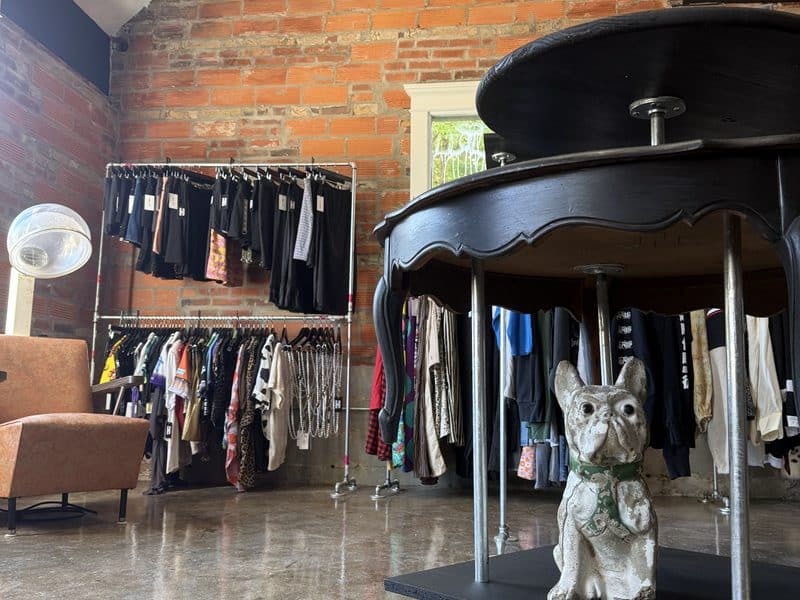
Ripped to Shreds is ready to hit the runway
The new resale shop, created in partnership between artist and musician Courtney L. Hall and Used Kids owner Greg Hall (no relation), will celebrate its grand opening on Sunday, Oct. 11.
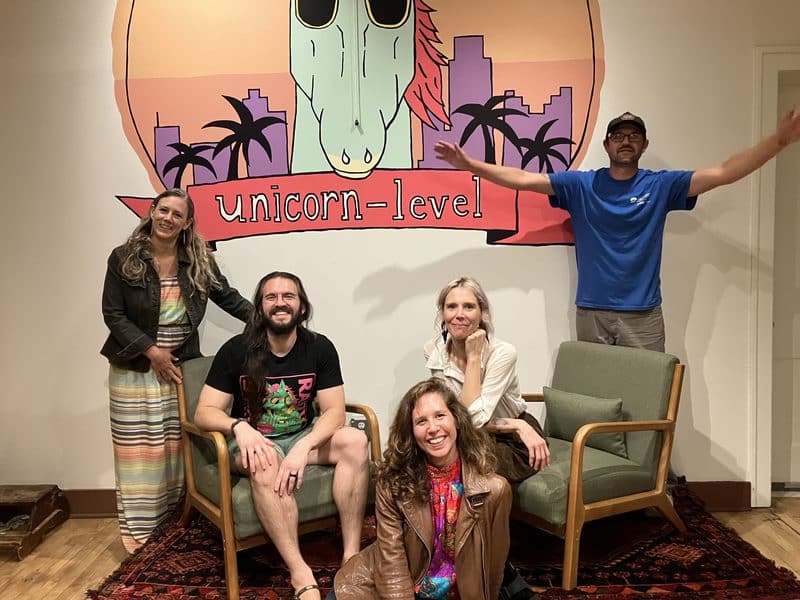
Two Dollar Radio HQ reopens with an expanded ownership group and a similarly expanded vision for the future
‘I think a big part from opening was to give authorship of the space to people with good ideas, to open the doors to people to try different things.’
An Ohio school needs funds. It voted to cut Anduril’s tax bill, anyway
How a factory for AI-powered weapons, a data center, and a needy public school collided in rural Ohio.