
The Worker’s View: The Parable Coffee debacle comes full circle with Palomino
Are pop-ups the future of Columbus’ service industry? Former Parable employees think so.
Four years ago, Brian Dages uprooted his life in California and moved back home to Ohio to work for Parable Coffee.
A community-centered, socialist coffee shop that pays a livable wage and where every employee’s voice matters? Count this barista in.
“The most striking thing to me [about Parable] was working as a collective, sitting down and making decisions about the business together,” Dages said. “Not ownership making these sort of authoritarian decisions.”
A donation powers the future of local, independent news in Columbus.
Support Matter News
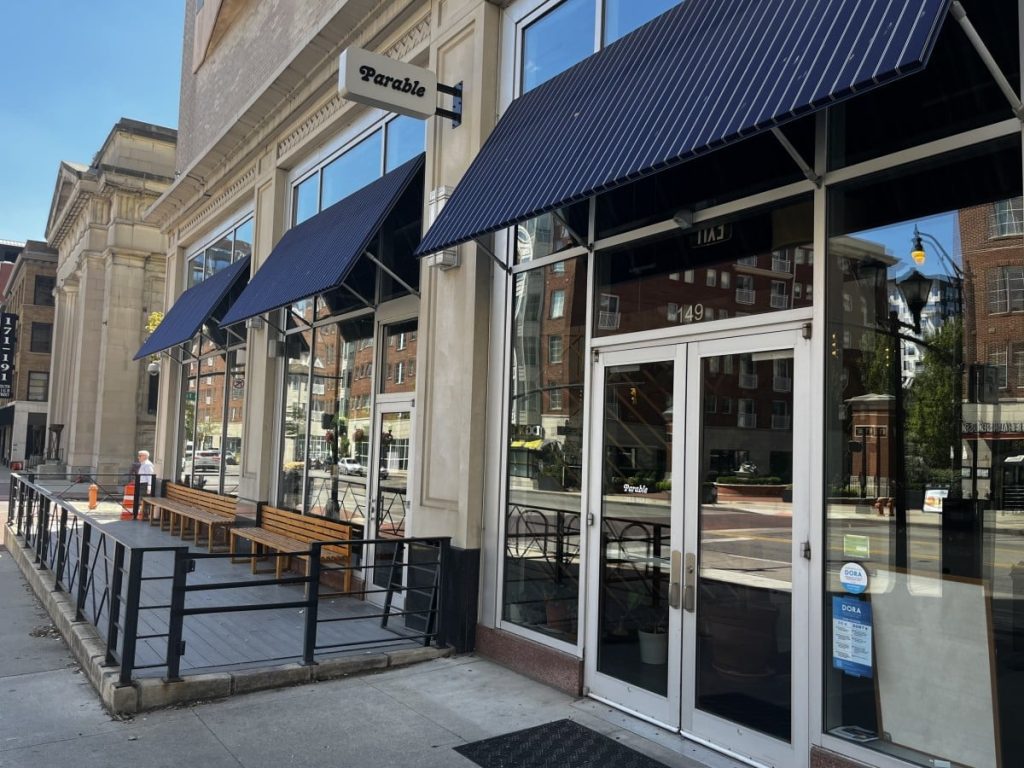
Parable, which debuted with a gratuity-free financial model paired with a “pay as you go” program for customers, started with a handful of employees manning a pop-up shop inside Comune on Parsons Avenue in 2020 and quickly became a much-adored anchor of the community. But after transferring to a brick-and-mortar storefront downtown in 2022, Dages said the shop’s owners – co-founders Benjamin Willis and Jeffrey Clark, plus majority-owner and venture capitalist Ron Reynolds – outgrew consensus and management no longer deferred to its employees.
Parable operated for three more years until Willis, who did not respond to a request for comment, informed his staff there was no money last summer, and left them collectively with roughly $37,000 in unpaid wages, Dages said.
Devastated but determined, neither Dages nor his fellow barista, Marco Colmenares Aguilar, wanted to work for corporate coffee companies in the city.
Colmenares Aguilar recalled thinking, “Well, what if I just get a pop-up going?”
The 29-year-old started at Parable back when it was essentially a lemonade stand inside Comune. He was convinced there was still an appetite in Columbus for the high-quality lattes and service his former workplace was meant to represent. Plus, Dages had an espresso machine and a background in roasting.
And both had a place in mind: The Bottle Shop.
Blast from pop-up past
When Dages joined Parable in 2022, Nan Meece had just quit The Bottle Shop.
Previous owners of the cocktail bar and market in the University District, Barbara Reynolds and German Vasquez, fired their bar manager, Brock Kalbfleisch, and Meece and five other employees quit in solidarity.
The wayward staff formed the “Walkout Collective,” an eight-member collaboration that hosted pop-up cocktail events across the city, The Columbus Dispatch reported. Later, Meece joined Parable’s ranks as a general manager when the coffee shop expanded to include bar service. A few months later, Reynolds and Vasquez sold The Bottle Shop to Greg Stokes, who recently renamed it Cordial.
Fast-forward several years, and now Dages and Colmenares Aguilar operate their coffee pop-up, Palomino, inside Cordial from 8 a.m. to 2 p.m. Wednesday through Saturday.
“It’s quite literally full circle,” said Meece. “Our friends who once housed us are now being housed at the place we walked out of. This whole last five years is just an example of the way this town, this industry works. … People who are really good at their craft and deserve a space will make that space.”
Both Dages and Colmenares Aguilar knew the story about The Bottle Shop’s previous owners and said they saw the irony in that cycle continuing with Parable’s owners.
“To see this happen again at Parable was crazy and emblematic of the service industry’s problems,” Dages said.
But both agreed that since Stokes took over, the space was theirs to reclaim.
“It sort of reopened that door for us to say, ‘Yes, this is kind of a strange coincidence to go back into this space where our friends were exiled – before we were all exiled together – but I think that Greg has a done a great job of getting out that bad juju,” Dages said.
Parables from Parable
When Dages was hired at Parable in 2022, owners Willis and Clark still gave their staff a voice in hiring decisions.
But that quickly changed as the coffee shop grew in popularity and Willis and Clark rented a storefront inside the Lazarus building on High Street. Soon after, Reynolds, the New York-based venture capitalist investor, noticed Parable’s popularity in the community, Dages said.
Dages, Colmenares Aguilar and Meece said they did not know all of the details at the time, but Willis and Clark were struggling to keep up with rising rent payments.
“Essentially it got complicated when the business was growing,” Dages said. “The landlords really had a lot of leverage over how Parable was operating … I think because our lease … wasn’t a fixed rate. It was based on how much money Parable made.”
County records show the RiverSouth Development Authority owns the storefront Parable used to rent, which is managed by Downtown Columbus Inc. (formerly known as the Columbus Downtown Development Cooperation), a nonprofit established in 2002 to revitalize the city.
Eventually Willis and Clark sold 51 percent ownership of the company to Reynolds, the former employees said.
That’s when the idealism quickly spun out of reach, Dages said. “Parable sort of became gentrified,” he continued. “It just became such a cool spot and hip spot to be and by that nature the dollar signs started ringing up in the suits’ minds.”
So, how do they stop the same cycle from impacting Palomino?
Meece, an 18-year industry veteran, is torn.
“You caught me at a time where I sometimes think we’re so ingrained in … capitalism, you know, the only way to change it is to go full anarchy: Burn it down and try and rebuild it,” she said, and laughed.
What keeps her feeling optimistic, Meece said, is the innovative way businesses like Palomino are adapting, similar to how Parable began.
“I think I wanna see more of businesses lending space to other businesses during their off hours,” she said. “Anyway you can piggyback in the service industry, or help out the next person coming out behind you, is the only way this works.”
Colmenares Aguilar and Dages are just grateful to have autonomy over their craft for now.
“We don’t answer to anyone but ourselves and the people we’re serving,” Dages said. “I think that sort of puts a little bow on [the last five years].”
Related Articles
An Ohio school needs funds. It voted to cut Anduril’s tax bill, anyway
How a factory for AI-powered weapons, a data center, and a needy public school collided in rural Ohio.

Flock is on pause. What about all that other surveillance tech we use?
Columbus has had a contract with Shotspotter, an AI-powered gunshot detection microphone system, since 2018.

If you start from a place of love, you can’t go wrong
A vigil for an unhoused community member who recently died in Newark served as a call to not look away.