
Opinion: Columbus’ Flock debate is not facts versus feelings
Residents did not speak at a City Council hearing this week merely to express discomfort with new technology. They presented an evidence-based argument that the current system is inadequately governed, vulnerable to abuse, and capable of uses far beyond the narrow public-safety examples emphasized by its defenders.
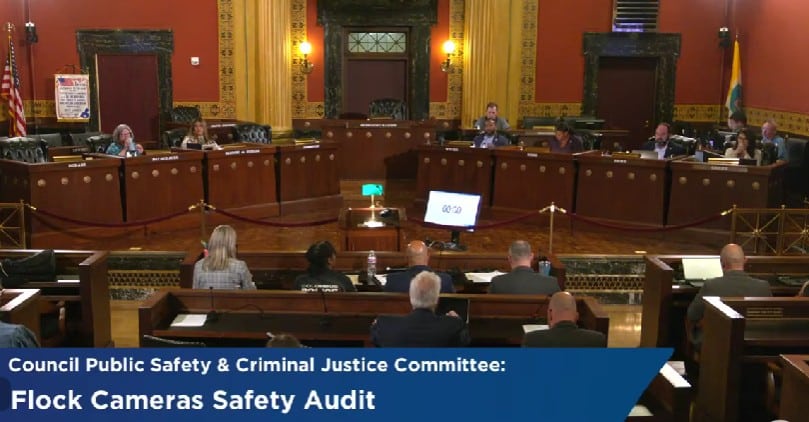
On Monday, I spent more than five hours waiting to testify at Columbus City Council’s public hearing on Flock license-plate cameras. I was the 48th speaker called. By the time the hearing ended, nearly six hours after it began, the public had expressed something approaching a consensus: of the 55 registered speakers, only five supported keeping the cameras, with three of those five qualifying their support by calling for stronger regulation and oversight. Matter News reported those numbers directly. WOSU described public comment as “overwhelmingly in favor of the complete removal of the cameras.” Axios called the feedback “overwhelmingly negative.”
Yet some local coverage has described Council as hearing “mixed views,” presenting the hearing as a relatively conventional debate between supporters who emphasized public safety and opponents that raised privacy concerns. WSYX used precisely that framing in its headline.
Technically, there were mixed views. Five is not zero. But journalism should communicate proportion as well as existence. Describing a hearing where roughly nine out of ten public speakers opposed the cameras simply as “mixed views” is like describing a 90-10 election result as evidence that voters supported both candidates. It is literally true and substantively misleading. More importantly, this framing obscures what opponents actually argued.
A donation powers the future of local, independent news in Columbus.
Support Matter News
A recurring structure in coverage of police surveillance looks something like this: Police provide facts, while critics provide concerns. Police say Flock helped solve homicides, recover vehicles, locate missing children, or produce investigative leads. Critics, meanwhile, are described as “passionate,” “worried about privacy,” or fearful that the technology could someday be abused.
The difference in language matters. When officials “demonstrate effectiveness” while residents “express fears,” the reader is subtly told which side possesses knowledge. When the government is presented as pragmatic and opponents as passionate, the dispute becomes one between expertise and emotion rather than between competing interpretations of evidence.
Police provide facts. The public provides feelings.
That is not what happened Monday.
Opponents did not simply argue that surveillance feels intrusive. They challenged the factual claims used to justify Flock, the way police described the technology, and whether Columbus currently has the capacity to regulate it responsibly.
Consider the claim that Flock helps solve homicides. Police repeatedly cited the technology’s role in homicide investigations as evidence that Columbus needs it. That is relevant. But saying Flock “aided” an investigation does not tell us its actual contribution. Was an ALPR hit indispensable to identifying or apprehending a suspect? Was it one lead among several? Would the case otherwise have gone unsolved? An empirical claim does not cease to be a claim because it comes from a police official.
The same problem appeared when police discussed nationwide data sharing. CPD cited a case in which losing access to the national Flock network made an investigation more difficult. But police also acknowledged that they ultimately found the suspect through other means. That does not prove nationwide access has no value. It does mean that the relevant question is not whether broader access can make police work easier. It is whether that additional investigative convenience justifies access to a nationwide movement database. That question largely went unanswered.
Police also gave Council a narrow description of what Columbus’ Falcon cameras collect. CPD emphasized license plates and denied that the system tracks additional vehicle characteristics. Flock’s own description of its product says otherwise. The company advertises the ability to search vehicles by characteristics including make, model, color, and other distinguishing features. Flock itself rejects the claim that its cameras capture “only” license plates. That contradiction deserved scrutiny on its own.
It became more important when Police Chief Elaine Bryant cited missing people, including people with dementia and autistic children who wander from home, as examples of Flock’s value. There may be a straightforward explanation. Police may have identified a vehicle associated with a missing person or with someone traveling with them. If so, that should be explained. But if Columbus describes Falcon as a narrowly limited vehicle-identification system, then it is reasonable to ask exactly what the system contributed to finding a person who was outside of a vehicle. A compelling story about finding a missing child is not a substitute for explaining what role the technology actually plays.
The hearing exposed similar problems with the argument that better “guardrails” can resolve concerns about abuse. The deputy police chief repeatedly emphasized the “human element” when discussing vulnerability to misuse. Human misuse is certainly real. A former Reynoldsburg officer is accused of searching a license plate associated with a former romantic partner 46 times. But human misconduct is not the only vulnerability. Critics cited documented plate-reading errors, cybersecurity problems, and weaknesses in the broader Flock system. Treating misuse primarily as a problem of individual officers also sidesteps the more basic question of whether the system itself makes abuse too easy.
When Council members pressed police on how misuse would be prevented, detected, and punished, several answers amounted to either “I don’t know” or “we are still figuring that out.” Police acknowledged that misuse is largely discovered after the fact and that they are still considering ways to identify it proactively. An audit log may tell us that someone searched a former partner’s movements dozens of times. It does not stop the searches from happening. There is also no clearly defined, Flock-specific punishment that automatically follows an improper search.
The same problem appears in claims that Columbus can prevent immigration use simply by restricting what CPD officers themselves are allowed to do. Speakers documented that other law-enforcement agencies with access to Columbus data cooperate with federal immigration authorities. The Licking County Sheriff’s Office, for example, had access to Columbus Flock data while its deputies were cooperating with ICE. Homeland Security Investigations also had direct access to Columbus’s Flock network. That means a rule telling Columbus police not to conduct immigration enforcement does not necessarily prevent Columbus-generated data from reaching agencies that do.
This is not a hypothetical “privacy concern.” It is a question about the architecture of the system and whether the city can actually control the information it collects once access is extended beyond CPD.
Councilmember Lourdes Barroso de Padilla raised a related issue while questioning Flock’s representative. She described Flock as an amoral company: It sells the technology but does not itself decide what uses are morally acceptable. The representative did not dispute that basic characterization. His answer emphasized that cities and states establish their own rules governing access and use.That places responsibility squarely back on Columbus.
Flock is a private company selling surveillance technology for profit. Flock’s CEO has gone so far as to call critics terrorists. A private company cannot substitute for democratic governance. If the company leaves decisions about acceptable use to its government customers, then Columbus needs a clear answer to a basic question before continuing deployment. What prevents the technology from being used in ways the public has decided are unacceptable? Monday’s hearing showed that the city does not yet have a convincing answer.
These were not expressions of anxiety competing with police evidence. They were challenges to the evidence and assumptions underlying the police case itself. The same evidentiary standard should apply to everyone.
When police say Flock helped solve a homicide, ask what “helped” means. When officials say guardrails prevent abuse, ask what actually prevents an improper search before it happens. When Columbus says its officers cannot use Flock for immigration enforcement, ask who else can access Columbus data and what those agencies and departments do with it. And when dozens of residents present audits, documented abuses, technical vulnerabilities, legal liabilities, court decisions, and concrete examples of loopholes in city policy, do not reduce their case to “privacy concerns.”
This matters particularly now because Councilmember Emmanuel Remy had already expressed reluctance before Monday’s hearing to eliminate ALPRs altogether and indicated that Columbus could consider another vendor if Flock itself proved unacceptable. Many residents who testified Monday were making a different argument: not which company should operate Columbus’s ALPR network, but whether the city should maintain an all-encompassing and unaccountable automated mass surveillance dragnet at all. If that argument is remembered only as one side’s “concerns,” Council can say it listened while leaving the basic policy framework (or lack thereof) untouched: retain ALPRs, perhaps change vendors, and maybe modify the rules.
Columbus residents did not come to Council on Monday merely to express discomfort with new technology. They presented an evidence-based argument that the current system is inadequately governed, vulnerable to abuse, and capable of uses far beyond the narrow public-safety examples emphasized by its defenders.
None of this requires the media to agree with Flock’s opponents or to minimize crimes solved, missing people found, or testimony from residents who support the cameras. It requires something more basic: Describe the testimony proportionately. Scrutinize official claims as claims. And when ordinary residents present audits, documented abuses, legal arguments, court decisions, and technical evidence, treat that material as evidence rather than translating it into emotion.
Columbus residents spent nearly six hours telling their elected representatives why they believe these cameras should go. The public deserves more than an assurance that its concerns were heard. It deserves answers to its arguments.
Related Articles

Opinion: Trifectas are only good for racing and the lottery
The legacy of Ohio’s Republican Party is corruption, scandal, and culture wars. Our votes could put an end to their occupation of state government.

If you start from a place of love, you can’t go wrong
A vigil for an unhoused community member who recently died in Newark served as a call to not look away.

On Development: Rapid-transit is moving slowly. Maybe we need a new model
Our policies suggest a willingness to spend any amount to add lanes and bigger (towering!) interchanges for major highways, while transit spending is too often regarded as frivolous.