
Prison finds freedom in sprawling psych-rock jams
The New York band’s current tour hits Rich Street Records on Saturday, Aug. 15.
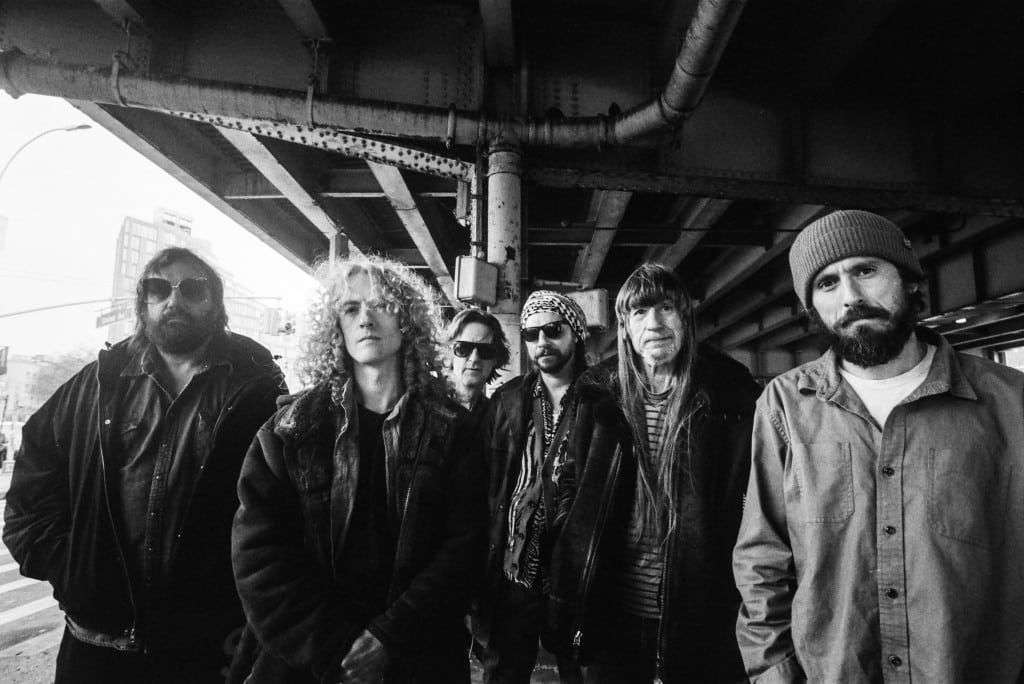
When Matt Lilly started jamming with friends in the 2010s, he had no intention of being in a band, tracing the genesis of Prison to a request made by Dom Boero, then the owner and general manager of Rippers in Rockaway Beach, New York.
“He heard about me jamming with Sarim [Al-Rawi] … and asked us to play a show there,” Lilly said by phone in early August. “And we were like, ‘But we don’t have a band name. We’re not a band. We don’t play songs. There are no vocals. We’re just stoners jamming.’ And Dom was like, ‘That’s cool. Just come do it anyway.’”
Then playing as a trio with Lilly on drums, Al-Rawi on bass, and Mike Bones on guitar, the three quickly settled on a band name, Prison, and created a logo by cribbing one from the hair metal band Poison and swapping an “r” for the first “o.” A second show followed with guitarist Paul Major joining the fold, establishing a transient dynamic that continues to this day, with players entering and exiting the group based on circumstance and availability.
A donation powers the future of local, independent news in Columbus.
Support Matter News
For the band’s current tour, which hits Rich Street Records with Pink Reason on Saturday, Aug. 15, Lilly will be joined by Al-Rawi and Major (both on guitar and vocals) and Matt Leibowitz (bass and synths), the lineup restricted in part by the Toyota Sienna in which the musicians travel. “Unlike other bands that have 15-passenger vans, we just have a little soccer mom van that we squeeze four guys into,” Lilly said, and laughed.
Over the course of our 45-minute conversation, Lilly checked off a handful of the musicians who have jammed with the group in the past, including Mike Fellows (Rites of Spring, Silver Jews), the late Doug Shaw (High Life, Gang Gang Dance), and the late Sam Jayne (Love and Laughter), the latter two of whom Lilly continues to carry with him into every show.
“We’ll always have them with us, and I think of them both every time that we play,” he said. “And I play my heart out as if it’s my last time playing, because I’ve lost these friends, and it’s a reminder of my own mortality. You never know when you’re going to go, you included Andy. And that doesn’t mean you have to live every day like it’s your last. In fact, that’s probably not the healthiest way of living. … But if you’re playing a show, you might as well play it as if it’s the last time you’ll ever get to play with this lineup of people.”
This urgency is reflected in the band’s music, a strung-out, sprawling tangle of psychedelia, punk rock, and garage boogie that reaches a visceral crescendo on Prison’s excellent new LP, Big Rigs on the BQE, released in late July via Drag City. Comprised of a pair of epic jams, “Sunrise Highway” and “Sunset Park,” that clock in collectively at a shade over 41 minutes, the record plays as the ideal accompaniment to an extended highway drive, the latter track building from patient guitars that echo open desert vistas to a chaotic bluesy squall that captures the tension of navigating stop-and-go traffic.
Of course, the album serves only as a snapshot of a moment in time, with the musicians mutating, altering, and otherwise evolving the songs with each performance, Lilly describing the band’s shows as “an experiment” influenced by everything down to the room itself. “It’s seeing what happens when we put these four people in front of this audience in this town and this venue that we’ve never played before,” he said. “All of these variables are in play that will affect the outcome. … We never know what to expect because everything’s entirely improvised. And that sounds like it might be a little too loose, and that it couldn’t possibly work. But we’ve been playing with one another on the regular for more than 10 years, and it’s become like each member is an extension of the other members.”
Lilly then went on to detail the intuition with which the players approach each concert, describing their onstage interactions as an ongoing dance of listening and responding that necessitates the ability to pivot in the moment. “A lot of times, the most magical moment in a jam will happen in the recovery from some sort of folly,” he said. “And if somebody slips up, or God forbid I drop a drumstick or something, then we’ll just kind of roll with it. … We can’t be so attached to things like perfection, because improvisation is all about imperfection, and you can thrive within that if you just allow yourself to.”
For the drummer, these performances have always served as a means of personal catharsis, allowing him the space to sweat out tensions, work through fears, or to revel in a communal spirt. Increasingly, however, he has also come to embrace a more outward perspective, seeing both his visual art and Prison’s music as a way to spread joy, love, and encouragement.
“And if we can pull that off, I’m stoked,” said Lilly, who expressed a sense of wonder at the avenues that music has opened for him. “It’s really surreal and kind of mind-blowing. … I’m just a dude from the Midwest who grew up skateboarding and loving music, and now here we are, where three years ago we opened for Pavement in Brooklyn. It’s just like, what the fuck? … We’re just a bonehead jam band from New York. How did any of this happen?”
Author
Related Articles
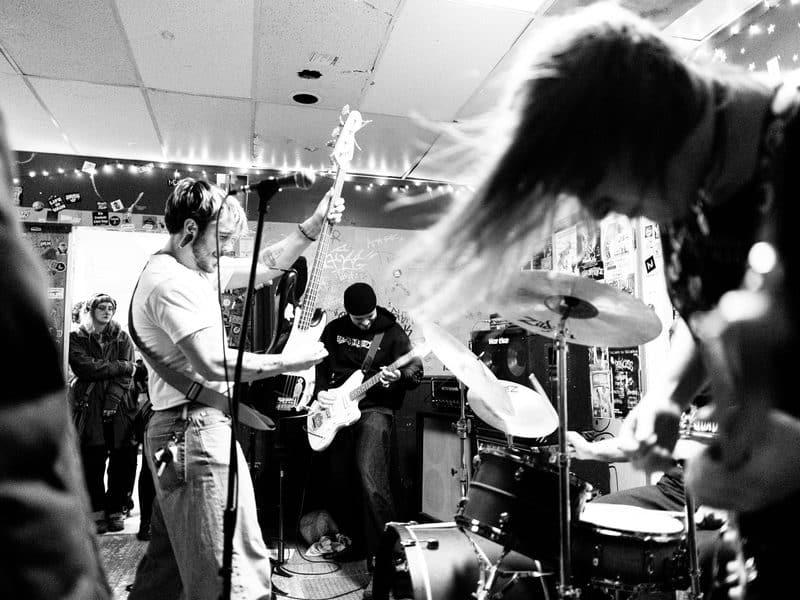
Kill Gosling rediscovers its joy on the way to ‘Super Plume’
The Columbus rock band will celebrate the release of its excellent new album in concert at Cafe Bourbon Street on Saturday, Sept. 26.
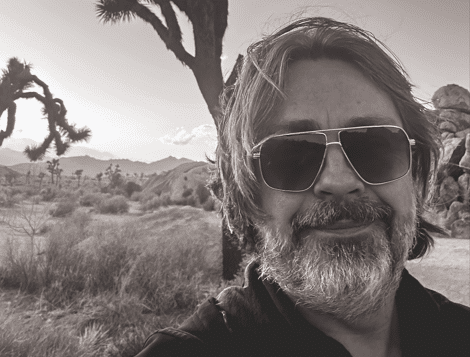
Keith Hanlon takes advantage of an unexpected layover to create ‘Music for Airport Workers’
The Columbus musician will celebrate the release of his new ambient album in concert at Old First Presbyterian Church on Friday, Sept. 25.
‘Obviously, we make songs for the sad folks’: BeachKitty gears up for 934 Fest
Ahead of the release of new album ‘Cool Breeze,’ the shoegaze-indebted Columbus band, led by songwriting duo Milly May and Keano Smith, will feature at the annual art and music festival on Saturday, Sept. 12.