
‘There’s no going back’: Inside the Freedom Flotilla Coalition’s latest humanitarian venture
‘We never assumed we wouldn’t make it,’ said Ohio University professor Tom Hayes, who returned to Columbus this week after being detained by Israeli forces on Oct. 8 following an attempt to deliver medical supplies to Gaza. ‘I think all of us wanted the mission to succeed.’
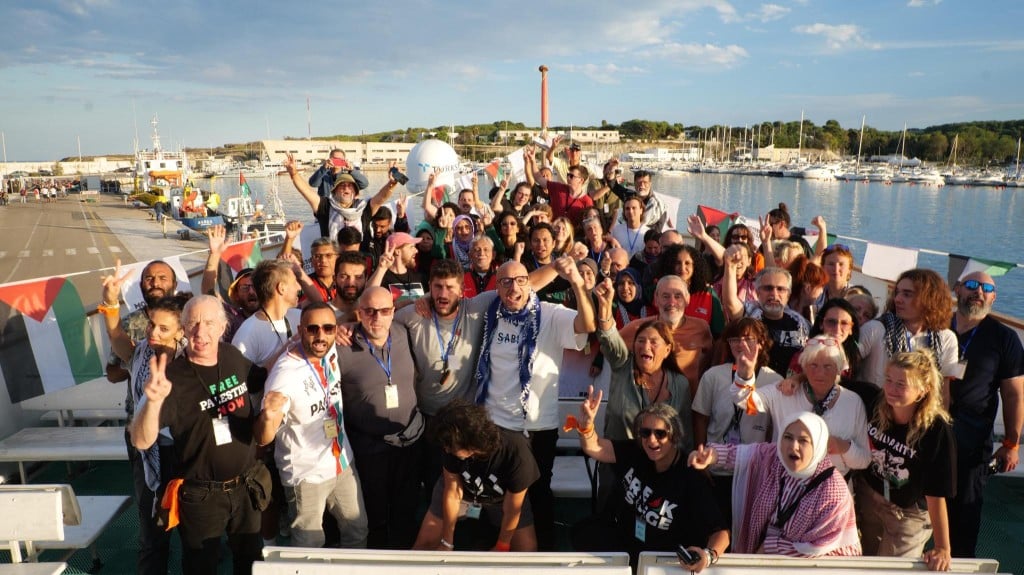
Tom Hayes received word on Sept. 24 that to take part in the next humanitarian mission to Gaza being attempted by the Freedom Flotilla Coalition, he would need to be in Italy two days later, with plans to set sail for the besieged region from the port city of Taranto on Sept. 26.
“I’ve been going back and forth [to Gaza] since ’83, so it’s not a political issue for me,” said the Columbus-based Hayes, an Ohio University associate professor and filmmaker who has made a trilogy of documentaries centered on Palestine, all of which are available to view free on YouTube. “What then must we do is this scrawl that runs across my skull constantly. What then must we do. So, having the chance to do anything substantive, I didn’t need time to adjust. I was ready. I wanted on that boat.”
Hayes previously traveled to Istanbul in 2024 planning to take part in a flotilla aimed at raising awareness of the Palestinian children killed by Israel in the ongoing genocide. But when the vessel on which he was supposed to travel, the Handala, was grounded by authorities in port, Hayes returned to Ohio. This time around, Hayes joined 10 crew members and 82 doctors and journalists aboard the ship the Conscience, setting out from the Italian port city with the aim of opening a maritime humanitarian corridor to deliver medical aid to the people of Gaza, including roughly $110,000 of antibiotics, pain killers, and other medical supplies stowed in the ship’s hold.
A donation powers the future of local, independent news in Columbus.
Support Matter News
“I think everybody on board tried to manifest success,” said Hayes, who entered into the venture with an understanding that the ship would likely be boarded and seized by Israel Defense Forces (IDF). “The medical personnel [in Gaza] have been decimated and murdered en masse, and we had a couple dozen people – doctors and nurses – who could step in upon arrival. … We never assumed we wouldn’t make it. I think all of us wanted the mission to succeed.”
Hayes described the vibe on the ship as communal, recalling the hours he spent teaching a handful of shipmates a pair of Civil Rights-era songs: “This Little Light of Mine” and “Ain’t Gonna Let Nobody Turn Me Around.” And despite 22 nationalities being represented on board, Hayes said the group operated in communal spirit, whether preparing meals or filling the quiet hours with urgent conversation. “In this gig, you’re with a community of people whose nerves are outside of their bodies,” he said. “They really care, and you’re grounded by this wonderful group of human beings.”
There was also, admittedly, a fair amount of apprehension – “We’re rolling up on an army that’s committing a genocide,” Hayes said – which spiked during daily drills in which the group rehearsed being boarded by the IDF. In these practices, the shipmates would gather their belongings at the sound of the alarm, quickly dress in warm clothes and life jackets, and move to their predetermined positions on the stern, assuming a pose in which their hands remained visible at all times. The shipmates would then begin their chant: “We are journalists. We are medics. We are journalists. We are medics.”
“We weren’t going to allow them to create a propaganda moment for themselves when they swung aboard, so we were ready, we were practiced,” said Hayes, who noted that nonviolence training was a prerequisite for everyone who traveled aboard the Conscience.
Going in, there was an expectation the group would receive a roughly 45-minute warning via radar before being boarded by the IDF – an idea that evaporated when Israeli forces swept in a day earlier than anticipated, triggering an alarm at 4:30 a.m. on Oct. 8 and leaving the shipmates scrambling in their preparations. (“Another futile attempt to breach the legal naval blockade and enter a combat zone ended in nothing,” the Israel Foreign Ministry wrote in a post on X.)
“We were about 150 nautical miles out [from Israel], and we figured we’d be a little closer than that when they hit us,” Hayes said. “So, the act wasn’t as tight as we expected it to be, and we hadn’t gotten through the full muster before they were down on us in their helicopters. … The helicopters were practically knocking us out of our seats on the fantail. But there was no panic. We were tight. We had practiced enough that we were ready for them. Still, it’s another thing when the guys with the machine guns come swinging in.”
Hayes said he has frequently come in contact with IDF soldiers in the making of his documentaries, and the forces that boarded the boat assumed a demeanor familiar to him: officious and menacing. Threats of violence were constant over the course of the 14 hours the flotilla members remained under Israeli control, said Hayes, who was forced by one soldier to strip off and hand over the “Free Palestine Now” T-shirt he wore as IDF soldiers boarded the ship.
Prior to porting in the Israeli city of Ashdod, Hayes said that IDF soldiers separated and zip-tied a half-dozen members from the flotilla, absconding them from view. The rest of the shipmates were sequestered together in the vessel’s dining area, grouped largely by nationality. After reaching port, the group members were led to the gangplank, where Hayes said each was assaulted, forced into a submissive position and marched off the boat one by one. Some of the captives were zip-tied, he said, while others were beaten before being led away. Hayes recounted how soldiers zip-tied and manhandled one member of the flotilla, an Israeli woman named Zohar Regev, tossing her forcefully into the ground after her arms were secured behind her back. “And there was just this collective Jesus Christ from all of us when we saw it,” he said. “And then you know your turn is coming.”
Detained in Israel, Hayes said the group members were forced into a stress position – on their knees, head down – for upwards of 90 minutes. If anyone complained, Hayes said the soldiers would add to the strain. After one shipmate whimpered in pain, Hayes said a soldier zip-tied the man, adding to his discomfort. “And the other thing that was corrosively disturbing is that you had 92 people who are hurting in this holding area,” he said, “and the troops around us are just laughing.”
Gradually, Israeli forces individually processed each member of the flotilla, conducting what Hayes described as a mild strip search and then going through their luggage and disposing of certain belongings. In Hayes’ case, he said soldiers seized all of his T-shirts that mentioned Palestine, his digital recorder, and even his comb. (Hayes joined other shipmates in throwing things like phones and laptops into the water prior to being boarded by IDF.)
An interrogation followed, during which Hayes responded to all of the soldiers’ inquiries by requesting access to an attorney and a United States diplomat. Eventually, an attorney materialized and Hayes signed a request for expedited departure. In a matter of days, he was back on U.S. soil, his plane landing in Columbus in the early evening hours on Sunday, Oct. 12.
When we spoke earlier this week, Hayes said he was still processing the experience, describing the challenge of acclimating to a space that can feel so detached from the horrors he joined in resistance with other passengers of the Conscience to confront. “I always find reentry more difficult than going out,” he said. “It’s all this adrenaline out the door … and then I come back and I expect people to start talking about the next Taylor Swift concert.”
Hayes is also concerned that this week’s highly publicized announcement of a ceasefire between Israel and Hamas might divert global attentions, leaving some thinking that the hard work has been completed at a point in time when existence remains undeniably fragile for millions of Gazans devastated by the genocide.
“One of the stipulations of this ceasefire is 600 trucks a day in aid, which is roughly what was coming into Gaza prior to the start of the genocide,” Hayes said. “And the thing is, 80 percent of the housing stock has been demolished or damaged. The medical infrastructure has been obliterated. The drinking water infrastructure is obliterated. The electrical infrastructure is obliterated. So, 600 trucks a day is cosmetic. Every crossing needs to be thrown open. The Gaza airport needs its runways repaved so there’s an air corridor. A maritime humanitarian corridor needs to be opened, and the world needs to respond on the level of the Berlin Airlift or the Marshall Plan.”
Moving forward, however, Hayes expressed optimism that a global tide had shifted in relation to how the world views the Gazan struggle for independence – a fight in which he’s been deeply engaged since he first visited a Palestinian refugee camp in 1983. “The young people really have a different consciousness now,” he said. “I think what they’ve been watching on their screens these last two years has been transformative. There’s no going back.”
Author
Related Articles

Ripped to Shreds is ready to hit the runway
The new resale shop, created in partnership between artist and musician Courtney L. Hall and Used Kids owner Greg Hall (no relation), will celebrate its grand opening on Sunday, Oct. 11.
Community Pride returns with a new urgency
Now in its ninth year, the volunteer-run festival takes place at Mayme Moore Park on Saturday, Oct. 10.
Two Dollar Radio HQ reopens with an expanded ownership group and a similarly expanded vision for the future
‘I think a big part from opening was to give authorship of the space to people with good ideas, to open the doors to people to try different things.’