Workers say Columbus Metropolitan Library management is union-busting
An Unfair Labor Practice Charge filed last week alleges that the recent termination of a CML employee was “unlawful and retaliatory,” motivated by the worker’s involvement in union organizing.
“We were pumped,” said librarian Maria Lee.
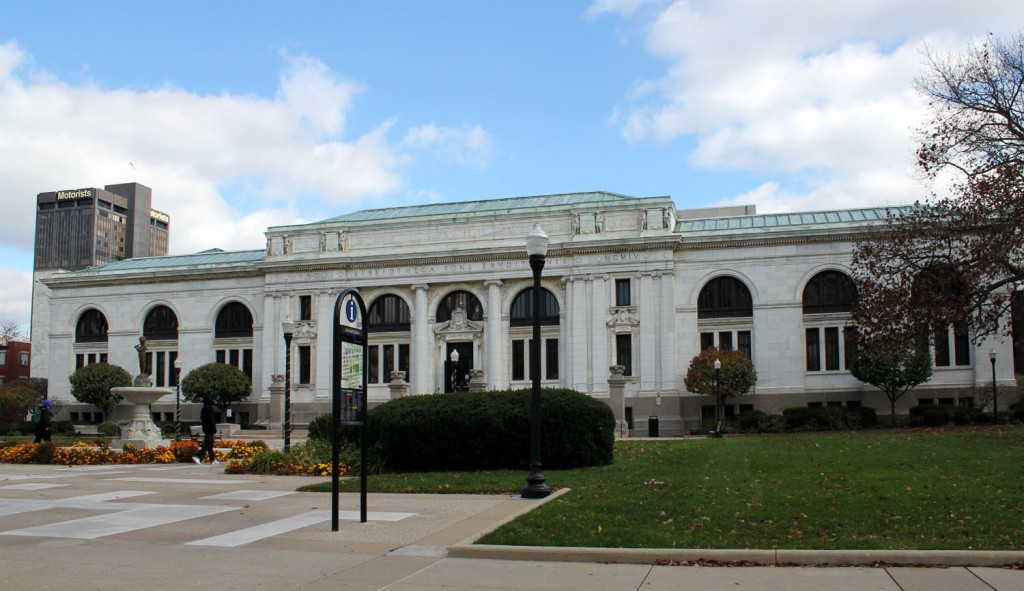
A group of employees had just marched upstairs at the Columbus Metropolitan Library (CML) Main Library, seeking out CEO Lauren Hagan to hand-deliver cards signed by a supermajority of library workers requesting a union election.
For the approximately 600 staff members who make up the bargaining unit at CML, the campaign represented the culmination of years of organizing. Pointing to the five other Central Ohio library systems that have unionized since 2021, Lee said, “I feel like the writing is on the wall; we’re in this moment of this wave of unionization in Columbus.”
A donation powers the future of local, independent news in Columbus.
Support Matter News
But the optimism of that day has turned to disappointment for CML workers, as Lee said CML management has delayed unionization “at every possible turn.” She said it has been an unexpected response when contrasted with the approach of several of those recently unionized suburban libraries, whose managements voluntarily recognized the unions or at least stayed neutral. “I think a lot of people would expect CML … to be a little bit more progressive in how they’re handling their workers unionizing,” Lee said, but “it’s been three months and we still don’t have election dates.”
Workers on the CML United organizing committee and representatives of the Ohio Federation of Teachers (OFT) now say the actions taken by the CML administration amount to union-busting. Citing delays, misleading information provided to staff, and accusations of a retaliatory termination cited in an Unfair Labor Practice Charge filed last week, they say CML is infringing on the employees’ legal right to organize and advocate for each other. The aggressive stance workers said CML management has taken also raises questions about whether fighting the union is the best use of public resources.
Kim Lowe, a Customer Services Specialist who has worked at CML for more than two decades, described libraries as “another home for me, a place that provides safety and community and resources that I made use of and that I was always seeing all of my community making use of.”
Lowe said workers know of at least three attempts by CML staff to unionize in recent years, though only this most recent campaign, which began in April 2024, has reached the formal election stage. After hearing about the group of workers beginning to speak one-on-one with each of the hundreds of potential union members, she said, “I was immediately on board, and immediately wanted to be part of bringing other people on board.”
For Lowe, who was previously involuntarily transferred from a team and role that she loved, the push to unionize centers around equalizing power with management and giving workers the ability to advocate for themselves. As it stands, she said, worker concerns ranging from involuntary transfers to safety issues are rarely addressed. Whether submitted to management or to the Staff Relations Committee, she said, “It doesn’t go anywhere so much of the time.”
If CML United wins the union election, staff will vote on negotiating priorities. Among the major concerns Lowe said might be prioritized are equal benefits for part-time workers, assault and mental health leave, and increased pay. Many workers do not make even a living wage, which has been referenced in presentations to CML staff about mental health, Lowe said. And while there are merit-based raises, there are no seniority-based increases in pay and “existing staff cannot negotiate their pay at all,” she said.
But before they can get to the bargaining table, CML workers would need to win their election, a process Lowe said is facing “coercion and intimidation” from library management. The first signs of library leadership’s approach came soon after workers filed their cards in December. According to Lowe, CML requested an extension to the deadline to provide the State Employment Relations Board (SERB) with a simple list of employees and job titles needed to verify election cards and to determine which positions could be represented by the bargaining unit. OFT representatives explained that while the election process is often slow, this and other delays by CML administration have pushed the timeline to several months longer than any other library system. (Following publication, OFT informed Matter News that election dates have now been set for June 16-30, with votes being counted on July 7.)
Then, Lowe said, CML objected to the inclusion in the bargaining unit of the transportation department – a small team that included an organizing committee member who had spoken to the press. While the transportation department was eventually included, in February the outspoken organizing committee member on that team, who had worked with CML since 2021, was fired. An Unfair Labor Practice Charge filed last week by CML United and OFT alleges that the termination of that employee was “unlawful and retaliatory,” motivated by the employee’s involvement in union organizing.
“We respect the rights of our employees who are for or against unionization and continue to comply with the law,” a spokesperson for CML wrote in a statement to Matter News requesting comment on accusations of anti-union activity. “CML is proud to offer competitive wages to both full- and part-time employees, along with a comprehensive benefits package and paid time off. Our compensation and benefits serve as a benchmark for libraries in our region and throughout Ohio.”
In January, all nine members of Columbus City Council penned a letter to the CML administration requesting that the library “remain neutral throughout the organizing campaign and the election, refraining from actions to interfere with or delay their legally-protected efforts.”
Meanwhile, management has shared a series of three FAQ documents containing increasingly anti-union messaging with all staff, Lowe said. The first, released in January, described the union election process. While Lowe said this document was mostly factual, she said she still felt it was worded to influence staff, including a comment that SERB would need to review and determine whether the union had demonstrated that at least 30 percent of employees in the proposed bargaining unit had signed authorization cards. Though that is the threshold, Lowe noted that CML United had submitted authorization cards signed by a supermajority of workers.
The second FAQ document, shared in February and titled “The Duty to Bargain in Good Faith,” Lowe said represented “an implied threat.” That document read, in part, “Collective bargaining can result in terms and conditions of employment improving, staying the same, or becoming less favorable for employees.” In another section, it stated that in contracts with other libraries, OFT had given management the right to “select and determine the number and types of employees required” and to “determine the size, composition and adequacy of the workforce.”
The third FAQ document, shared in March, focused on union dues, citing costs of up to $530 per year for union members at Pickerington libraries and $606 per year for union members at Worthington libraries. It also noted that, “Ohio law does not require the union to allow members to vote on the amount of dues,” and that “the timing of union dues is determined by the union.”
OFT representatives clarified that dues for members of new OFT unions start only once a contract is ratified and takes effect, do not include an initiation fee, and are set at the local, state, and national levels by democratically elected member leaders. Likewise, they said information about the wage increases negotiated by union members at those libraries and their high union membership rates are conspicuously absent from the supposedly neutral FAQ documents. Moreover, they argued that CML management, given their research into dues at neighboring libraries, would be well aware of this missing context. Taken together, OFT representatives said these statements likely cross the line into misinformation and union-busting in violation of state law, which makes it an unfair labor practice for a public employer to “interfere with, restrain, or coerce employees” exercising their right to unionize.
The union filed a second Unfair Labor Practice Charge with SERB last week citing the second and third FAQ documents. In a follow-up statement responding to the filing of the Unfair Labor Practice Charges, the library said, “CML is aware of the charges, and we believe they have no merit. We look forward to demonstrating that lack of merit to the State Employment Relations Board, which will ultimately make a determination on OFT’s claims.”
Grace Walker, a Youth Services Librarian at Pickerington Public Library, served on the organizing committee, then on the bargaining committee after a 92 percent majority of workers there voted to form a union. She said their new contract, ratified in March 2025, includes raises of up to 10.5 percent over three years, makes merit raises correspond directly to evaluations rather than being limited if there are many high-performing employees, and includes a longevity bonus of $0.15 per hour per year worked at the library. For a full-time employee like Walker, who has worked at the library for more than a decade, that longevity bonus alone equates to more than $3,000 annually.
One goal, Walker said, was to help retain staff members. Just one year on, she said, “even [the] administration has said that they’ve noticed that staff morale was better.” More broadly, Walker averred that the union, rather than representing a source of confrontation, has been an outlet to improve collaboration and communication between management and workers. She said administration now regularly invites union representatives to meetings with staff, even when not required.
Pickerington Public Library administration, Walker said, never sent out the kind of anti-union messaging attributed to CML. In light of the benefits she and her coworkers have experienced, she said, “I think eventually, hopefully, CML admin will come around to see that it’s not a bad thing. It can be a very good thing. If you are working together it can strengthen your library and be a positive thing for the staff members, it can be a positive thing for the community.”
In contrast, workers at Delaware County District Library who ratified their first union contract just last month, said their administration used some of the same language as CML in their attempts to dissuade workers from voting to unionize. At a captive audience meeting for staff before their election, Adult Services Specialist Kaie Russo said one message from management was “you’re starting from nothing and you have to barter to even get up to what you currently have,” in addition to similar warnings about union dues.
But that stance may have backfired against the library administration. “It was a big reason of why I started to get more involved at that point, because of what I heard, and I was like I don’t think that’s right and true,” Russo said.
Thanks in part to Russo’s work on the bargaining committee, the newly ratified union contract is anything but less favorable to workers. It includes tuition reimbursement, vacation time for part-time employees, “just cause” rather than “at-will” termination, and raises of 9 percent for librarians and 11 percent for non-librarians over three years. Of the unionization effort as a whole, Russo concluded, “It’s a million times worth it, just being able to have a voice at the table and to know that you have each others’ backs.”
Though administration claims to respect both sides, Local History and Genealogy Librarian Maria Lee said that as librarians whose jobs center around information literacy, research, and helping others identify biased sources, it has been disappointing and insulting to see the FAQ documents escalate to what she termed “intimidation, misinformation, [and] coercing employees to not support the union.” She said, “Clearly, their actions speak louder than words.”
Lee said she has been inspired not only by union campaigns at local libraries, but also by campaigns further afield which have advanced community interests through the bargaining process. For patrons of CML, apart from having a happier library staff, Lee said the union would mean a more democratic library. “We will be able to have a democratic table with our bosses where we’re able to talk about and negotiate our conditions of work,” she said, “and our conditions of work are the conditions that you enjoy here in the library.”
Related Articles
Lawsuit, ballot initiatives seek to make Columbus City Council more accountable to residents
A lawsuit looking to restrict council from closed-door sessions is making its way through the courts at the same time that organizers with Our City, Our Say are beginning to collect signatures for a ballot initiative designed to recast how council members are elected.

Meet the Columbus Black-Owned Bookstore Collective
Tracy Ramey of Tastes & Tomes will join fellow collective members Barbara Bailey (Eqstesi by B.E.E.) and Megan Turner (Rooted Books) in a panel discussion at Zora’s House from 6-8 p.m. on Tuesday, April 7, as part of the inaugural National Black Bookstore Day.

On Development: Developing better health care and hospitals
Despite the hospital construction projects all over the state, residents across most of Ohio are no closer to health care – and many are even further removed from hospitals.