
Karlsberg takes back control with ‘Must Be Nice’
The Columbus artist’s new exhibition kicks off in Blockfort’s Gallery B with an opening reception from 6-8 p.m. today (Friday, Sept. 5).

The reelection of President Donald Trump initially left Karlsberg in a state of shock, the Columbus artist stung by the reality that a majority of Americans voted for a convicted felon whose campaign traded heavily in fearmongering, with attack ads directed at trans people and immigrants in addition to his Democratic opponent, Kamala Harris.
“I didn’t understand how the country could put a person like that in power,” Karlsberg said in early September at the downtown gallery Blockfort, where their new exhibition, “Must Be Nice,” kicks off with an opening reception in Gallery B from 6-8 p.m. tonight (Friday, Sept. 5). “And in my mind, it had a lot to do with the fact that the other option was a woman.”
This idea percolates throughout “Must Be Nice,” reflected in a diverse series of paintings, written materials, and sculptural installations that address everything from the unrealistic beauty standards heaped on women to the way those in political power use the cross as a means to shield themselves from policies that so often run counter to the perceived tenets of the Christian faith. “This is a religion that’s supposed to preach equality and friendship and love,” Karlsberg said, whose work started with this seed of an idea and gradually evolved. “And then that transitioned into a more feminist look at things, because the more I sat with it, the more it was like, ‘Okay, it’s because of these Christian nationalists … that Roe v. Wade was overturned and women lost access to healthcare,’ which made me start thinking more about my experiences as a woman.”
A donation powers the future of local, independent news in Columbus.
Support Matter News
These memories surface most cleanly in a trio of sculptural pieces, including “You Never Know Who Is Going to See Your Underwear,” which Karlsberg created by tacking worn undergarments they had amassed to a sheet of cardboard and then slathering it in red paint. “My mom used to be like, ‘You have to make sure you have cute underwear on, because if you get in a car accident [doctors] might cut open your clothes,’” they said. “Men can go into a store and buy a pack of briefs that are super comfortable and fit their bodies, versus women who … are choosing from options that aren’t even designed to fit the female anatomy. … And then I use the red a lot in my work because I think it’s a highly feminine color. I mean, we bleed five to seven days a month, every month. And it’s something we’re not supposed to really be talking about.”
Karlsberg untangles their own experiences with menstruation elsewhere in the exhibition, with writings that address the physical and mental challenges that arrive each month and for which doctors have been able to offer no solution beyond birth control, which the now 32-year-old has refrained from taking since their late 20s. “I consider myself genderfluid, and so it’s hard for me to find affirmative care, because I’m not trans and I’m not trying to transition, but I don’t want to introduce more hormones into my body,” they said. “So, there are writings, lyrics, poems about my period, specifically. I have pretty bad PMDD (Premenstrual Dysphoric Disorder), where I’ll wake up and suddenly have this irrational thought pattern that is loosely related to something that happened that week, and it will completely take over my body. And these are those [thoughts] taken out of my mind and put onto the page.”
Other pieces are rooted in past experiences, including “You Can’t Sit Here,” a striking installation consisting of a white, two-seat couch splattered in red paint and set next to an end table staged with condoms and birth control. The artist traced the piece to their first sexual encounter as an older teenager, when the mother of the boy she had dated for more than a year falsely accused them of trying to become pregnant to ensnare her son. Then there’s “Angel,” a sculpture born the years Karlsberg logged as a model, and which features a female form ensnared by a web of tape measures.
Growing up, art served as a constant for Karlsberg, who traced their connection to the form back generations, recalling how their grandmother and great grandmother both painted. Early on, this passion most often took the form of unfinished sketches that filled countless notebooks – “I’m very ADHD, so I never finished a drawing,” they said – with Karlsberg finding new means of expression after discovering photography in high school.
At the time, the artist said, they were struggling with depression, and the camera allowed them to focus on those moments of beauty most often present in nature (flowers, lush forests, manicured gardens). “Getting the camera helped get me out into the world,” said Karlsberg, who described their photography as a needed counter to the work present within “Must Be Nice.” “There’s a duality within me, this balance of darkness … and joy. Everything is a balance – life and death, pain and love – and if you spend too much time on one thing, it can take over your life.”
For Karlsberg, the exhibition also marks a return to artmaking following a couple of years in which that urge had largely laid dormant, this work emerging from a growing sense that “the whole system had backtracked” and that the rights of women, the queer community, and people of color were being steadily trampled. “This regression to quote-unquote ‘traditional’ values is just misogyny in a different outfit, frankly,” they said. “And I can sit around with all my friends and be like, ‘Oh, man, this is happening,’ and we can talk about it, go to protests, we can vote, but we can really only do so much. And this [art] makes me feel like I’m taking some control back. I hope someone sees this and it makes them angry, and that it makes them be like, ‘Why would a girl make art like this? Their lives are so good.’ And then I want them to think, ‘Well, maybe not.’”
Author

Related Articles
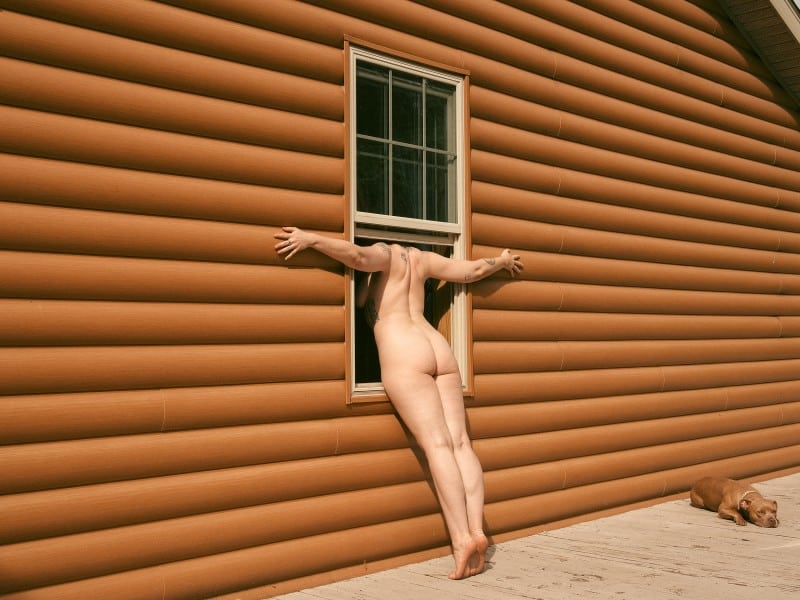
Kate Sweeney captures herself at the threshold
The Columbus photographer recently had two images named to the 2025 Booooooom photo awards longlist, including an eye-catching shot taken on a summer trip to Michigan that she described as ‘a self-portrait of transformation.’
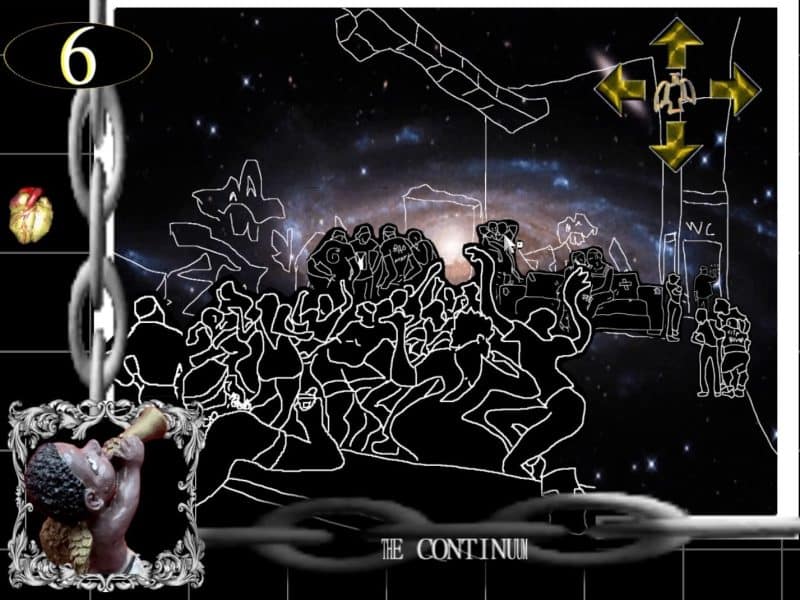
Cameron Granger’s debut video game doubles as a love letter to the Columbus DIY scene
In ‘Sidechain,’ set at a warehouse party on the final night before the world ends, players navigate scenes that draw inspiration from the formative years the artist spent frequenting spaces such as MINT, Corrugate, and Skylab.
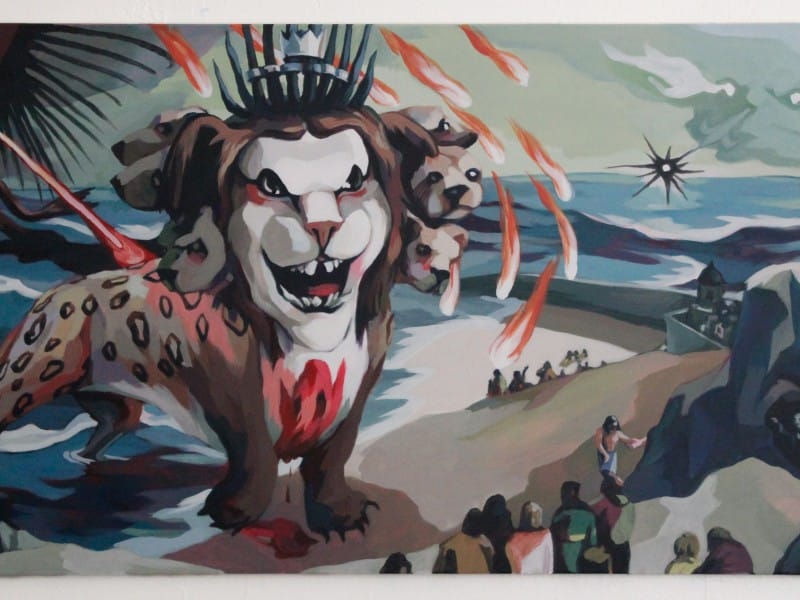
Aaron Burleson explores the nature of reality at Chaos Contemporary Craft
The Columbus artist will celebrate the opening of ‘Touchdown Jesus’ with a reception from 5-8 p.m. on Friday, April 17.