Luka Weinberger overcomes censorship, celebrates trans bodies with new mural
When the artist and tattooist completed their most recent mural, dubbed ‘We Don’t Wait for the Rain (No Body Is Political)’ and originally intended to grace a building in Franklinton, it marked the end of a more than year-long odyssey.
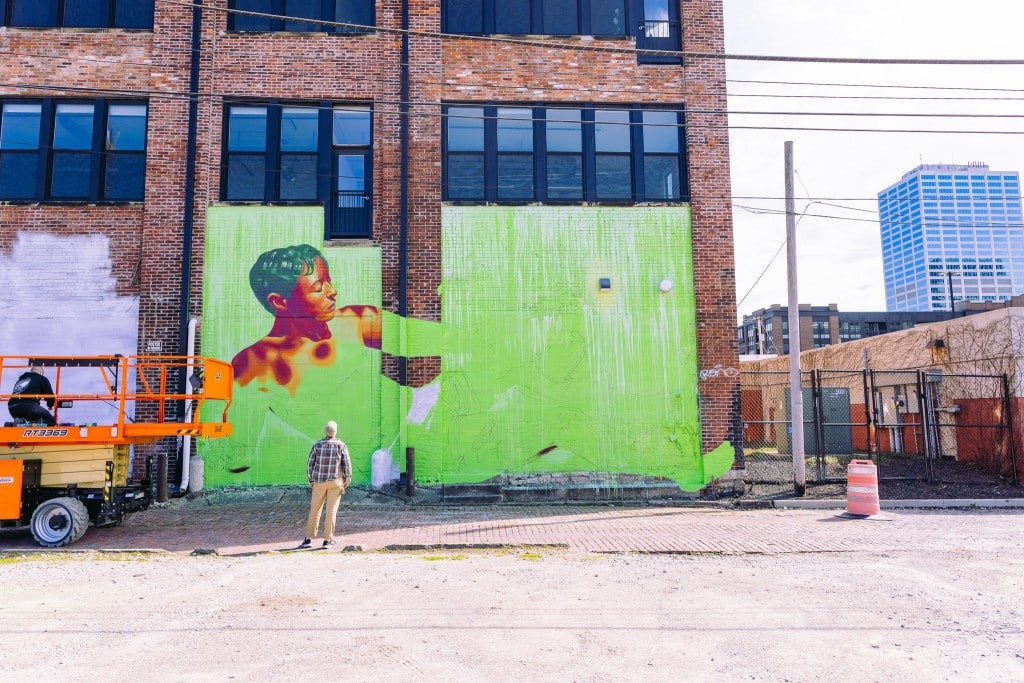
When Luka Weinberger put the finishing touches on their mural for this year’s Alley Islands festival and stepped back, there might have been a few tears shed.
For Weinberger, the completion of the mural, dubbed “We Don’t Wait for the Rain (No Body Is Political),” marked the end of a more than year-long odyssey that began when the image was first proposed for a building in Franklinton. Meant to reflect the importance of self-care, the story-tall painting shows a trans body in peaceful repose, their face at rest and their body dotted with sprouting plants and a pair of golden top-surgery scars. On the whole, the image is warm and serene, alive with sun-kissed colors that evoke an early spring garden.
And yet, the first response that Weinberger received from the developer that commissioned the piece was that the mural was “too political.” When pressed for further explanation during a later in-person meeting, Weinberger said, a company representative dismissed the proposed image as “trans propaganda.” (Weinberger declined to name the developer, citing potential career repercussions.)
A donation powers the future of local, independent news in Columbus.
Support Matter News
“And that, for sure, had me furious. And I told them, ‘What you’re saying is that being trans, being who you are, is propaganda, is inherently political,” said the artist and tattooist, who relayed the challenges muralists from marginalized groups experience in navigating a Columbus environment where a majority of walls are owned and managed by older, straight, cis-gendered white men. “And so, to get work, we often have to focus on other parts of ourselves and other parts of our story.”
Weinberger also expressed a belief that developers and businesses can on occasion take a narrow response to a piece of public art and embrace it as a means to advance censorship, recalling how someone tagged a “Love Is Love” mural painted in the Short North by their friend, the artist Lucie Shearer, with a swastika. “And then businesses and arts organizations can use that almost as an excuse to make us invisible,” Weinberger said. “But that is showing us that we need to be more visible. And we need to be more supported in the community in general.”
After Weinberger received the initial mural rejection, they continued to advocate for the concept for the better part of a month, only relenting once they realized the developer was entering into meetings not with the idea of engaging in meaningful dialogue but rather waiting for them to concede. “And so, I made a different mural for them, only this time I didn’t tell them the person was trans,” said Weinberger, who described the completed image as “an ode to trans and intersex people.”
Coming into the new year, however, Weinberger held onto the idea of not only completing the original mural as intended but also on laying the groundwork for an even more radical 2025, where they intend to focus even more intently on creating a collection of public work that uncompromisingly celebrates trans lives. “Starting next year, it’s going to be all trans work, featuring trans bodies. And I’m letting everyone know that ahead of time, so if they want to work with me, awesome,” Weinberger said. “I’m really tired of pandering to building owners who want work they consider apolitical, or who want work that won’t offend anyone. I mean, at this point, there is someone who is going to be offended by anything. I designed a mural involving birds for a suburb of Columbus, and everyone on the city board liked it except for the mayor, who said, ‘I hate birds.’ So, you’re always going to offend somebody, right? … We need to just take that [idea] out of the room and out of the conversation. And we need to think not about who we’re going to offend but who we are going to touch.”
To that end, Weinberger recalled how artist and Alley Islands founder Adam Brouillette reached out to them in the weeks after they finally completed work on “We Don’t Wait for the Rain,” which is located on the rear of a building on East Lafayette Street, kitty-corner from Brouillette’s gallery, Blockfort.
“And Adam sent me photos of this group standing next to the mural, and he told me, ‘I just want you to know that I was standing nearby, and they asked me if it was a mural of a trans guy, and I said yes,’” Weinberger said. “And one of the guys [in the group] lit up and said, ‘This is my one-year anniversary of getting top surgery,’ and he threw his shirt off and posed for a bunch of photos in front of the mural. And, wow, that makes it all 100 percent worth it. That was the goal. People need to see more than trans people being discriminated against or abused or involved with sex work. They need to see them at rest. They need to see them happy. Because there are so many kids here just struggling.”
These challenges have only intensified in recent years as Republican legislatures nationwide have passed increasingly restrictive bills preventing trans people from using public bathrooms that align with their gender identities and from participating in amateur sports. (The Trans Legislation Tracker lists 13 anti-trans bills under consideration in Ohio in 2024.) This in addition to school boards across the United States continuing to enact book bans, which have overwhelmingly targeted material by and about people from marginalized groups.
“We can’t assume kids are getting these good, compassionate, authentic conversations about gender and sexuality at home or in school, because, honestly, it’s probably not happening,” Weinberger said. “I started struggling with my gender identity at age 4. And if I’m not hearing about trans joy in my home or in my school, where else am I going to hear it except in public? … If as a kid I had seen this very peaceful, very normalized mural, where someone decided, yes, this particular identity, this particular body is of importance enough to put on a wall, it would have made me feel a little bit less alone. … Once you see something [painted] on a wall, you know it’s not something that needs to be hidden away. It’s not taboo.”
Author
Related Articles
Afi Lane explores concepts of memory, migration in stirring 934 Gallery exhibition
The Houston-based artist’s ‘Northbound’ will remain on display at the Milo-Grogan gallery through Saturday, June 27.
WIT Gallery celebrates turning five while keeping an eye on the future
Poet, artist, and gallery founder Larry Robertson will celebrate the Franklinton art space’s anniversary with a sprawling group exhibition opening on Friday, June 12.
Adam Hernandez aims to uplift immigrant workers with his latest mural
The Columbus artist will be on site at 1014 Parsons Ave. for the public unveiling of ‘We the People/Nosotros la Gente” on Thursday, June 11.