
Melissa Vogley Woods slows things down for ‘When the Earth Bends we Bend’
The artist’s new exhibition opens at Brandt Gallery on Friday, Sept. 11.
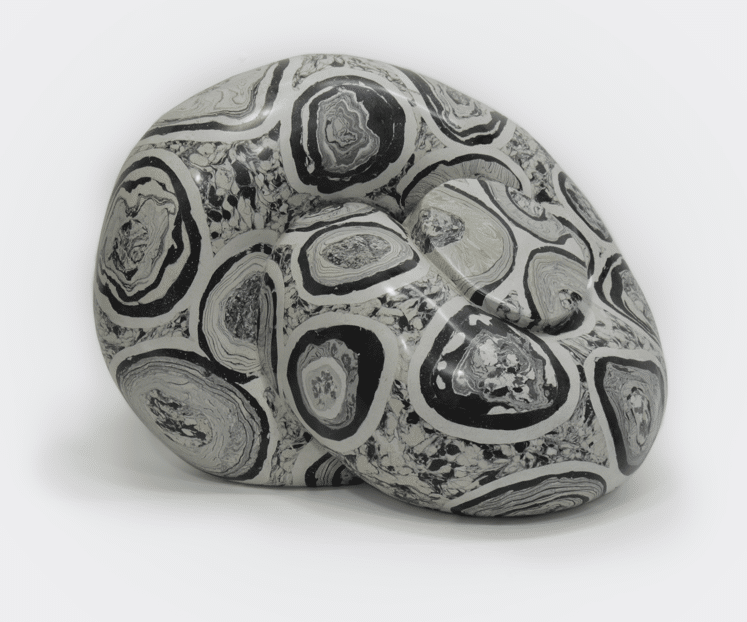
The path to new exhibition “When the Earth Bends we Bend” has been a more than 15-year odyssey for Melissa Vogley Woods, with the chance discovery of a Russian-language video leading her down a rabbit hole that culminated in periods of study in the Finger Lakes region of New York and later in Rima, a tiny town in Northern Italy backed immediately up against the Alps.
“It just hits the Alps, and there are waterfalls gushing down, and there’s the girl with the goats,” Vogley Woods said in early September at Brandt Gallery, where a new exhibition from the artist centered on a series of sculptures and a half-dozen earth-toned watercolors will be on display beginning with an opening reception from 5-7:30 p.m. on Friday, Sept. 11.
Vogley Woods said she was compelled to journey more than 4,000 miles to Italy in her ongoing quest to learn more about scagliola, a baroque-era composite plaster that mimics the appearance of marble and was most commonly used to create durable, architectural elements, tracing her introduction to the material to a Russian-language video on YouTube.
A donation powers the future of local, independent news in Columbus.
Support Matter News
“And this was more than 15 years ago, before there was Google Translate, and I couldn’t make out any of the information,” she said. “But it was like, ‘Oh god, what is this process?’ And I just watched people slapping this stuff up on a wall and shaving it down.”
Further research informed the artist that “this stuff” consisted of a blend of plaster and pigment that craftsmen then applied wet to architectural surfaces, allowing the material to cure (typically a 24-hour process) before shaving it down and sanding it with increasingly fine grains.
Vogley Woods immediately viewed in the material a way to bridge her interests in painting (in the use of pigments to create different marbled patterns) and sculpture. When she studied alongside James Gloria in New York and asked him about the potential for scagliola to be turned into three-dimensional forms, though, he said it would be too time consuming. “And then he was like, ‘I don’t even know how possible it is,’” she said.
But years of experimentation, along with the support and mentorship of Simone Desiro, whom Vogley Woods studied alongside in Italy, eventually helped the artist to crack the code, leading to the launch of her company, Madestone Studio, which among other projects assisted artist Beth Stuart with the fabrication of a large-scale scagliola sculpture installed at National Bank of Canada in Montreal.
“And it was really when Beth Stuart reached out and said, ‘Can we do this? Can we make these 15 feet?’” Vogley Woods said. “And I was just like, ‘Yes.’”
By that point, Vogley Woods had homed in on the skeletal structure required to support the scagliola. For smaller pieces, the artist utilizes plaster frames strengthened with burlap, while larger works necessitate steel frames to which she and her team then attach plaster and burlap “arms.”
“It was a big learning curve, because no one had done it,” said Vogley Woods, who in her research studied among other things the plaster ceilings in places such as the Ohio Theatre. “Those plaster [fixtures] you see at the Ohio Theatre, they’re all hanging, and they’re cast. And I was like, ‘If they can make that … with plaster, then why can’t we make these giant things?’”
The work present in “When the Earth Bends we Bend” exists on a smaller scale, with most of the sculptures, which read as marble knots, standing at most a foot or two high. The relatively small stature of the work doesn’t mean it was any less labor intensive to create, though, requiring the artist to lay the scagliola atop the frame in small sections before beginning a multi-step sanding process alongside a team that included studio assistants Miranda Holmes, Echo Martin, Adelaine Muth, Polly Woods, Jayla Butler, and Christina Dietz.
“And you really have to sand down into the material to get down to the pattern, because it just looks like a mudpie when you first carve into it,” said Vogley Woods, who based a number of the designs included in the sculptures on extinct slabs of marble she encountered in her research. “And in order to get that shine, you have to sand up to 3,000-grit, so that’s a lot of sanding. … You go from 150-[grit] to 220, 400, 600, 800, 1,000, 1,500, and then 2,000. And then the final grit is tin oxide … because 3,000-grit doesn’t work on paper. It literally falls apart.”
It’s fitting, in a way, that these works are so time-consuming, with the artist coming to view the collection in part as a reflection on geological time and the “way the Earth is constantly rotating and churning from the surface back down under the surface and back up to the surface,” as she explained it.
There’s also a sense of playfulness present, with the artist adopting the knotted structure in part because it lent almost humanistic characteristics to the marble-evoking forms. Alternatively, the knots evolved to suggest for Vogley Woods the idea of “trying to hold onto something that’s slipping away,” which she said was rooted in part on the patterns having been adapted from extinct marble.
Other benefits have come from spending these recent years enmeshed in concepts such as geologic time, this significantly pulled-back view bringing with it a greater sense of perspective in terms of how the artist views the modern rat race.
“Even just in the way we live our lives, or the way we rush, or how we live in this time when it’s like, ‘Get me past this moment,’” Vogley Woods said. “I think looking at the Earth’s time signature can help you manage those stresses, those feelings. … It can maybe show you that human time – that human speed we have created and are gravitating to in our culture currently – is kind of put upon us in a way that maybe isn’t natural or good.”
Author
Related Articles
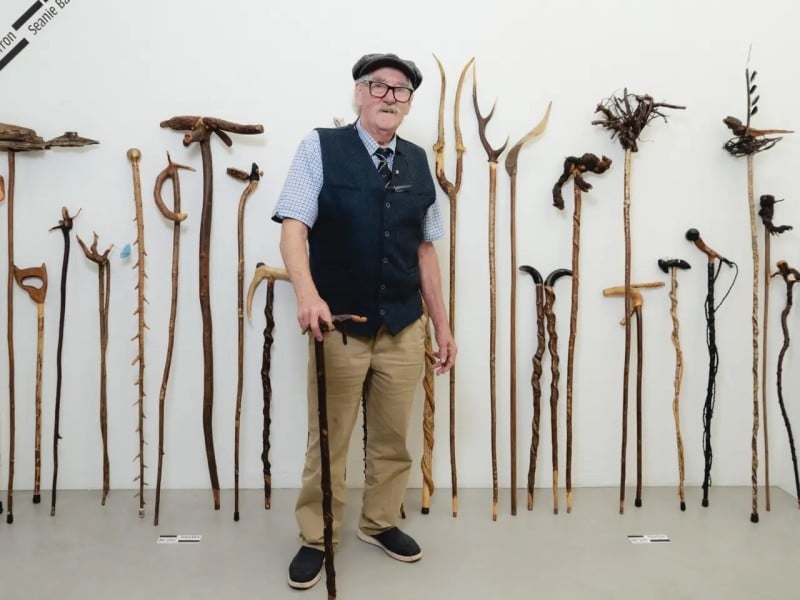
Take a leisurely stroll through the woods with Seanie Barron
The Irish artist’s new exhibition of hand-carved walking sticks kicks off at No Place Gallery with an opening reception today (Friday, Oct. 16).
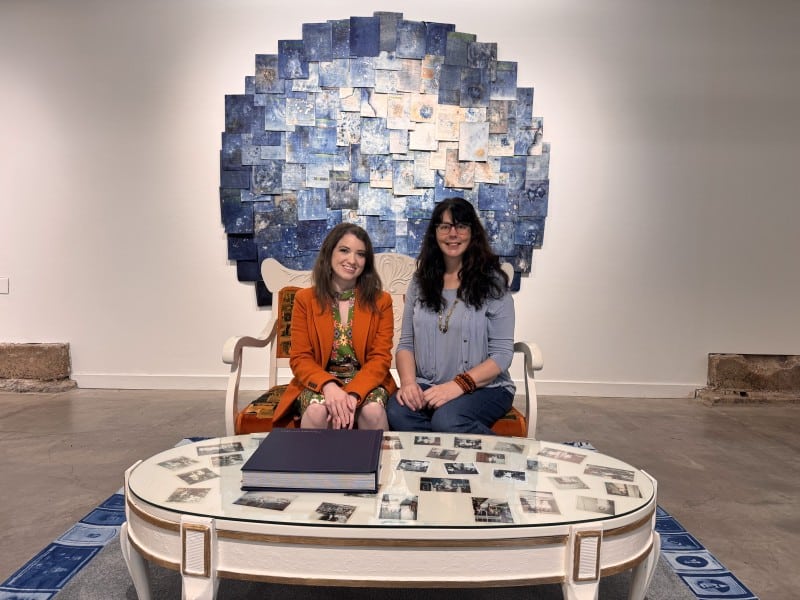
New Urban Arts Space exhibition opens up a conversation about death
‘Spirit & Dust,’ co-curated by Diane Callahan and Michelle Burdine, explores grief, loss, and the weight of mortality from a wealth of perspectives.
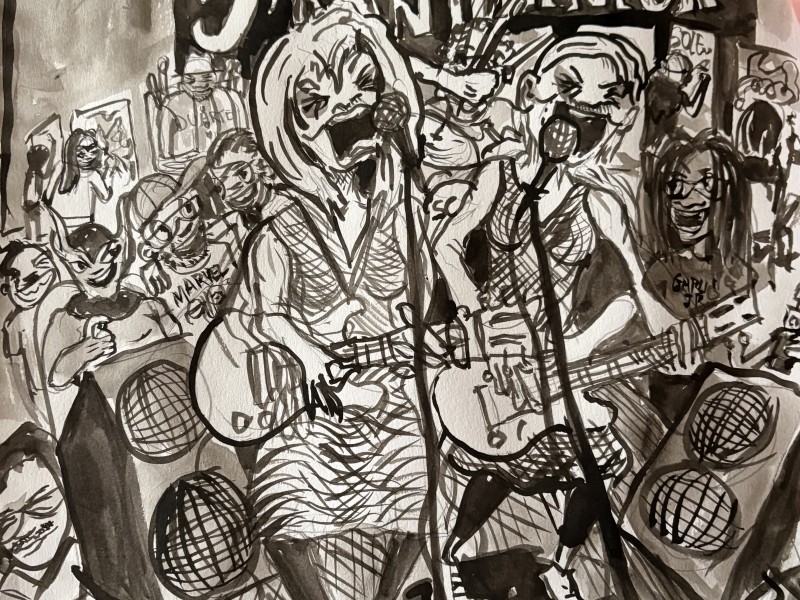
Scrawl meets Scrawl
Marcy Mays and Sue Harshe recently joined pioneering Urban Scrawl artist Dan Gerdeman for a conversation ahead of the band’s performance at the Franklinton art event that has been a longtime source of confusion for some of their fans.