
Ohio State med students think the DOJ admissions investigation is ‘bogus’
The U.S. Department of Justice says OSU’s medical school is discriminating against white and Asian applicants. Six current med students shared their thoughts with Matter News.

The U.S. Department of Justice released investigative findings two weeks ago accusing the Ohio State University College of Medicine of violating civil rights laws by discriminating against white and Asian students in its admissions process.
The report came after a months-long investigation into the college’s admissions between 2019 and 2026, though it only made the accusation for classes admitted in 2023, 2024, and 2025. It claimed that, by using a “‘Holistic Approach’ to admit more so-called ‘underrepresented minorities’” and offering nontraditional pathways to medical school, Ohio State had intentionally given Black and Hispanic students an unfair advantage.
Matter News spoke to six current OSU med students across multiple classes and racial and ethnic groups whose admissions records were among those reviewed by the DOJ. Four of them agreed to speak anonymously to prevent potential backlash from the institution. None of them agreed with the DOJ’s findings.
A donation powers the future of local, independent news in Columbus.
Support Matter News
When asked whether they believed the results of the DOJ’s investigation, one student immediately started laughing.
“No,” they said. “The results are absolute bogus. Just looking at the class composition, it is a very, very tall assumption to say that there was discrimination for white and Asian members of the class, when that is a very, very clear majority of the class. As a member of the group that theoretically would benefit from this sort of probe, I think that there is a little more evidence for reduced admission of Black and Hispanic individuals in our class, given that there are so few numbers of those individuals to begin with.”
Ohio State does not publish a demographic breakdown of its admitted students. But multiple students Matter News spoke to echoed these sentiments.
“Our numbers for Black people in our class are steadily dwindling each and every year,” said Maya Dunson, a third-year medical student who serves as the school’s student council director of diversity and inclusion. “I had double digits in my class, and it was very small double digits. Out of 220, there were about 14 of us or so – not even representative of the population of the United States. But that number has slowly gone into single digits every single year. This was just kind of a punch-in-the-gut type of moment.”
The DOJ findings letter alleges that the school’s Holistic Approach, which is designed to look at personal and experiential qualities of applicants beyond simply their test scores, is “used to increase racial diversity, not recruit better physicians.” But, the med students argue, there are legitimate reasons for why racial diversity makes better physicians.
One is the make-up of the communities they serve. Ohio State med students work in the Wexner Medical Center hospital system, one of the largest in central Ohio and ranked second-best in the state; they also run a series of free clinics designed for different medically underserved groups within the city. Noor Community Clinic, for example, serves Muslim and Arabic-speaking patients; La Clinica Latina serves Spanish-speaking patients. Studies have shown that patients’ health outcomes improve when they’re treated by doctors who share their background.
“We have a very, very diverse population in Columbus,” Dunson said. “It’s heavily minority. It has a big, big immigrant and refugee population. And it’s a very poor socioeconomic status across the board. How do I navigate someone not having insurance? How do I navigate someone afraid to come to the clinic because of cultural aspects? We had someone in the free clinic one time who was afraid to come and get care, and it was serious, because they were in an ICE detention center before, and they were afraid that they were going to get sent back. If they see people that look like them, they feel more comfortable. You make really good connections with the regulars. It makes them want to come back and get care.”
Ohio State is not the only medical school the DOJ has investigated. It released similar findings against UCLA and Yale, and in June announced it would be looking at another 15 schools.
“Many of America’s top medical schools appear more concerned about the demographics of their incoming classes than training students to succeed in the profession,” Harmeet Dhillon, assistant attorney general in the DOJ’s Civil Rights Division, said at the time. “Under this Justice Department, we will continue to protect American students from discriminatory and illegal preferences in admissions – especially in professions as critical as medicine, where quality of training should be the top priority.”
The “quality of training” at Ohio State is not under investigation. Ben Johnson, a spokesperson for the university, confirmed that this was an admissions-focused investigation.
But diversity is also broadly important in an academic setting.
“Students who are in environments filled with people who have different backgrounds than themselves, regardless of what that background is, tend to do better,” said Evangeline Warren, a second-year Ohio State medical student with a PhD in sociology. “In medicine in particular, this becomes really important, because doctors are entrusted with so much by the general community. We take an oath to heal everyone and to take care of everyone regardless of their backgrounds. So, it’s important that we are training our doctors in a way that makes them the best that they can possibly be, just so our communities can be the best that they can possibly be. If we know that diverse learning environments create better doctors, we should just do that so we can have better doctors, right?”
The DOJ has not presented evidence that students in so-called unfairly advantaged groups are somehow underperforming.
“The Black students at Ohio State College of Medicine have a fantastic history of success and are some of the smartest, most successful students that we have,” another med student told Matter News. “If you look at who we have in our classes, I don’t think there’s any way to claim that these students aren’t some of our best. If you’re in the top 25 percent of your class, and you have leadership roles, and you’re fundamentally successful as a medical student, then there’s really no argument for you not to be here. I would hope that most of the students here know that.”
So, why would the DOJ be so interested in medical school admissions? And why in Ohio State, of all places?
The Trump administration has pursued a number of educational reforms, including abolishing the Department of Education, cutting how much loan money students can get to finance increasingly expensive higher education, and spearheading the end of diversity, equity, and inclusion (DEI) programs, which in turn led to Republican-controlled states such as Ohio passing anti-DEI legislation, including Senate Bill 1 in 2025.
Ohio State was criticized for its DEI commitments and quickly sought to limit them, including closing its DEI office before the bill even went into effect. The DOJ hasn’t been entirely clear as to why it wanted to probe the school, but the medical students had their own theories.
Dunson believed it was “because we take pride in our diversity, and I, with full confidence, believe that the current federal administration did not like that.”
Another medical student thought it was because of the administration’s “control-F habit of saying, ‘If you mention the word DEI, we’re going to hammer down on you.’”
Two others thought it was because Ohio State might have been an easy political target.
“I think it’s a factor that we are a public land-grant university in what was until last night a red state that had friendly GOP lawmakers,” one of those students said on Wednesday. “I think they thought this would be a friendly, target-rich environment for them to try and affect how admissions work, and that this might be an easy state to create some kind of landmark legislation regarding admissions.”
“ I am of the opinion that it is less about enforcing the renewed unconstitutionality of affirmative action, as described by the Supreme Court, and more about going after publicly funded institutions that seem like an easy political target and produce very highly educated individuals who could potentially upset existing power dynamics, especially with so many physicians taking on political roles such as with Dr. Amy Acton and Dr. Abdul El-Sayed,” another student said on Tuesday, just a few hours before the Ohio gubernatorial race was called with Acton as the winner.
But with a wave of Democratic wins in the midterms, including Acton as well as Sherrod Brown’s successful bid for Senate, Ohio might no longer be such a politically friendly place for admissions probes. The med students said they were curious to see how the rest of the fight would play out, but that they hadn’t heard yet from the college’s administration about its plans.
Spokesperson Johnson said the university was “in full compliance with the Supreme Court’s ruling and all federal and state laws and regulations regarding admissions,” and that Ohio State would contest the DOJ’s findings.
Related Articles
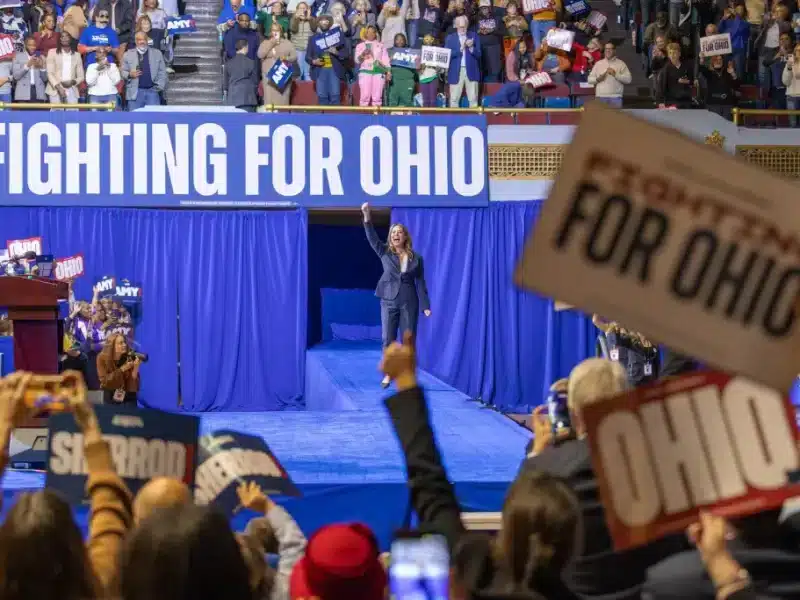
Amy Acton wins Ohio governor’s race, setting up a new era of divided government
The Democratic physician breaks a 16-year Republican hold on the office. Delivering on her promises will require negotiating with a GOP-controlled legislature.

Ohio Democrat Sherrod Brown wins U.S. Senate seat in comeback election
The populist Democrat, who lost a Senate seat in 2024, knocked off Trump-backed Republican Jon Husted in a campaign where affordability issues and data center expansion played heavily. The seat is up for re-election in 2028.
Local Politics: Who is that at the bottom of my ballot?
These are the county-level midterm elections taking place this coming Tuesday.