Shannon Downey draws on community to help move the needle
The Chicago crafter and activist, who had to cancel a planned Columbus stop this week due to illness, on the federal surge currently causing chaos in their hometown, the importance of fighting back, and the ways that embroidery can help to foster difficult conversations.
The decision to leave Chicago for a brief book tour proved incredibly challenging to Shannon Downey, who has spent the past month engulfed by the surge in immigration enforcement operations being undertaken by federal agents in the city.
“It’s hard to describe. It’s everywhere and every minute, so the whole city is on edge, because they’re so fast in their abductions,” said Downey, a crafter, activist, and author who yesterday was forced to cancel a reading from their new book, Let’s Move the Needle, planned in coordination with Craft Raccoon and initially set to take place at Two Dollar Radio Headquarters on Tuesday, Nov. 11. (The Queer Craft Society will still be on-site at HQ for an in-person crafting session from 6-8 p.m.) “But I will say we are organized and everybody is resisting. I never would have dreamed that every Chicagoan would be wearing a whistle, would be out on the streets, would be protecting the schools, would be patrolling the neighborhoods. And it’s beautiful, in terms of the response we’re getting out of it.”
During the first Trump administration, Downey joined with a couple dozen fellow residents of Chicago’s Rogers Park neighborhood to launch the activist group Protect RP, developing a model that has been adopted by community groups across the city as immigration enforcement has intensified in President Donald Trump’s second term. Downey said this spread was spurred in part by intensive training sessions the members of Protect RP held for a couple hundred activist leaders in Chicago earlier this year, which focused on anti-abduction tactics, how to build a rapid response network, digital security, and ways to cultivate creative direct actions, among other topics.
A donation powers the future of local, independent news in Columbus.
Support Matter News
These lessons can be heard in the symphony created by (literal) citizen whistleblowers across the city, with three short bursts alerting residents that ICE is in the area and three long whistles indicating an abduction in progress. The sessions have also inspired myriad Signal chats launched for residents to share information about ICE movements in their neighborhoods, along with shared spreadsheets documenting the license plate numbers and makes/models of the vehicles being utilized by masked federal agents.
Living in this state of heightened existence had become all-consuming in a way that Downey didn’t realize until they were a couple of days into this most recent road trip. “Two days in, it was like, ‘Oh, my God, my nervous system is relaxing a little bit,’” they said. “I didn’t realize how on edge I had been, and how the things I normally did to take care of myself, like go for a walk around my neighborhood, had [changed]. When I go for a walk now, it’s with a whistle and a gas mask in my backpack, and I’m surveying. And my gym, where I used to go and sweat it out, is doing self-defense training.”
While activism has long been entwined in Downey’s artistic practice – they grew up in a union home and have always viewed embroidery as a means to introduce radical ideas to unsuspecting audiences – current events have drawn out an even greater intensity in this connection. The bulk of their recent work has been aimed at raising public awareness of on-the-ground realities in Chicago, conveying the different ways people can resist ICE, and informing vulnerable communities of their legal rights.
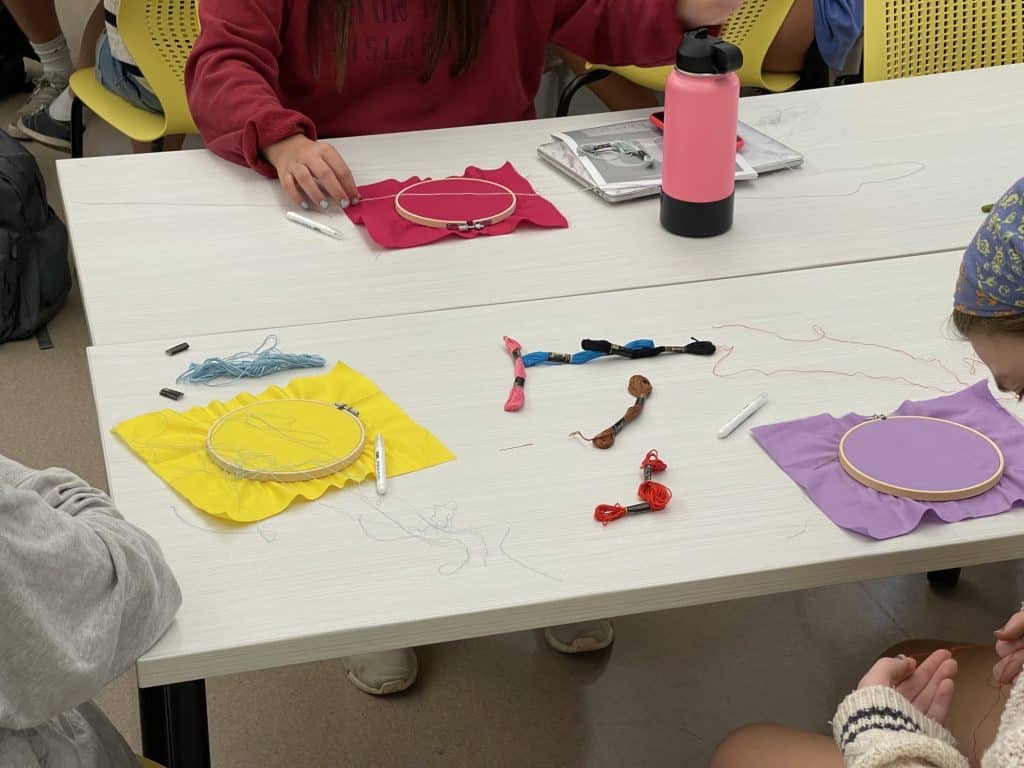
In the past, Downey said this activism sometimes took more conventional forms, including a stretch in which they served as a door knocker despite loathing everything about the process. Through crafting, however, Downey has uncovered a better way to foster these same conversations in a way that can fly a bit more under the radar. “I get to sneak my way into places. I’m like, ‘It’s embroidery, how bad can it be you guys?’ And then we get in there, and I’m like, wha-ha-ha!” Downey said, and laughed. “So, yeah, it’s sneaky as fuck. And that’s another reason I love it, because people are like: ‘Oh, ladies do that’; ‘Women do that’; ‘What a cute little hobby.’ And then they find out what’s actually happening in the room.”
For Downey, the ability to cultivate these kinds of communal spaces has come to serve as a far better measure of success than amassing a digital following on platforms such as Instagram. “I’m not interested in followers. That idea is disgusting to me,” they said. “You are my digital community, and I want you to be my IRL (in real life) community. … I’m interested in getting in a room with you.”
Once in this shared space, the hard work of building community can begin, Downey said, with the artist leaning into embroidery as a means to soften the soil and leave people more open to potentially difficult conversations. “If I’m at a meeting to talk about abortion, there’s an intensity to that that doesn’t exist in the rooms I build,” Downey said. “If you’re triggered by something or you don’t know how to respond, you can just go back to working [on your embroidery] and no one will think anything of it, because you’re working. And it gives people time to process and digest, and then they’re able to jump back into a conversation that is more thoughtful as a result.”
Author

Related Articles
Columbus artist Colleen Scott learns how to love herself again
‘Redirected Pathways,’ which kicks off with an opening reception at the Franklin County Coroner’s Office on Thursday, April 2, centers on work created both pre- and post-sobriety, capturing a personal evolution that speaks to a range of universal concepts.
Emily Morgan and Hannah Maltry rely on instinct for ‘We Did It Wrong’
The two artists will host an opening reception for their exhibition at High Road Gallery & Studios from 6-8 p.m. on Saturday, March 28.
Brian Canini takes stock of 25 years in self-publishing
The Columbus comics artist will unpack lessons learned over the last quarter-century in a weekend talk at SPACE.