
Tyler Davis reclaims his power with ‘You Think You Know Me?!’
For a new exhibit now on display at Fresh A.I.R. Gallery, the Columbus artist created a series of portraits focused on people for whom he had been confused, in addition to the various stereotypes to which he has been subjected while traversing white spaces.
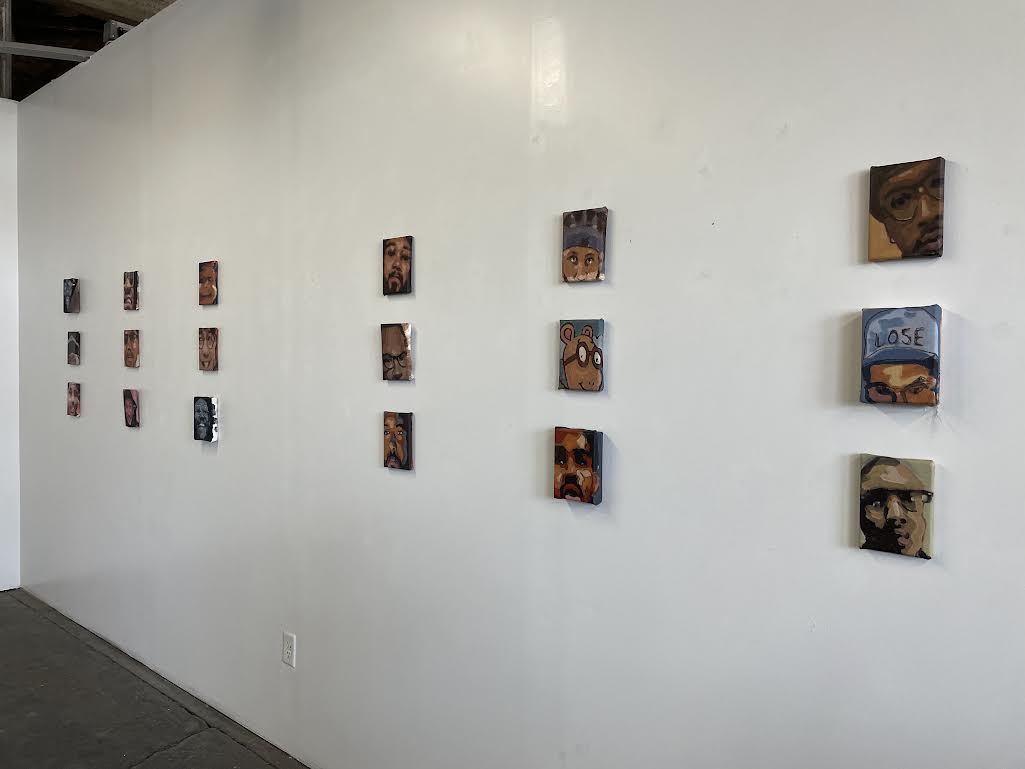
While attending CCAD about decade ago, artist Tyler Davis said he felt pressured by classmates, instructors and even random voices on social media to make work that centered “the Black experience,” a consideration he initially described as jarring, believing that, as a Black artist, anything he created in some way reflected this reality.
“Before college, I was just making art for the fun of it,” Davis said in a mid-August phone interview. “And then I switched, and I was trying to [fake] it since everyone wanted me to make work that had this meaning. I was feeling pressured … to make quote-unquote ‘Black art.’ But in my head, it was like, anything I make should be considered Black artwork, so I should just make whatever I want.”
While Davis resented the undertones of some of these college-era critiques – he recalled one white professor who told him he was “privileged” to be a creative Black man working at a point in time when more attention was finally being paid to art that explored issues of race and inequality – he now appreciates how they made him reconsider his approach, resulting in series of collections that have exhibited increasing depth and complexity.
A donation powers the future of local, independent news in Columbus.
Support Matter News
“I really feel like a proud father,” Davis said in describing the portraits that make up his new exhibition, dubbed “You Think You Know Me?!” and on display at Fresh A.I.R. Gallery through Sept. 13. “There was one time in my studio when I hung up the work, and I was looking at it the way a dad looks at the lawn after he’s mowed it, his hand on his hip, feeling proud.”
Davis said the idea for “You Think Your Know Me?!” originated nearly 10 years ago, first surfacing in a zine he made titled Merican Boy and for which he created a series of portraits of various friends and acquaintances to whom people always told him he bore resemblance. At the time, Davis said he was also suffering from a form of psychosis made worse by a burgeoning interest in simulation theory. So, when people told him that he looked like somebody else, “it really started to fuck with my brain,” he said.
“People would always be like, ‘You know, you look like blah, blah, blah,’ and I used to get really pissed off and angry about it to the point I wanted to physically fight,” continued the artist, who added that these misidentifications most often occurred when he traversed white spaces – something sadly familiar to the Black experience. “And then I went to therapy and got put on medication, and I started to understand I shouldn’t … give other people that kind of power.”
These ideas began to resurface around the time Davis received an email last year about exhibiting at Fresh A.I.R., a project of Southeast Healthcare that centers the work of artists affected by mental illness and/or substance abuse disorders. At the time of the email, Davis was in the midst of creating another series of portraits focused on people for whom he had been confused, as well as the various stereotypes to which he has been subjected when traversing certain spaces.
“It got me to thinking deeper about myself,” said Davis, who shared that concepts often have to marinate for months or even years before they begin to surface and take shape on the canvas. “I know how I see myself, and how I see Tyler. But when I go into some white spaces, I feel like they see me like some goofy little monkey boy, as if I’m supposed to perform or be a certain way.”
Growing up, Davis initially gravitated toward music for this creative release, with a deeper love for art surfacing after he discovered Gorillaz, a cartoon band created in the late 1990s by musician Damon Albarn (Blur) and London artist Jamie Hewlett. “I was just a kid when that first album (Gorillaz) came out [in 2001], but it made me draw so much more,” said Davis, who as a youngster based everything from his sense of humor to his style off of the various band members, and in particular the Albarn-voiced Murdoc. “Before Gorillaz, drawing was just something I did for fun. I didn’t know you could do anything, really, with art. There was no career path, and I didn’t see a pathway for doing anything [professionally] with it until I saw Gorillaz. But seeing them encouraged me to keep going. And I started to take art more seriously and to figure out who I was and what I wanted to do with it, because I knew I could take it as far as I wanted to take it.”
Initially, however, Davis took what he described as “a toxic and negative approach” to art, creating with the aim of striking it rich or reaching a certain level of fame. In more recent year, though, he has started to paint purely for the sense of release he finds in his craft, with art generally serving as a necessary form of therapy.
“I’m really trying to be a lot more vulnerable. And it’s realizing that the things I’m seeing, smelling and hearing are ultimately influencing what the art looks like and feels like,” Davis said. “And I love how people can connect with it, and how it can make other people feel better about themselves. I’m really just trying to take [young Tyler] and make that kid feel happy and safe and prideful. … It’s loving what I do and loving the fact that this is something that just naturally comes out of me.”
Author
Related Articles
April Sunami is learning to take up space
The Columbus artist will be on hand when her new exhibition, ‘Living Mythologies,’ opens at Lindsay Gallery tonight (Friday, Nov. 6).
Community takes center stage in Shelbi Toone’s ‘A Village Folk Artist’
The Columbus artist will celebrate the long-delayed opening of her new, career-spanning solo exhibition beginning with a reception from 6-8 p.m. on Thursday, Nov. 5.
Forget about happy little trees: Ben Lamb translates his anxieties to ‘Axe of God’
The Columbus artist’s new exhibition kicks off at St. James Tavern with an opening reception on Thursday, Nov. 5.