
J.U.S.T. reminds Pride parade revelers that ‘Stonewall Was A Riot’
‘We wanted to honor what Stonewall really was, and that was an uprising against our oppressors.’
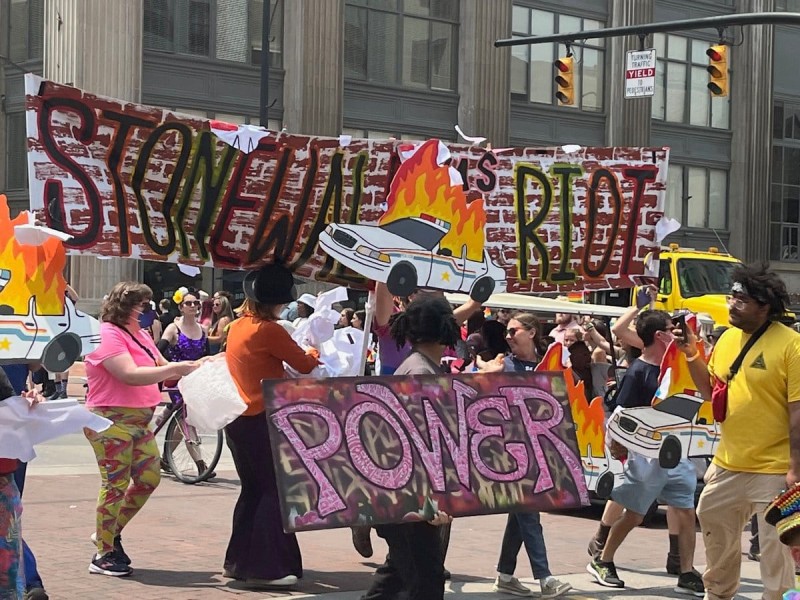
Nearly three hours into the Stonewall Columbus Pride parade, J.U.S.T. (Justice, Unity and Social Transformation) reached the intersections of North High and East Gay streets. At that point, a handful of the group’s members uncovered a previously hidden banner, revealing one that read “Stonewall Was A Riot” on one side and “Trans Liberation Now” on the other.
At the same time, a half dozen other members uncovered a series of smaller cutouts depicting burning police cars, while another hoisted a sign that read “POWER.”
The planned protest, which took inspiration from the Black Pride 4 events of 2017 and was designed, in part, to remind parade revelers of Stonewall’s radical roots, has been in motion for months, with final preparations taking place the day before Saturday’s parade.
“Every year, we see a Stonewall march that represents a particular core of our community, and that is people who are not abused by the police. These are people who are okay with a corporate-sponsored Pride, and who have a certain level of privilege,” said J.U.S.T. member Storm. “Pride has never really been about the people who are most marginalized in our community, and that’s trans people, and that’s Black people, and that’s Indigenous people, and that’s all people of color.
“We wanted to honor what Stonewall really was, and that was an uprising against our oppressors. And our oppressors are the police. … And our oppressors are the corporations that take our money and then pollute our planet. We want to bring that original energy of what [Stonewall] was into the parade.”
In the days and weeks leading up to the parade, members of J.U.S.T. created the signs and banners, which were then disguised. The “Stonewall Was A Riot” banner, for example, was covered in paper and then painted with the names of Columbus residents shot and killed by police (Casey Goodson, Henry Green, Donna Dalton), murdered trans women of color (Koko Da Doll) and modern movement pioneers (Black Pride 4).
J.U.S.T. also prepared a statement in the event that Stonewall Columbus yanked the group from the parade immediately following the reveal rather than allowing them to complete the route. “There is no apolitical Pride,” the statement read, in part. “There is no apolitical ally. There are those who seek our destruction and those who will enforce it. What side are you on?”
Prior to the appearance of J.U.S.T., however, this year’s Pride march was largely apolitical, save for a number of marchers who held signs urging attendees to vote no in the August special election, and the Planned Parenthood members who held signs that read “Bans Off Our Bodies.”
There were also a number of marchers who wore T-shirts and held signs urging people to “Protect Trans Kids,” which shouldn’t be a political message but has become one in this climate.
Corporate groups dominated the parade, represented by restaurateurs (Cameron Mitchell), big box retailers (Walmart), banks (Chase, 5/3) insurers (Liberty Mutual) and utility companies (AEP). Storm noted that a number of these participating companies also donate to right-wing politicians, who are currently passing laws targeting the trans and queer communities.
According to FEC filings, AEP has donated thousands of dollars to Rep. Jim Jordan, who just last year lobbied his Republican colleagues to vote against the marriage equality bill.
“The companies that donate to politicians who write anti-trans laws are the same companies donating to Pride,” Storm said. “By inviting them, by inviting the police, the message it sends is, ‘This parade is not for you.’”
Storm said she was nervous in the days leading up to the parade, unsure how the protest would be viewed, and wary the action could have been met with police violence. At the same time, she said the public outpouring she witnessed in Columbus during the Black lives matter movement of 2020 instilled some hope that people might be receptive to the group’s message.
“I think most of what we’re doing is for that shock, and as much as that frightens me, because people can react to shock with violence, I’m also excited for people to be like, ‘What? Why would you say that? What does that mean?’” Storm said. “Because when someone has that reaction, it normally causes them to ask more questions. And I think that’s a very good place to start.”
Author

Related Articles
Supporters rally to try and win clemency for Keith LaMar
Speakers at Friday’s demonstration, which is scheduled to take place outside of Trinity Episcopal Church at 3 p.m., will include death row exonerees Elwood Jones, Lamont Hunter, and Derrick Jamison.

Ohio State med students think the DOJ admissions investigation is ‘bogus’
The U.S. Department of Justice says OSU’s medical school is discriminating against white and Asian applicants. Six current med students shared their thoughts with Matter News.
On Development: Local challenges become regional
The data on growth patterns raises the question of how a region should be governed.