
The long road to non-police crisis response in Columbus
Chana Wiley said the goal of creating non-uniformed crisis response teams composed of medical professionals and peer supporters is aimed at making sure ‘people feel safe when they’re calling for help for a loved one in crisis.’
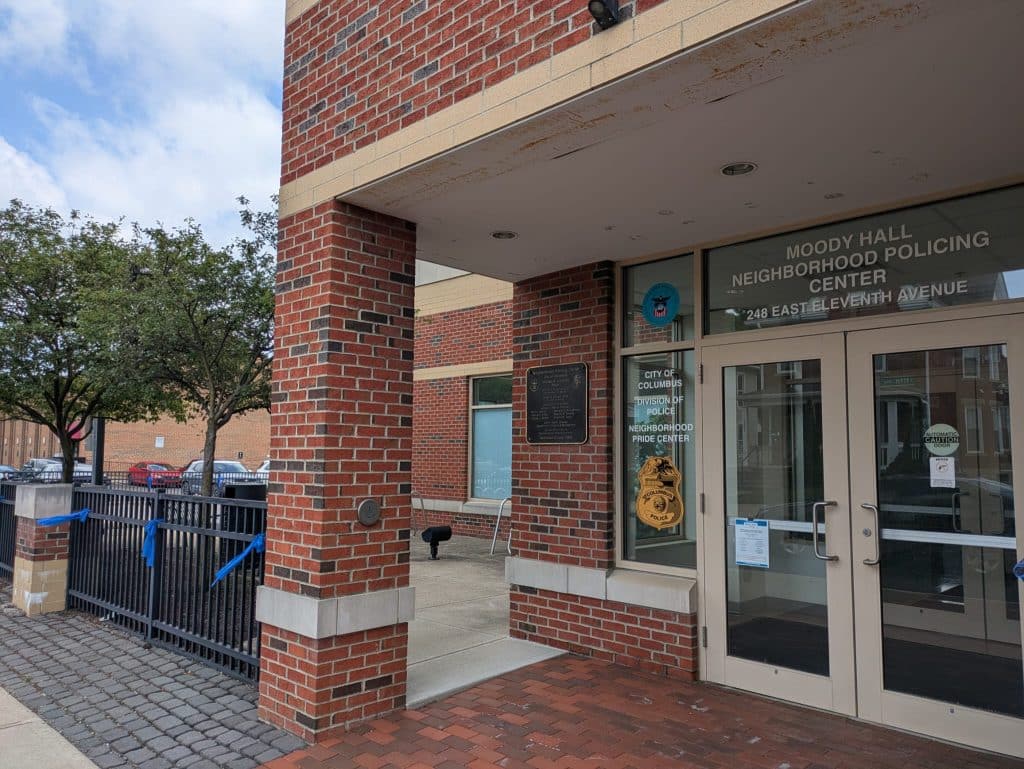
It’s not every day that police union leaders sit down with social justice advocates for coffee.
Nevertheless, both Columbus Safety Collective activist Chana Wiley and Fraternal Order of Police (FOP) president Brian Steel both said one such meeting may have proved pivotal in the years-long campaign to implement an alternative non-police crisis response system in the city for certain 911 calls.
“That first meeting really sealed the deal,” Wiley said.
A donation powers the future of local, independent news in Columbus.
Support Matter News
Alternative crisis response systems that replace police with clinicians have proliferated across the United States in the years since the reinvigorated Black Lives Matter protests of 2020. But prior to this year, when more than 76 percent of voters approved an amendment to the city charter, Columbus had yet to implement its own around-the-clock non-police crisis response service.
Though the charter amendment eventually gathered a coalition of broad community support, including both activists and the police, the road to non-police crisis response was long. And as the city moves toward implementation of a 24/7 service by 2030, questions remain about funding and structure, the need to hold the city accountable, and the work left to do to foster public safety in Columbus.
The goal of creating non-uniformed crisis response teams composed of medical professionals and peer supporters, according to Wiley, is aimed at making sure “people feel safe when they’re calling for help for a loved one in crisis, whether it’s behavioral health, mental health, houselessness, substance use, a welfare check, all non-violent calls.”
According to William Cotton, a pediatrician and former president of the Columbus Medical Association, the evidence shows that “alternative crisis response models reduce avoidable emergency department visits, prevent escalation, improve long-term outcomes, and even save tax dollars,” leading him to call such programs “lifesaving.”
For many, the need to bring alternative non-police response to Columbus is personal. Wiley’s own brother died in police custody in 2017 after his call for help while using drugs and experiencing a mental health crisis ended in police using force to restrain him. Other organizers, Wiley said, had experienced firsthand the difference between Columbus and other cities in responding to welfare checks.
Though Columbus does currently run multiple alternative co-response programs that pair police officers with clinicians, Wiley said when compared to the rest of the country, the city “needs to catch up with alternate crisis that’s specifically non-police.” The Columbus campaign, she said, drew inspiration from programs across the country, in Albuquerque and Denver, but also closer to home in Shaker Heights and Dayton.
The road to non-police crisis response in Columbus has not, however, been straightforward. The Columbus Safety Collective spent years “not seeing any traction or any movement for what we knew the residents wanted,” Wiley said.
In 2023, City Council allocated $1.2 million to pilot non-police response. But Wiley said the city let them down. “There was no movement as far as standing up the pilot,” she said, adding that a large portion of the money went to a consulting firm to produce a report evaluating the existing crisis response system.
Bonnie Maney, vice president of operations for Mission Critical Partners, the public safety consulting firm that conducted that assessment of existing crisis response, called Columbus “forward-thinking” in its implementation of co-responder programs, and particularly in regard to the integration of licensed mental health clinicians in the 911 call center. She also pointed to mobile civilian crisis teams already accessible via 988, the Suicide and Crisis Lifeline, and operated by private providers Netcare and North Central.
Still, the report, released in December 2025, ultimately recommended the establishment of a unified non-police response unit composed of a licensed clinician and a peer support specialist, which Maney said they found “was clearly a gap and a need and a desire by the community.”
While that report was being produced, activists moved ahead from the broken trust of the missing non-police pilot. “If you don’t stand it up, we’ll see you at the ballot,” Wiley said of their approach, adding, “That was not a threat. That was a promise, because we promised to advocate for the residents of Columbus.”
Alongside partners Ohio Voice, the ACLU of Ohio, and Ohio Families United for Political Action and Change (OFUPAC), the Columbus Safety Collective formed their official amendment campaign and began collecting signatures for what eventually became Issue 5 in the May 2026 election. Wiley described the campaign as “scrappy,” with campaign managers sometimes working without knowing when they would be paid. “We couldn’t afford to do additional fundraising if we had someone putting in a ton of money to oppose us,” she said.
Support, or at least friendly neutrality, from union leaders was critical for success. “I knew, and the other labor unions knew if we fought this, this would get dragged out for years,” said Brian Steel, president of FOP Capital City Lodge 9, which represents approximately 4,700 police officers, mostly in Franklin County.
Despite their differences, Wiley and Steel said they were able to find common ground on this issue over a series of informal meetings. Steel said officers will be relieved if non-police crisis response teams with additional training or resources can assume the approximately 20,000 mental health calls Columbus police take annually.
For officers and the union, Steel said there were two major concerns. First, he said the money for the program could not come from the police budget. And second, the safety of the social worker needed to be prioritized. Once Steel was satisfied that the social workers’ union approved of non-police response teams and that police were not being defunded, he signed off on the plan. “At the end of the day, we said, not only will we support this, we will endorse this,” he said.
The final hurdle for the campaign involved the timeline and, given that money would not be taken from police budgets, finding the funding for implementation of the non-police crisis response system.
Earlier this year, Wiley said, the campaign came to a compromise with Columbus City Council. They agreed to withdraw the original charter amendment for which community members had signed petitions, and which included a clause mandating funding of $5 million for non-police response starting in fiscal year 2027 and at least $12 million by 2031. It was replaced by a similar amendment that requires funding only “in an amount sufficient to pay for the personnel, services, and other resources necessary for the planning, implementation, and sustainability of community crisis response system.”
In explanation, Wiley said the money “was something we were willing to negotiate on” to ensure that non-police crisis response would be enshrined in the city charter.
The 2026 city budget includes $8.8 million for all alternative crisis response programs, of which $1 million will go to the first non-police response. The budget also includes more than $444 million for police, up from the $397 million allocated in 2025.
In an interview with Matter News, City Council President Shannon Hardin said that the city will move to unify these alternative crisis programs and increase funding to meet the requirements of Issue 5. Explaining why funding would not be reallocated from police budgets, Hardin said, “I think that we should be investing in public safety all the time. There are times when we need armed police officers, there are times when we don’t.”
“This was never framed as an anti-police effort,” he added. “This was, how do we make sure that police have the support to do the work that they are trying to do?”
Regarding the timeline for implementation of non-police crisis response in Columbus, Hardin said the city has worked steadily to continue to grow alternative crisis programming. But, he said, they knew it would take time to stand up this new type of first response, and that “Council was trying to bring along the administration to convince them that this was not just worth the investment but was worth the prioritization.”
Turning to next steps for implementation, Hardin said he is excited about the 11-member advisory board included in Issue 5, which will be selected by public application and advise the planning, implementation, and sustainability of the community crisis response system. “We’re going to be working on making sure that the programs that we set up are transparent and that there’s public accountability,” he said.
That recognition of the need for accountability is mirrored by Joey McQueen, an organizer on the leadership team of the People’s Justice Project (PJP). She called for the public “to stay informed about implementation, participate in public meetings and community discussions, monitor transparency and outcomes, hold their leaders accountable for delivering on their commitment.”
McQueen noted that the conversation around alternative crisis response had originally emerged from the defund the police movement. “People were starting to imagine what they would like to see instead of overpolicing,” she said. “Instead of sending police to a situation, [people were asking], who will be the more appropriate professional to handle non-violent situations?”
Still, McQueen called the charter amendment a “great step in the right direction. For her, the backing from the FOP signaled an understanding that the community needs to have more say, and that “they agree that something different needs to happen and perhaps that something different needs to come from a different set of professionals.”
Jason Renaud, the administrator of the Alternative Mobile Services Association (AMSA), a national trade association for mobile crisis programs, said the path Columbus has taken to start a non-police crisis response service is likely unique. “No other city, to my memory, has required a vote. Most cities have recognized the value and set staff and local experts in motion,” said Renaud, who also noted that evidence has shown the crisis response model can benefit a city’s bottom line. “Especially if leadership brings other city services to an integration posture – the 911 PSAP [Public Safety Answering Point], the police and their labor unions, ambulance contractors, local hospitals, et cetera.”
Based on the experiences of other cities, Renaud said Columbus could also face challenges. “Because you have such a long windup, there’s going to be a huge amount of public expectation that they’re going to solve all the problems, which no mobile crisis or alternative crisis team does,” he said. “They’re just another tool in the toolkit.”
More broadly, Renaud said programs across the country experience problems securing sustainable funding and building the workforce of crisis responders.
Renaud also cautioned that successful implementation of an alternative crisis response program comes down to personal relationships and trust between stakeholders. He pointed to Chicago, where the non-police CARE team has been held back by adversarial relationships that have made it difficult to transfer emergency calls. “Having the alternative response team know the mobile crisis team know the co-responder team know the police team know the ambulance service,” is crucial, he said. “And not like we have an MOU (Memorandum of Understanding) to work together, like no, I know Joe, and I know when I call him, I can trust him to come and help me out.”
With Issue 5, the Columbus non-police crisis response service is required to be operational by 2028 and to run 24/7 by 2030. Despite the long road to get to that point and the long road ahead, hope is abundant, as are shared visions for a safer future.
“My vision is that when you call … just automatically those dispatchers know how to route that call, they know that this team is highly skilled, highly trusted, and they’re going out and doing this,” Wiley said.
Hardin said his vision is of “a day – and not that far off – where when you call 911, you’re not worried about who’s coming or what the response is. … You will get the best response to whatever crisis you are experiencing.”
For McQueen, the goal is aligned with the work done at the grassroots level by PJP. “When people are out in the world, especially our Black folks, our people of color, our disenfranchised,” she said, “they feel a little safer knowing that if something were to happen … they’re going to be met with care.”
Related Articles

The billionaire-backed think tank that wants to change harm reduction and homeless policy
Joe Lonsdale’s Cicero Institute contends that we can arrest our way out of the housing crisis, and that states must enforce laws ‘prohibiting open drug use, urban squatting, camping, and loitering.’
Opinion: You can’t talk about Issues 8 and 9 without race
A problem with the discourse around these issues is that it isn’t being completely honest when it comes to race. Not publicly, anyway.
Inside Ohio’s Revolt Against Data Centers
A colorful crew of activists helped spur moratorium votes in 10 communities next month. Now, they’re aiming for a statewide ban.