
Care is a verb: Lessons in building supportive community from lifelong advocate Vince Engel
Times of uncertainty and fear can foster societies of care.
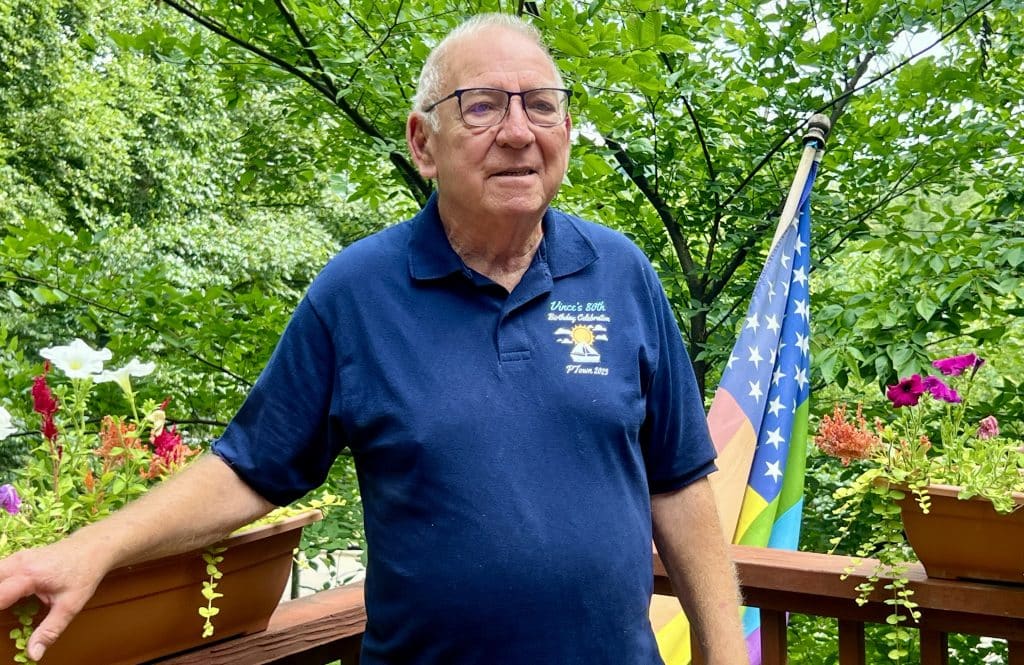
Vince Engel would drive people to appointments, help them get groceries, and sit with them in waiting rooms, spending time with them in their most difficult moments.
It was the early 1990s and the AIDS epidemic was killing people in his community. There wasn’t time to consider, Vince says. You just stepped up.
Gay men faced hate, and those with the diagnosis faced stigma: What will my employer do if I test positive? Will my insurance know? Will the government? There was so much fear.
A donation powers the future of local, independent news in Columbus.
Support Matter News
In Columbus, the AIDS Taskforce created a buddy program that would partner trained volunteers with someone who needed support – often until they died. People were tasked with caring for complete strangers.
It’s been more than 30 years and Vince is recounting this from his easy chair, his bright smile lit by the sun coming through the large windows in his living room. VInce is kind but always direct.
It was what people did, Vince says. And there were many people working as buddies, raising money, working to address stigma. In addition to his volunteer work, Vince was a physician’s assistant, serving on the frontlines addressing stigma and care in the state. But even he went beyond what was expected of him. At one point, when his own partner became sick, Vince brought a friend into his home and cared for him until he passed away.
“The community was bigger than just gay men, too,” Vince says. “But anybody that was not very sick yet, or was negative, was in the fight.”
At this moment, too, the work of harm reduction continues to spread in the United States, fostered by grassroots organizers – Black and Brown and LGBTQ+ people who form ideas and organizations that persist. A time of fear and uncertainty fostering societies of care.
A recent essay by public health scholars Gregg Gonsalves and Amy Kapczynski in Daedalus explored what it would look like if care, not just for our immediate loved ones, but for strangers was at the center of our politics, our social life, and our economy. Care, they write, is a “social activity and commitment. Care in this context is defined as the life-sustaining activities and infrastructures that enable all other things we do.”
This social activity is health care, childcare, and home care. It is having concern for others and making choices and commitments to them – especially during moments of crisis and change.
Through the chaos and disruption of industrialization, for example, came the notion that water and sanitation are necessary public goods that support the safety of the whole community. But these public goods “remain vulnerable in a political economy that prioritizes financial gain.” Consider the water in Flint.
Care must counter the hyper-individualistic currents in our culture fostered by a self-centered administration and tech billionaires who would rather leave the Earth behind than save it. On the 250th anniversary of the Declaration of Independence, we should be painfully aware of our dependence on one another.
As I write this in Ohio, breathing outside is hazardous, lettuce is making people sick, and 161,000 people recently lost health insurance coverage with the rollback of Affordable Care Act subsidies.
Gonsalves and Kapczynski wrote that it’s our work “to rebuild the very ideal of care in its social sense. … Our earlier care awakening came from periods of deep darkness – the industrial revolution and devastating wars and pandemic. That is small solace today, and yet no insignificant thing, as we try to imagine the future ahead, in which something arises from the ashes better than before.”
The way Vince Engel quietly cares for others has always impressed me. He does so without fanfare or praise or under the auspices of some organization. His compulsion for care has deep roots. He bakes cookies for unhoused folks, he opens doors, he makes sure the people he encounters in his daily life are supported and cared for.
Vince is 83 years old and has had cancer for several years now. He told me that he is not seeking treatment at this point because the quality of his days is more important than the number of them. So, he travels with his husband and finds time to visit with his friends – relationships that developed in that moment of crisis in the early ’90s. And now they have offered to help him. The care has come full circle.
“How do we replicate that?” I ask. “Like, how do we, what do we do? What’s wrong with us?”
“Society right now is so much, not everybody, but so many people are all about themselves,” Vince said. ”But we can start with friends and family and then keep going. We have models. We start where we are.”
As I stand up to leave, we talk about a mutual friend who is sick. I share how I sometimes get frustrated with helping and with the fact that it’s so complicated to get assistance for him in this country.
“You have to,” Vince said. “He’s a part of the community.”
In other words, get over yourself.
It had been a week since I had seen my friend. After dinner I made an extra plate for him, put on my shoes, and walked over to his house.
Author
Related Articles
Opinion: You can’t talk about Issues 8 and 9 without race
A problem with the discourse around these issues is that it isn’t being completely honest when it comes to race. Not publicly, anyway.
Opinion: Trifectas are only good for racing and the lottery
The legacy of Ohio’s Republican Party is corruption, scandal, and culture wars. Our votes could put an end to their occupation of state government.
If you start from a place of love, you can’t go wrong
A vigil for an unhoused community member who recently died in Newark served as a call to not look away.