
Elizabeth Newell takes off her masks with ‘An Act of Defiance’
The Columbus artist confronts both internal demons and fractured support systems in her awe-inspiring new exhibit, which kicks off with an opening reception at the Awesome Gallery from 1-3 p.m. on Saturday, Sept. 13.
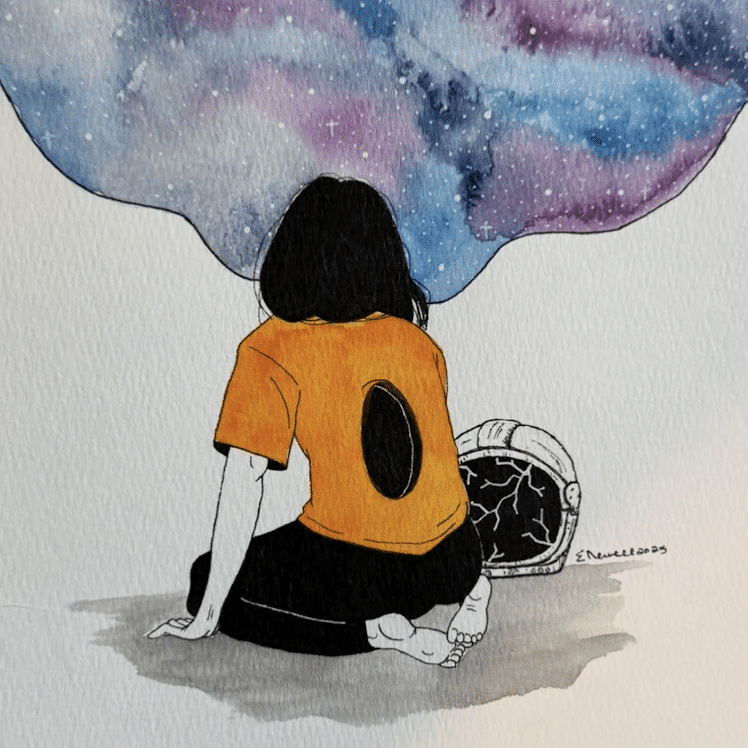
Growing up with autism, Elizabeth Newell said she relied on masking to get by, with her words and actions often serving as safeguards meant to protect her complex interior world.
These various metaphorical masks take on physical form in the artist’s remarkable new exhibit, “An Act of Defiance,” which kicks off with an opening reception at the Awesome Gallery from 1-3 p.m. on Saturday, Sept. 13.
There’s one mask constructed of mirrored fragments and another modeled to look like a parrot – both echoing the way the artist said she would “take in people’s energy and kind of match it” as one means to mitigate the sense of overwhelm that often accompanied personal interactions.
A donation powers the future of local, independent news in Columbus.
Support Matter News
“I spent so much time copying other people that I couldn’t even tell you what my favorite color was, because I didn’t have one, and it would change based on the person I was copying,” said Newell, joined for an early September interview by Awesome Gallery founder Jacquie Mahan.
Other masks reflect different guises the artist adopted in social settings, whether leaning into her silly side (a clown), making herself “look pretty like the pictures on TV” (one with doll-like hair and features), or projecting a beaming facade “because we are taught that’s what people want, no matter what is behind it” (a golden-hued mask made to look like the shining sun). There are also a handful of masks that fall closer to the artist’s truest self, and which she said allowed her “to live more authentically, but in a way that would still keep me safe.”
Adding to the complexity of these works, each mask is embedded with a small painting that offers viewers deeper insight into Newell’s vulnerable inner world, and which is visible only by peering through the eyes of each form.
When Newell made her debut as an exhibiting artist at Awesome Gallery in September 2024, the story that unfolded within the space emerged as a product of chance, with a series of paintings featuring anthropomorphic frogs somehow combining to show her efforts to hold to the beauty and magic present within our sometimes-tumultuous world. In starting work toward her latest collection, however, Newell said she wanted to be more intentional in her storytelling, initially viewing the masks as the backbone of an exhibition dubbed “A Cabinet of Curiosities” and partially rooted in the books she was reading at the time.
But in January, Newell’s daughter Lily, then 12 years old, survived a suicide attempt, surfacing a mix of despair, anger, and helplessness in the artist, who began to self-harm at age 13 and survived her first suicide attempt a year later. With the ghosts of these past traumas violently crashing into the present, Newell shifted the direction of the work, crafting what she termed “a museum of darkness’ in which she could shed her various masks and lean into the more raw-nerve, visceral realities she had long obscured from the view of outsiders.
“Last year, the frogs were really fun and joyful, but I think when she got done with that project, she got really pissed off and was like, ‘I am angry and I don’t like how the world isn’t meant for me,’” Mahan said.
Newell takes centerstage within “An Act of Defiance,” frequently appearing in her surrealist watercolors as a space helmet wearing explorer – likely a nod to the central character in The Little Prince, which the artist has read countless times and holds so dear that she has three tattoos inspired by the novella. This series of paintings finds the artist exploring ideas both internal (disconnect, loneliness, rage) and external, with Newell repeatedly concentrating her ire on those systems that so often fail the people who most need them.
For one collaged work, Newell incorporated handwritten poems and journal entries, building a deeply layered composition that she described as “the piece I wish I could give my younger self,” and which serves in part as an affirmation of the artist’s desire to leave the world a better place than she found it. Absent that drive, Newell said, she might not have survived to this point. The collage rests aside watercolors that capture unguarded moments of bonding – between mother and daughter, especially – and others that ripple with the sense of disconnect that Newell said she often feels in navigating life with autism.
As one example, the artist relayed her deep love for the wind, and how she can sit on a bench in the park as a breeze passes through and feel its power and softness on her cheek, so awake to the vitality of the world in that instant that she can discern the rustling of each individual leaf in the nearby trees. “And sometimes I wish that at that moment I had someone there to share it with,” she said. “But then I’ll feel sad and lonely all over again, because I know it’s something that people can’t really experience.”
Elsewhere, Newell takes a more outward look, examining the various broken systems tasked with providing support for those in need. One painting, for instance, consists of a tall room lined with endless rows of doors and is rooted in Newell’s failed attempts to have her Social Security assistance reinstated in the wake of her autism diagnosis, which she said led to door after door closing unceremoniously in her face.
The east wall of the gallery, in particular, captures the resonant anger that helped give shape to this particular collection, reflected in everything from the subject matter explored by Newell in these paintings (police brutality, the reality that autistic people experience both incarceration and death by suicide at significantly higher rates than others) to the way the works are displayed. One of the paintings is mounted in a purposely broken frame, while others are set askew, as if someone had let out their frustrations by pounding on the wall and disrupting the gallery’s usual sense of order.
“We have built these systems, but these systems have so many cracks, and in the story it talks about how there are so many cracks in the museum that I don’t know how it can even stay standing,” said Newell, who came to view these fractures as endemic to the various support systems on which people rely, be it churches and families or state-run institutions.
“And it’s so much easier to place the blames on these cracks on the individuals,” Newell continued. “‘No, the system is not broken. You just don’t fit into our box.’ ‘No, the church isn’t flawed. You just need to pray harder.’ … We put all of this on the person, and we try to blame them and make it their responsibility, but it’s not. And [the system] is killing people and putting them in jail, and still, we blame them, and it’s fucking awful.”
This reality surfaces most cleanly in a collaged work that features photographs of nearly a dozen departed autistic people, the majority of whom either died by suicide or were shot and killed by police while in the midst of a mental health crisis, including Victor Perez, a nonverbal teenager with cerebral palsy fatally shot by Idaho police in April.
“Unfortunately, a lot of autistic people end up in prison or in the cemetery,” said Newell, who a decade ago suffered her own assault at the hands of police while experiencing crisis. “And there’s this huge question mark asking, which one is going to be my place? I don’t think I have the personality where I’d end up in prison, though some days I question that. But it feels probable that Lily or I will end up [in the cemetery]. And because so many do, I wouldn’t be alone, and I would be in good company.”
In creating work for the exhibition, however, Newell’s story began to shift in subtle ways, with the artist drawing out the impact of people such as Mahan – those rare, safe people she came across who had the ability to step “into the darkness and make it safe, and not try to talk over it, cover it up, or deny the cracks.”
It’s an awareness that gave rise to the ending of this particular story, in which Newell envisioned herself seated on a park bench next to a ghost holding a single red poppy, a second flower pinned to their chest.
“And then they gave me the [poppy] in their hand and whispered, ‘I am safe. I will help you. You are not alone,’” said Newell, who recreated this bench within Awesome Gallery, decorating it with a few of her favorite books and a smattering of origami stars made from old journal pages, placing beneath it a small chest filled with poems, drawings and handknit red poppy pins. “Sometimes things can get confusing, and people will all look and feel the same. The poppy pins are my way of identifying the safe people; the people who even when the darkness comes and I can’t really see, I’ll know at one point I said they were safe. It’s something to keep me anchored in the darkness.”
Author
Related Articles
Afi Lane explores concepts of memory, migration in stirring 934 Gallery exhibition
The Houston-based artist’s ‘Northbound’ will remain on display at the Milo-Grogan gallery through Saturday, June 27.
WIT Gallery celebrates turning five while keeping an eye on the future
Poet, artist, and gallery founder Larry Robertson will celebrate the Franklinton art space’s anniversary with a sprawling group exhibition opening on Friday, June 12.
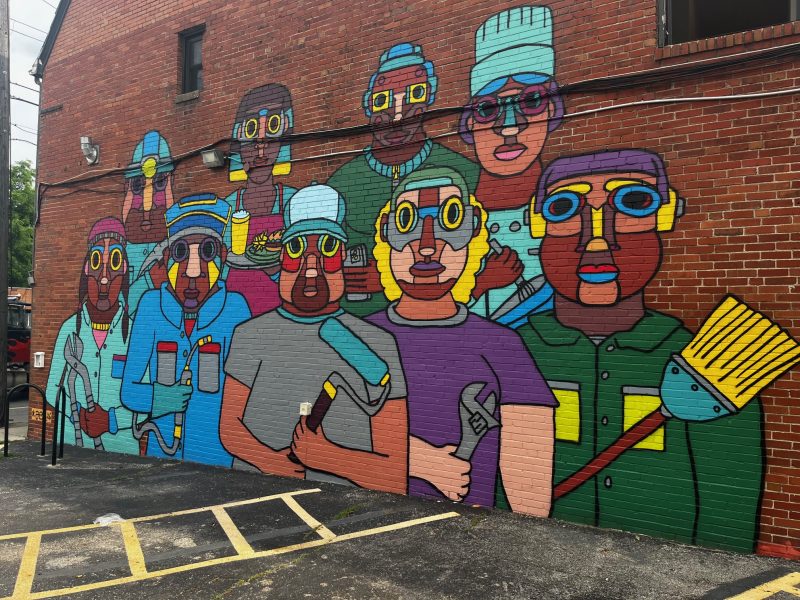
Adam Hernandez aims to uplift immigrant workers with his latest mural
The Columbus artist will be on site at 1014 Parsons Ave. for the public unveiling of ‘We the People/Nosotros la Gente” on Thursday, June 11.