
Pigeon Pit takes in the big picture, centers the small moments on ‘Leash Aggression’
The Olympia, Washington folk-punk band hits Dirty Dungarees for a concert on Wednesday, May 6.
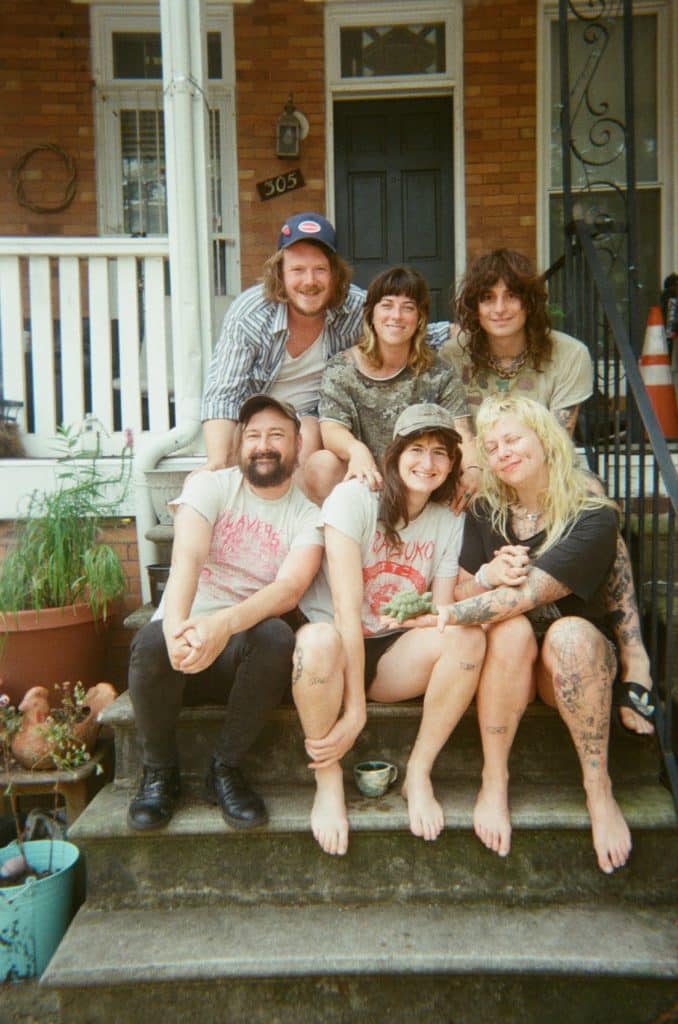
Pigeon Pit frontwoman Lomes Oleander wrote the song “Anthill Mode” as a means to capture her mental state when she’s “fully zoomed out,” as she explained it, taking in the social and political landscapes from 30,000 feet above the Earth.
“When you’re in an airplane looking down from above, you see all these identical neighborhoods, and it’s hard to see any humanity or to have any hope for the individual,” Oleander said by phone ahead of the Olympia, Washington folk-punk band’s concert at Dirty Dungarees on Wednesday, May 6. “It’s like the futility of being in traffic, where everyone is pissed off and hating each other all because they’re trying to get to their job a little faster. It’s fucking crazy and not okay. … And then you compare that to zooming in to the little shit you have in your life, and the people you have, and the uniqueness you get to experience, which is so sick. And I think a lot of my strategy in songwriting is zooming in on those little moments that I see in my life and trying to remember them and hold onto them.”
This reality holds on Pigeon Pit’s most recent album, Leash Aggression, from 2025, where Oleander makes clear these surrounding big-picture faultlines (unchecked capitalism, the growing housing crisis, the psychological damage inflicted by being able to watch multiple genocides unfold in real time on social media) but continues to home in on those moments of intimacy that can serve as emotional ballast. “I’ll take the wins that I can get with my time/Like a morning spent in bed with a love of mine,” she sings on “Go Ahead Then! Beat Me to Death!”
A donation powers the future of local, independent news in Columbus.
Support Matter News
Leash Aggression opens with “Last Night on Planet Earth,” and Oleander responds by singing with an urgency throughout that suggests she’s racing against this doomsday clock, her words often arriving in a tumbling avalanche of syllables. Aspects of this rush reflect the more condensed writing process, with Oleander noting that most of the songs arrived in a burst over just four or five months – a stark contrast to the band’s previous album, Crazy Arms, which gestated for nearly three years before its release.
“And a lot of that [time] was learning about recording techniques and layering and arrangements, and it was really fun and I was really happy with what came out of it. But I also had this belief that if I just pushed something out as fast as possible, and without thinking or putting that intellectual processing into it, it would still hold up, and it might be more experimental,” said Oleander, who acknowledged there are aspects of the album she continues to unpack as a result of this approach. “I wrote a lot of it when I was traveling, or when the things I was writing about were still happening, so it was very stream of consciousness, honestly, or this raw processing, where I hadn’t taken much time to really think about a lot of it.”
Oleander penned “People on the Bus,” for one, while riding public transportation in New York City, taking in the scene of passengers staring absentmindedly at their phones and using it as a launch point to expound on everything from the inequities baked into the capitalist system to the psychological harms being done by having mass death streamed to us via social media. “You watch warplanes killing in slow motion,” Oleander sings on the track, buttressed by a disarmingly jaunty guitar jangle.
“It’s the first time a genocide has been this well documented and this accessible. And I think there’s a tendency in people who are horrified by war, and who are horrified by this situation, to believe that by witnessing it on our phones and exposing ourselves to it, that we are inherently doing something,” she said. “And it’s not that we should blind ourselves to it, but … I think social media preys on this very human drive to care about each other as a way to capture our energy, or to [tamp down] our potential to organize and change things in the world.”
Elsewhere, Oleander explores issues of class (“Landlord Special”); the ways scar tissue can serve as a bonding agent, particularly within the trans community (“Threading the Needle”); the sense of joy and escape that can be found communing in music (“Last Night on Planet Earth”); and on the wondrous, deeply intimate “Rearview Mirror Blues,” the inevitably of death and the complex mix of emotions this reality has stirred within the musician as of late. “I’m afraid now of certain things I didn’t used to be,” Oleander sings, the abutting couplets reflecting a growing awareness of mortality that comes from seeing both pets and parents become increasingly gray and enfeebled.
“It’s seeing people age or going to see your parents and they look significantly older. Or knowing your dog is going to die,” Oleander said. “But another thing I’ve been feeling, having other friends who have passed away, is that getting to witness your friends and parents and the people around you growing old is such a beautiful fucking thing. It’s a gift to get to see the people you care about get old. So, yeah, I’m afraid of things I didn’t used to be, but I’m also excited about certain things I used to be afraid of.”
The same could be set of parenthood, with Oleander addressing her fears of bringing children into such a damaged world early on the album – “Parents tuck their children into bed/And for what future, I don’t know,” she sings on “People on the Bus” – and then gradually softening her stance as things progress.
“I had a dream I had a daughter/Her soft breath melted my cold heart,” she sings toward the end of the record on “Anthill Mode.” “And I believe that where we’re headed/Was worth all the trouble that we start.”
“My struggle with having children someday is part of the album, and the idea that our future is tied up in these global issues that we feel powerless in the face of,” said Oleander, who described hope as an active choice rather than something that exists passively within the individual. “And I think it can be easy to retreat to a comfortable place of doomscrolling and be like, ‘Oh, I could never do that because the future is so bleak,’ as opposed to thinking about what we can do for the future and realizing that raising children can be a part of that. And hope isn’t necessarily a prerequisite for having children, but children are hope.”
The musician has also been helped by her decision to take a more active interest in the people she encounters in her day-to-day – a revelation sparked in part by her experience riding that NYC bus with passengers more engrossed by their phones than their actual surroundings.
“We talk about screen addiction, but it’s also the reality we choose to spend our time in. And this thing we’re choosing to spend our time with is this very curated and manicured zone that is tailored to keep us locked inside of it,” she said. “And so, my New Year’s resolution has been to talk to strangers more and to talk to random people in public more. And even if you’re just being playful, and even if you’re just talking about bullshit, it’s about sparking a conversation and maybe some sort of connection.”
Author

Related Articles
Sluice is still figuring things out
The Durham, North Carolina band visits Rumba Cafe for a concert on Saturday, May 9, playing behind its excellent new album ‘Companion.’
Faye Williams begins her climb with ‘Woman in Black’
‘I would say hitting rock bottom helped to remind me what my priorities are and why I even started making music to begin with.’

Happy Chichester provides comfort amid hardship with ‘Test Time’
‘I’ve always been drawn to artists who take a moment to actually look that awful reality in the eye … and then give us something that helps us.’