
Lance Johnson draws on the power of his ancestors for ‘Look at Us’
Shaped by everything from his mother’s death and the recent presidential election to an October trip to Selma, Alabama, a new collage piece by the Columbus artist sees him drawing on the past to find new ways to move forward.
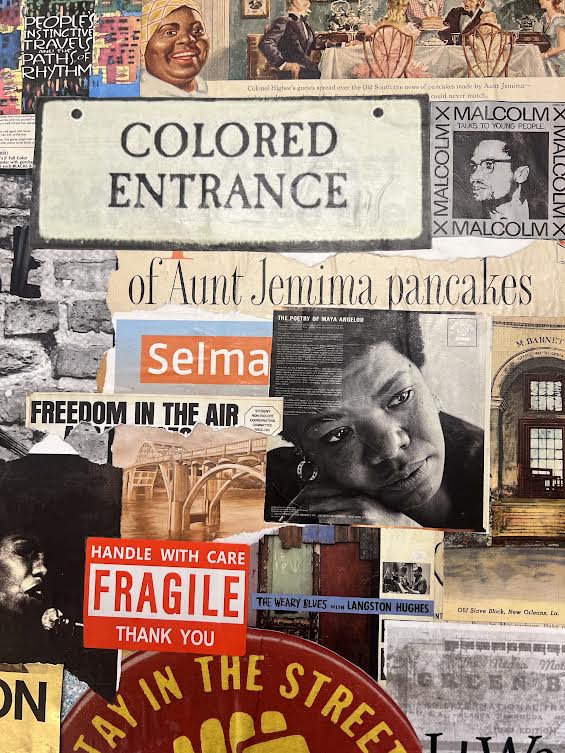
It’s been a challenging couple of years for Columbus artist Lance Johnson, who lost both of his parents in that time and has attempted to carve out needed space in which to grieve.
As one means of coping with these losses, Johnson, who in recent years has embraced a style heavily influenced by street art and graffiti, again began to experiment with collage – a form that served as his introduction to creating, and a return to which allowed him to draw closer to the spirit of his mother.
“When I was 14, my mom showed me a documentary, ‘I’ll Make Me a World,’ which celebrated African American art, and in particular the Harlem Renaissance. And there was one artist who really resonated with me, Romare Bearden, who was an amazing collage artist, and I always wanted to create collages that riffed off of his work,” Johnson said in an early December interview. “So, collage was really the foundation of me starting out as an artist, and then I kind of drifted away from it. … With my mom passing, it felt like the time to get back to the essence of what got me creating. … It felt like I was tapping into my mom’s energy, for sure.”
A donation powers the future of local, independent news in Columbus.
Support Matter News
One of these more recent pieces, titled “Look at Us,” draws further inspiration from an October trip Johnson took alongside fellow artists Richard Duarte Brown and April Sunami to Selma, Alabama, during which the three were afforded the opportunity to collaborate on art installations with local high school students. Johnson, who had long resisted visiting that part of the United States – “I always said there were two places in the country I never want to visit: Mississippi and Alabama,” he said – decided to embrace the opportunity when presented, even walking the Edmund Pettus Bridge where police brutally attacked Civil Rights Movement demonstrators in March 1965.
Johnson described the walk, undertaken just weeks after the death of his mother, as deeply personal, leading him to reflect not on the evils that continue to be enacted on the Black community but rather on the woman who helped to steel him against these forces and continues to serve as a beacon of hope even in her absence. “I had a picture of my mom in my pocket when I was walking the bridge, and it was like we were walking the bridge together,” he said. “And it was hard for me, but it also felt like it was an act of defiance to be there, because we were there celebrating the community, working alongside the community, creating art for the community.”
The artist said he could feel the weight of the past as he moved throughout Selma, particularly when a tour guide brought him to the site of a monument honoring Nathan Bedford Forrest, a Civil War Confederate general and the first Grand Wizard of the Ku Klux Klan. Erected in 2000 by the Sons of Confederate Veterans, the monument was unveiled in the same week the city’s first Black mayor began his term – a reality not lost on Johnson.
“As a counter to [a Black mayor being elected], they created this monument,” said Johnson, who captured the granite pillar in a photograph posted to Instagram, foregrounded by his extended, paint-covered middle finger. “And it reminded me of how evil has been celebrated in this country for a long time, and how tragic the history of this country has been for so many people. And it also reminded me of the ways that history can repeat itself.”
This reality came crashing back in the wake of the recent presidential election, which saw Donald Trump again elected into power just four years removed from staging an attempted coup. “I said I wasn’t going to post about this today but… this IS who we are as a country,” Johnson wrote in a Nov. 7 Instagram post in which he described Trump’s reelection as an “epiphany.” “Many Americans prefer chaos and division. Trump is the vehicle. … THEY always have leaned on the side of chaos, hate, and division, and history proves it over and over.”
“Too much of this country really leaned into hatred and division,” Johnson said in December. “It was a reminder that the fight is still raging.”
As he did in the aftermath of Trump’s first electoral victory, Johnson again channeled these frustrations into creation, describing the art-making process as one that allows him to mutate these accumulated angers, hurts and sadnesses into something more inspirational, with Johnson generally preferring his work to point some way forward through the dark. But within “Look at Us,” Johnson manages both, collaging painful, backwards-looking images (a sign denoting the “Colored Entrance”; a vintage Aunt Jemina ad) with symbols of forward-looking resistance that range from the Public Enemy logo to a page ripped from a magazine article about “Art and the Black Revolution.”
“I was really tapping into the energy of the ancestors whose shoulders I lean on,” Johnson said. “And my trip to Selma was part of that, too. It’s about tapping into that power, into the struggle they went through, and then understanding they still found ways to create and to bring joy to the community. … As hard as this country has been on us, we have always found ways to shine.”
Author
Related Articles
‘Immigration: A Journey of Belonging’ seeks deeper understanding
The new group exhibition, open now at the Losinski Gallery at the Main Library, will host a reception from 2-4 p.m. on Saturday, Oct. 3.
Deep conversations pave the way to ‘Chasing the Light’
A couple of years ago, Loren Bucek invited a group of artist friends to her Clintonville home. The gathering soon evolved into regular meetups that shaped the creation of a new exhibition opening this week at McConnell Arts Center.
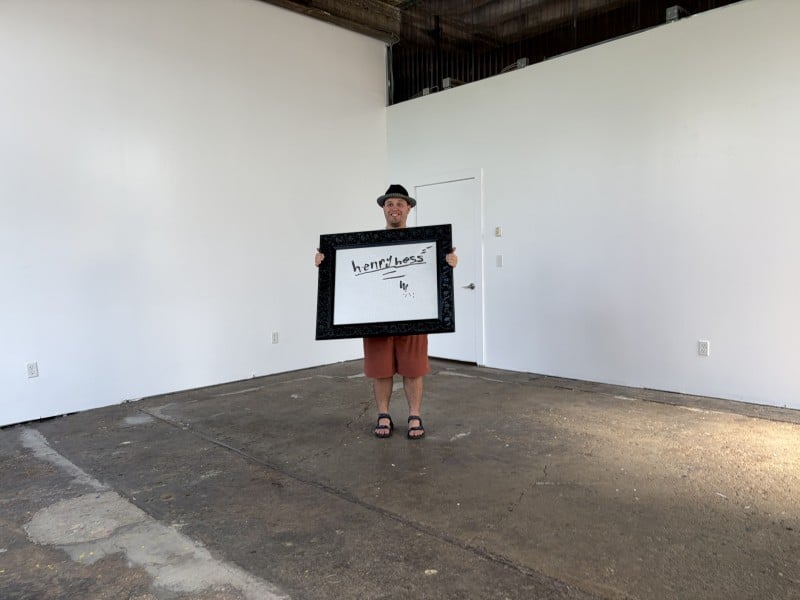
Henry Hess says goodbye to his longtime Chromedge studio
Faced with a rent increase of more than 30 percent, the Hess family opted to move on from the artist’s creative home of the last eight years. And while the next steps remain uncertain, they stressed that Henry would maintain a presence in Franklinton. ‘We’re not going anywhere,’ Sophia Hess said.