
How to disappear temporarily with Darren Demaree
The Columbus poet will celebrate the release of his new collection, ‘Got There: Poems on Vanishing,’ with a reading at Prologue Bookshop on Wednesday, June 10.
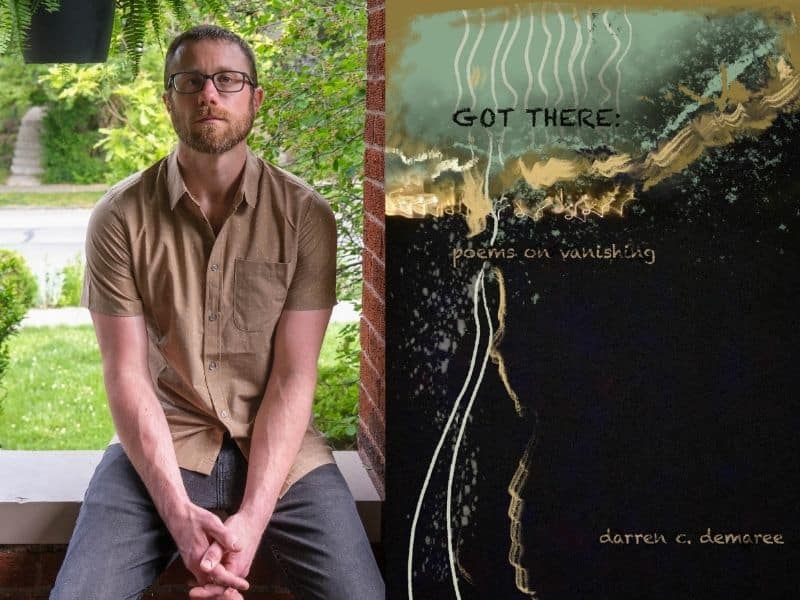
When Darren Demaree saw the photo “ibid” by Alina Stefanescu, he was immediately taken aback, struck by how the image of a dancing streetlight gave way, swallowed by black, only to reappear briefly on the far side of the frame.
“It elicited something in me just looking at the picture and seeing the point where it vanishes and then reemerges right at the very edge of the picture. And I think there are a lot of outside factors going on in the world that make vanishing sound like a great idea,” said Demaree, who then expounded on these mounting external forces. “It’s [asking], how much do you want to be an American right now? How much do you want to work through the sludge of modernity and AI? … Every election, I end up looking at property on a lake in Canada.”
These escapist fantasies tend to be fleeting for the poet, who like the image of the streetlight continues to return, owing both to the necessity of engaging the moment and the knowledge that he wants his work to be observed. “So, even when there’s a vanishing point on the horizon,” he said, “at the end of it, you’re always going to look back, you’re always going to want to be seen.”
A donation powers the future of local, independent news in Columbus.
Support Matter News
The prolific Demaree explores the tension created by this push and pull within his latest collection, Got There: Poems on Vanishing, writing at one point about his desire to “leave the city & still be seen from the highway.” It’s an idea that surfaces in ways both modest – the ravine at the rear of the poet’s home emerges as a space of refuge from the adjacent traffic on High Street – and more expansive, Demaree flirting with the idea of abandoning a society set up in a way that requires constant protest and struggle. “We, all of us, could leave today,” he writes in “It Makes Sense During the Day, It Makes Sense at Night.” “Be finally, finally fighting nothing at all with me.”
Elsewhere, the poet surveys the harms being done by our country on a global scale, with “Terrifying and Fearlessly Inventive” calling attention to the rot existent within our society (“The racism is a damn bone,” he writes) and the ways it evidences itself across oceans. “The symbol of war is a hotel left standing next to a bombed hospital,” he writes.
“The angle in here is capitalism, and we wouldn’t save the hospital, we’d save the hotel, because the hotel makes real money,” said Demaree, who will celebrate the release of Poems on Vanishing with a 6: 30 p.m. reading at Prologue Bookshop on Wednesday, June 10, joined by Jeremy Llorence, Cat McMahan, and Stephanie Ransome. “It’s sort of mystifying, and some of the world is just beyond you at a certain point, where it’s like, I don’t understand how any of this is a thing. There’s so much misunderstanding and violence that comes from capitalism and nation states. … The way they’re structured, it doesn’t allow growth, and it doesn’t allow humanity in the way maybe we thought it would. And that’s what I was thinking in introducing the war imagery into the landscape, where it becomes one of the driving forces to just leave, to head in a different direction, and to hope there’s safety somewhere else.”
There also exists an acknowledgement throughout that Demaree can’t absolve himself entirely from the violence done in our country’s name. Witness “I’ve Written Worth,” where the poet writes how he likes “to point out that every golf course is a burial ground, but I’ll use the pool next to the eighteenth.”
“There’s a duplicity that comes with being an active member in a society that is failing people,” Demaree said.
In the past, Demaree has typically written with music playing in the background, generally something instrumental and epic, such as Explosions in the Sky. But for this collection, he challenged himself to write in silence, which he said led the poems that took shape to become more landscape-based and visual. “I spent a lot of time looking around, and I spent a lot of time trying to place myself,” he said. “Like, if this was a physical act I was doing, how would I physically get further away? How would you prepare your body to disappear?”
And yet, the poems are also littered with those things that compel his return, be it ego – “I want my name to be said out loud,” Demaree admits on “Peace or Quiet” – or the responsibilities that come with being a father, a husband, and a part of a community. “I know my psychologist has some dark things to say about the project,” Demaree said, and laughed. “But I don’t disappear, and I get seen at the end. It’s worth it to be part of society, even if you need to reject it at times. Family is important. Community is important. And I know these things.”
Almost a decade back, Demaree published Lady You Shot Me: Remembering Sam Cooke, a collection of poems in which he wrestled with the life and legacy of the legendary soul singer. Entering into the creative process, the poet said he expected the work to be more laudatory. As he got deeper into the research phase, however, his impressions of the singer changed, drawing forth the reality that grace and beauty Cooke captured in his music often existed at odds with how he chose to live his life – a shift reflected in the poems that eventually surfaced.
“And I liked having that initial impulse and then allowing it to be changed along the way, because that’s what the art did, and that’s what you learned,” said Demaree, who watched a similar evolution unfold within Poems on Vanishing. “I love the idea of getting rid of my ego. That’s a beautiful idea. But it’s also a hard thing to not go, ‘Well, did you read the poems?’”
Author

Related Articles

Barbara Fant returns to Columbus ready to leave her mark on Thurber House
The poet and newly minted executive director of the literary nonprofit will take part in a community reception welcoming her to the role on Thursday, Sept. 17.
Signe Damron begins to see things more clearly with ‘Sift Me Through’
The Columbus poet said her new collection, illustrated by artist Marcus Blackwell, arrived as she began ‘processing and coming into my own.’
Cristin O’Keefe Aptowicz finds in history lessons for this current moment
The author will celebrate the release of her new work of historical nonfiction, ‘The Ballad of the Fugitive William Parker,’ in conversation with Ernest Cline, Hanif Abdurraqib, and Scott Woods at CCAD this weekend.