
AI weapon-detection systems make their way to central Ohio schools
Even as the weapon-detection technologies offered by companies such as ZeroEyes find a place in local school districts such as Jonathan Alder, questions about its real-world efficacy remain.
In the aftermath of a thwarted February walkout by students at Jonathan Alder High School in Plain City, Jonathan Alder board member Sonia Walker spoke with a district parent about the school’s decision to clamp down on the planned protest, imagining a scenario in which “some psycho lays down in the field across the street with a shotgun and kills one of our students” had the teenagers been allowed to exit the building.
In the course of the same phone conversation, a recording of which was provided to Matter News (Ohio is a one-party recording consent state), Walker also told the parent that Jonathan Alder schools had previously installed an AI weapon-detection system known as ZeroEyes.
“We’ve never shared this with the public,” she said. “We have a monitoring system that alerts if a gun shows up in the building. … We pay for it. It’s called ZeroEyes. You’re welcome to look it up.”
A donation powers the future of local, independent news in Columbus.
Support Matter News
ZeroEyes is one in a number of AI weapons-detection companies that have gained visibility in the wake of the 2018 mass school shooting in Parkland, Florida – a tragedy that has led to a boom in the school security industry, with NPR reporting in September that the sector is now worth as much as $4 billion and climbing.
Jonathan Alder is the lone school district in central Ohio that has acknowledged the adoption of ZeroEyes, according to public records requests made by Matter News to Columbus City Schools, Dublin City Schools, Upper Arlington Schools, Olentangy Local School District, Westerville City Schools, Hilliard City Schools, Delaware City Schools, Reynoldsburg City Schools, Big Walnut Local Schools, Worthington Schools, New Albany-Plain Local Schools, Gahanna-Jefferson Public Schools, and Whitehall City Schools.
Aside from Upper Arlington, which declined the request, telling Matter News that the records sought “either do not exist and/or are otherwise protected from release by state or federal law,” all of the school districts contacted said they did not currently contract with ZeroEyes.
Dublin City Schools, meanwhile, provided emails between superintendent Dr. John Marschhausen and a representative for ZeroEyes in which Marschhausen thanked the rep for demonstrating the company’s product while telling him the district would not be incorporating ZeroEyes for the 2025-26 school year. “As previously discussed, a successful implementation timeline for next year would require seamless integration and confident decision-making, and at this time, we’re not comfortable with the product’s reliability to confidently move forward,” Marschhausen wrote in April 2025. “That being said, we are open to re-engaging in a future proof-of-concept meeting once new versions are released.” (Marschhausen did not respond to interview requests from Matter News.)
In response to a records request from Matter News, Jonathan Alder provided relevant emails along with a copy of the purchasing packet for ZeroEyes, which shows that the district committed in March 2023 to spend $141,000 to operate the software in five school buildings for a period of five years.
“While I respect the role of the media, publicly detailing specific school security measures and identifying which districts do or do not utilize them creates unnecessary risk. Information like this can unintentionally educate individuals with harmful intent on vulnerabilities, response gaps, and ways to circumvent protections,” Jonathan Alder superintendent James Miller wrote in a statement to Matter News issued in response to an interview request. “That is not transparency that enhances safety, it is exposure that could contribute to catastrophic consequences.”
Experts point to a lack of transparency as one in a number of issues with AI weapons-detection systems, along with the potential for false positives. One Florida middle school, for example, was placed under lockdown in December when ZeroEyes confused a clarinet for a rifle. And in a late May interview, Beidi Dong, an associate professor of criminology, law, and society at George Mason University and the co-author of a 2024 paper on the limitations of visual weapons-detection systems, noted the lack of available hard data to prove real-world efficacy.
“It’s really hard to empirically verify the benefits of this kind of technology,” Dong said. “We might know we have good detection, but we can probably never know whether or not the detection will lead to actual results … [in terms of] saving people’s lives or reducing the number of injuries.”
The company isn’t providing many answers, either. Asked how many prosecutions had resulted from use of the technology, for instance, Sam Alaimo, CRO and cofounder of ZeroEyes, who responded via a representative with Fusion Public Relations to a series of questions from Matter News, said the company “does not monitor the legal disposition of most of these incidents” while also claiming the software had detected “thousands of real brandished firearms brought into and around schools and other facilities.” Alaimo also declined to answer how many school districts in the United States have adopted the technology, citing customer privacy.
“And these questions are hard enough without trying to talk to a brick wall,” said Hannah Quay-de la Vallee, a computer scientist and senior technologist at the Center for Democracy and Technology. “So, basically what they’re saying is, ‘We’re not going to give you answers. Trust us.’ … And that secrecy concerns me, just for a number of democratic process reasons, but also because you can’t ask critical questions about how this thing works if you don’t even know that it’s in place.”
There are two primary kinds of AI weapons-detection systems. The first and most expensive type features AI-enhanced metal detectors that scan for concealed weapons. This type is typically deployed at sports stadiums, hospitals, and other highly trafficked places, including the Columbus Zoo and Aquarium, which installed a weapons-detection system manufactured by Evolv that can penetrate clothing and bags to detect concealed guns and knives.
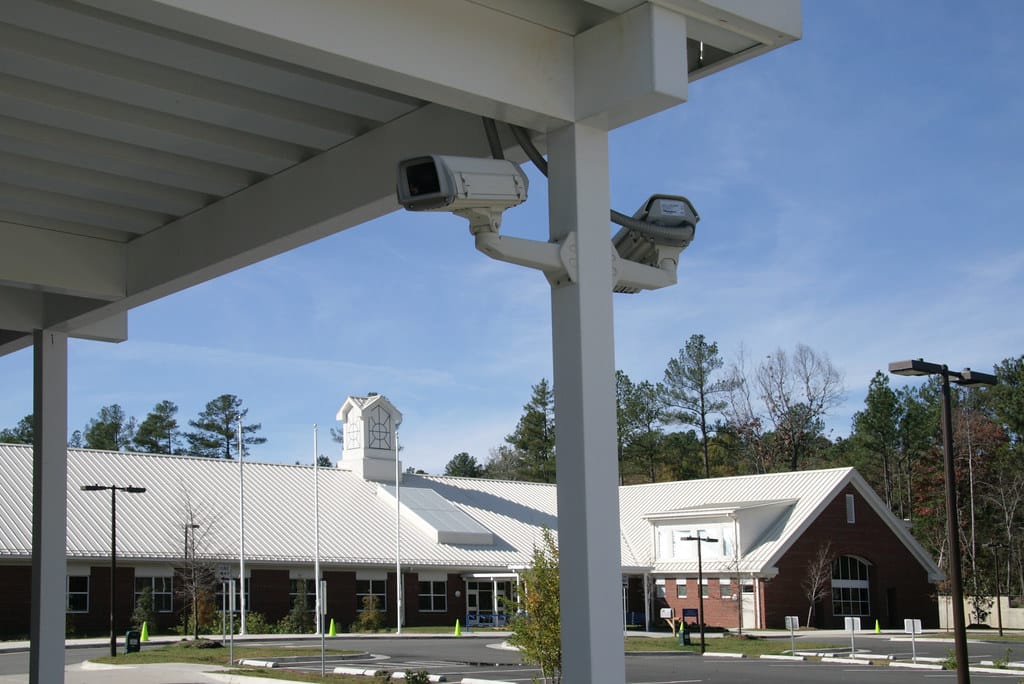
The second kind of AI weapons-detection system – the one currently in use at Jonathan Alder schools – employs AI to monitor the feeds of existing video security cameras, sending an alert when a weapon is detected visually. Providers of these systems, which have been installed in schools, hospitals, and public transit systems across the United States, include Omnilert and ZeroEyes, among others.
ZeroEyes operates by processing every object in a video frame and assigning it a label. A promotional image recently emailed by the company showed a still from a parking lot with every car labeled “vehicle” and a person on an adjacent rooftop labeled “human.” Once a gun is detected in any frame, the image is forwarded to a remote operations center for human validation. If the presence of a weapon is confirmed, alerts are sent automatically to local law enforcement, with the company claiming the entire process from detection to informing the authorities takes place “in a matter of seconds,” according to Alaimo.
The use of a human moderator to make these final determinations sparked concerns for Quay-de la Vallee, who noted this additional layer might provide increased accuracy but could also introduce implicit biases. “Especially when you’re talking about the turnaround time that they’re trying to do this in, where you’re talking about issuing alerts within seconds of seeing an image,” she said. “And obviously they’re doing this because that’s the time scale that school shootings happen on, but it also means a reviewer’s initial bias is going to play a role in what they see. … And so, to the extent that you’re getting false positives, those are not going to fall equitably across populations.”
The decision by districts to install AI weapon-detection software can’t be considered in a financial vacuum, particularly when steep funding cuts to school mental health resources have been introduced at the same time the spending on these technologies has surged. “And there’s a bit of it, to me, that feels like a very downstream solution,” said Quay-de la Vallee, who advocated for investing in more proactive, upstream tools such as mental health counseling and personal intervention. “[Weapons detection] is about the downest downstream you can get. We’re six inches before the waterfall, and I don’t know if that’s the place where you spend money.”
While advancements in AI have led to improvements in weapons detection, including fewer false positives than in earlier software, those interviewed said questions remain about the technology’s accuracy and effectiveness, particularly in real-world settings. In April, the students at the College of William and Mary approved a referendum calling on the college to void its contract with ZeroEyes, with administrators telling the student newspaper that the system had triggered five false alarms in just three months of operation. “All of them were what we would call a non-lethal notification, where somebody is walking on campus with a mock-up of a musket or a Nerf gun.,” vice president for public safety Cliff Everton told the paper. (Alaimo countered that most ZeroEyes customers had never received a false positive, pointing as evidence to its adoption of human moderators.)
Quay-de la Vallee, meanwhile, drew a sharp contrast between the lack of data available documenting the efficacy of weapon-detection systems with the wealth of studies that have been conducted examining the impacts of increased surveillance on people, and in particular on those in marginalized populations. “We have a ton of data about the chilling effect of surveillance on people’s behavior. And it’s essentially that surveillance alone, without any interventions, will change how people behave. So, you’re talking about students of color, LGBTQ students, immigrant students, who are less willing to be their full selves because of this surveillance,” said the senior technologist, who also brought up the privacy concerns inherent in powering existing camera systems with AI technology. (Alaimo responded to these concerns by saying that ZeroEyes is “designed with privacy in mind,” noting that the company does not store personal or biometric data and does not use facial recognition technology.)
Dong, for his part, acknowledged the technology’s current shortcomings while also extolling its future potential, saying that if AI weapons detection can advance to a point where it results in police arriving at the site of a school shooting even 60 seconds earlier, it could “actually save a lot of people.” At the same time, he cautioned that the technology’s current limitations – including occurrences of false positives and the reality that accurate detection hinges greatly on the quality of the camera system in place – are such that schools that adopt the software should utilize it as just one in an assortment of tools.
It’s this gap that concerns Quay-de la Vallee, who sees a yawning gulf existent between the expectations people currently have for the technology and what it is actually capable of achieving. “And I think it is possible that is a very significant gap,” she said. “And if the administrators aren’t filling that gap, that could result in schools ultimately being less secure, because they have this disproportionate trust in this tool.”
Author
Related Articles

If you start from a place of love, you can’t go wrong
A vigil for an unhoused community member who recently died in Newark served as a call to not look away.
Henry Hess says goodbye to his longtime Chromedge studio
Faced with a rent increase of more than 30 percent, the Hess family opted to move on from the artist’s creative home of the last eight years. And while the next steps remain uncertain, they stressed that Henry would maintain a presence in Franklinton. ‘We’re not going anywhere,’ Sophia Hess said.

Barbara Fant returns to Columbus ready to leave her mark on Thurber House
The poet and newly minted executive director of the literary nonprofit will take part in a community reception welcoming her to the role on Thursday, Sept. 17.