
Cristin O’Keefe Aptowicz finds in history lessons for this current moment
The author will celebrate the release of her new work of historical nonfiction, ‘The Ballad of the Fugitive William Parker,’ in conversation with Ernest Cline, Hanif Abdurraqib, and Scott Woods at CCAD this weekend.
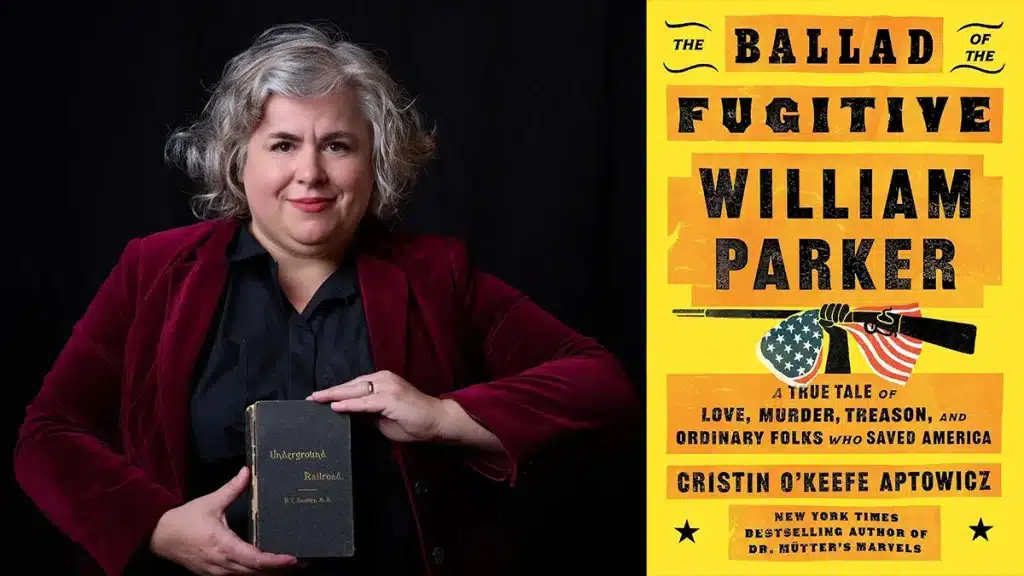
About six months after Cristin O’Keefe Aptowicz’s mother died in 2015, the poet, historian, and author began researching her family tree, intent on learning more about her lineage as one means of maintaining a sense of connection.
Going in, Aptowicz said she understood her ancestors to be exclusively Irish immigrants “fresh off the boat during the potato famine,” as she described it, but she quickly discovered a German offshoot on her mother’s side that had a deep connection with the Underground Railroad, which in turn led her to an 1883 historical work by R.C. Smedley that documented the secret network’s history and operations in Pennsylvania.
“And it was written by a doctor who had no background in history writing or in writing at all, but he was treating these agents of the Underground Railroad as they were getting old and dying, and he realized he needed to capture these stories before they disappeared,” said Aptowicz, who within Smedley’s Underground Railroad first discovered the story of William Parker, an escaped slave who fled Maryland for Christiana, a Quaker town just over the border in Pennsylvania, where he formed a self-defense organization that later engaged in a gunfight with his former enslaver. “And [in Smedley’s book], they kept saying this phrase, ‘The Christiana riot,’ and the name William Parker. And he appeared over 70 times in this book. And I, born and raised in Philly, had never heard of the Christiana riot, had never heard of William Parker. … And I was like, if this was such a seismic event to the community, how had I not heard of it?”
A donation powers the future of local, independent news in Columbus.
Support Matter News
This initial inquiry eventually snowballed into Aptowicz’s latest work of narrative nonfiction, The Ballad of the Fugitive William Parker, which recounts Parker’s life in vivid detail while also painting a portrait of Philadelphia as a backbone of the abolitionist movement and early home to a thriving, prosperous Black community.
Then living in Texas, Aptowicz’s research took her virtually to university libraries across the United States, with the author collecting documents and book passages – including sections from a memoir written by Parker – that she then scanned to create Microsoft Word documents. Changing the color of this text to blue, she pasted relevant passages directly into her outline for the book, creating what became a sprawling, 1,000-plus-page historical “bible” she could then reference in the writing of her draft.
“And I can do that very confidently, because my facts are there. And I know I’m not doing any plagiarism, because when I write my original nonfiction prose, I change that to black, and anything left in blue is something I have to address,” said Aptowicz, who will appear in a Thurber House-curated event at CCAD’s Canzani Center from 6:30-8 p.m. on Sunday, Sept. 6, joined in conversation by a mammoth panel that includes Ernest Cline (Ready Player One), Hanif Abdurraqib (There’s Always This Year), and Scott Woods (Black Night Is Falling).
Aptowicz’s research also brought her physically to the sites featured in the book, with visits to Philadelphia and Christiana surfacing details that proved instrumental. The author credited time spent on the ground in Philadelphia with sharpening the picture of “the wealthy, free, Black elite who created … a city within a city with their own libraries and labor unions and cemeteries.” In Christiana, meanwhile, Aptowicz discovered an active historical society populated by descendants and historians eager to share the rural town’s story. Even more than historical detail, however, these visits helped to conjure for the author a stronger sense of place, with the sights, sounds, and smells adding greater dimension.
“In the book, I talk about how sunrises are different in the city than the country, which is scientifically true,” Aptowicz said. “But even those subtle changes in the light shaped how I told the story, because I’ve not just understood the history, but also the worlds these characters walk through better because of that on-the-ground research.”
The ability to perceive these kinds of details is a skill Aptowicz developed and refined in writing poetry, and she said it carried over naturally to her historical work, with both rooted in a similar sense of curiosity and a want to dig beneath the surface. As one means of explanation, Aptowicz shared how in teaching poetry workshops she will often tell writers struggling to find inspiration to take any story they’ve told three times and turn that tale into a poem.
“If you’re like, ‘Man, this crazy thing happened on the bus,’ and then you tell your coworker, and then your spouse, and then later when you’re hanging out with someone you mention it again, then there’s something about that story that is also resonating with you,” she said. “And by examining that in a poem, you’re sort of peeling back some of those layers. And sometimes that means finding beauty. And sometimes it means sitting with a discomfort that you had been avoiding. And I think that transfers really well to history.”
There are other aspects to writing historical nonfiction that Aptowicz acknowledged fall out of a writer’s control but can still shape how a given work is perceived, up to and including the political realities of the day. When Aptowicz started work on The Ballad of the Fugitive William Parker, for example, Joe Biden was president and ICE patrols had not yet ramped up deportation efforts in brutal scenes reminscent of federal agents hunting down escaped slaves.
“There’s this scene right before the passage of the Fugitive Slave Act [of 1850] where a new president comes in, fires everyone involved with the old [administration], installs lackeys, and pushes forward legislation that is just so unbelievably cruel. And I had readers that were like, ‘Oh, my god!’ And now you have people fighting against ICE in their community, and against data centers, and there’s this sense of a monolithic federal government that will oppress, and one that certainly has a lot of power,” Aptowicz said. “But another thing this book showed me, which I think we’re seeing today, is that communities can push back. … And I took a lot of comfort in researching and writing this story, because when you’re fighting injustice, it can feel so huge. But when you look at your community, it can feel very doable. Especially if you focus on those little things you can do, and then quietly expand from there.”
Author

Related Articles

Barbara Fant returns to Columbus ready to leave her mark on Thurber House
The poet and newly minted executive director of the literary nonprofit will take part in a community reception welcoming her to the role on Thursday, Sept. 17.
Signe Damron begins to see things more clearly with ‘Sift Me Through’
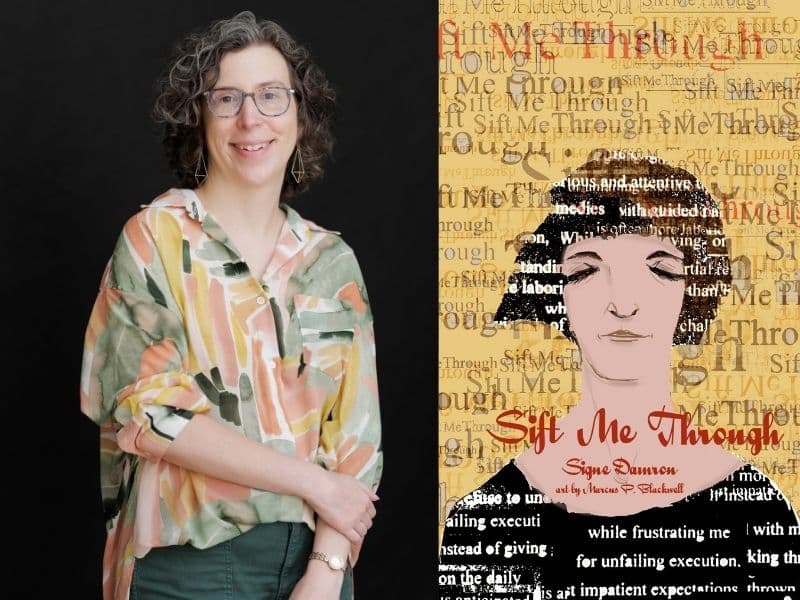
The Columbus poet said her new collection, illustrated by artist Marcus Blackwell, arrived as she began ‘processing and coming into my own.’

Matthew Ellis reckons with the impacts of religion in ‘Little Heresies’
The Columbus poet will celebrate the release of his debut collection with a reading at Two Dollar Radio Headquarters on Tuesday, Aug. 25.