
‘I am not going to stand before God and say, well, I chickened out’: Reflections on building caring coalitions
More than three years after the City of Columbus bulldozed Camp Shameless, one of the founders of the encampment offers their perspective on the housing crisis and the people working at the grassroots to give aid to those routinely left behind.
Editor’s Note: Names that have been changed are indicated by an asterisk.
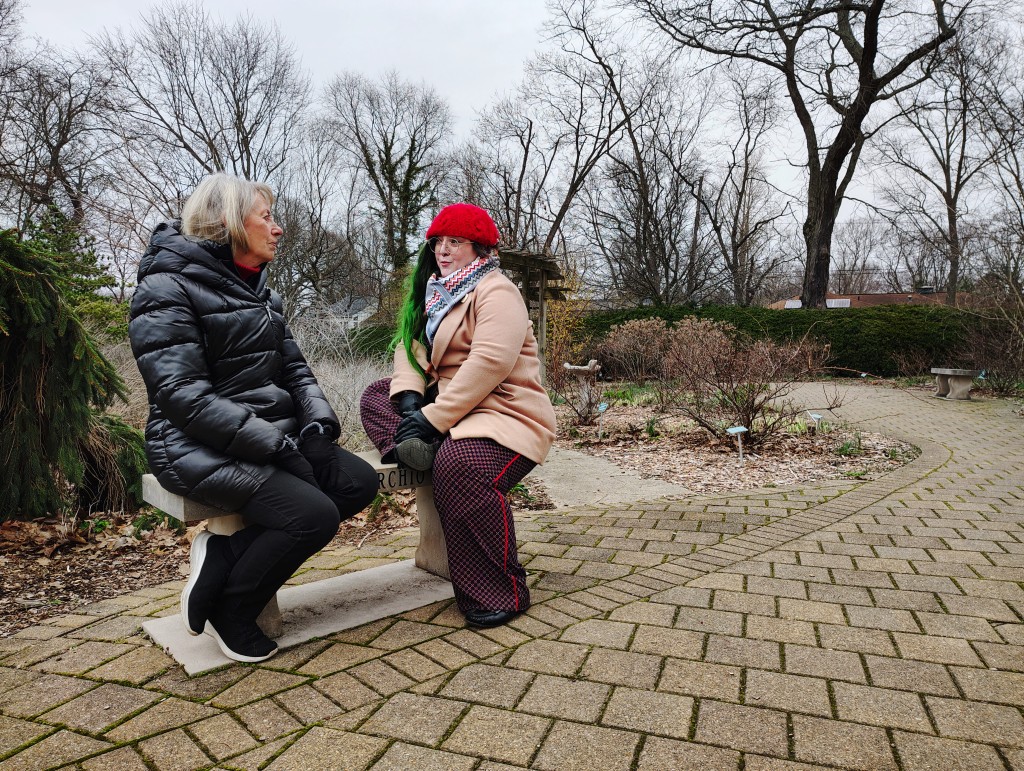
The best burritos in Columbus are made by an unusual local celebrity. If you’re unlucky enough to know where to find her, you can have one for free. “They’re certainly not authentic,” she told me on the phone back in late September, “but it’s a lot of fun.”
Every Saturday morning, Leslie Bush and volunteers from her church deliver burritos to seven homeless camps spread all over the capital city, feeding around 100 people. Her mission, Heart of St. Teresa (HOST, named for St. Mother Teresa of Calcutta), has rarely missed a week in the six years since she started the project with her late husband, Geoff Bush.
A donation powers the future of local, independent news in Columbus.
Support Matter News
I met Leslie and Geoff in 2022 while living and working at Camp Shameless, an urban encampment formerly located on Columbus’ Near East Side. They delivered hearty, foil-wrapped bundles of rotisserie chicken, rice, and cheese with care. Geoff would give me a coffee and a cookie or two. They asked after their friends, and I’d update them on our battles with the city. Before heading to their next stop, Leslie would give me a hug and extra burritos to distribute to latecomers.
Elizabeth: Are there more people now than there were three years ago?
Leslie: It seems like we’re getting more every week now. There’s more and more people losing housing, thanks to you-know-who.
The Trump administration is undeniably exacerbating the housing crisis. The “Ending Crime and Disorder on American Streets” executive order further criminalizes homelessness and disability through involuntary civil commitment of those deemed unable to care for themselves. Dramatic cuts to Medicaid coverage and SNAP benefits compound the financial pressure on struggling households, as does the loss of tax subsidies for Affordable Care Act marketplace insurance premiums. They plan to roll back a new Department of Housing and Urban Development (HUD) rule requiring that landlords give HUD-assisted tenants 30-days’ notice before filing eviction for nonpayment. Biden’s HUD made this change in January 2025 to reduce evictions amid a patchwork of state requirements. Where California mandates a mere three days’ notice, a West Virginia landlord can evict immediately.
Homelessness was also climbing under the Biden administration. In January 2025, the annual Franklin County, Ohio Point-in-Time (PIT) count identified 2,556 people experiencing homelessness – a 7.4 percent increase over 2024. This tally combines 2,101 individuals in emergency shelters and transitional housing with 455 observed living on the street and in other uninhabitable spaces. To paint a national picture, the 2024 Annual Homelessness Assessment Report uses all PIT counts to estimate there were 771,480 homeless people in the United States – 497,256 sheltered and 274,224 unsheltered.
While PIT counts are vital for resource allocation and trend identification, they are just a snapshot captured on a single night in the dead of winter. The unsheltered people you can see (and count) represent a fraction of those living rough; hiding from prying eyes is a means of survival, as is couch surfing during the coldest months.
Leslie: You know, there’s one stop where there might be only three or four people. And another stop where one day we had 52. We used to have 20 at that stop.
On FIRST Collective
Though I’m not a Christian, I’ve spent the past few years looking for common ground with them.
In September 2021, Pastor Gary Witte (a Methodist) and our mutual friend David S. Harewood (mistrustful of churches) invited me to join FIRST Collective. Originally an acronym for Faith, Inclusivity, Resistance, Solidarity, and The arts, the name was also a reference to Old First Presbyterian Church – where Pastor Gary had recently begun preaching. The organization’s goal was to empower a coalition of activists and artists with use of space at the church, and to continue a long tradition of social justice organizing inside its crumbling walls.
Old First’s elderly congregation comprised fewer than 10 members and had no money for repairs; as such, the 120-year-old building was on its way to demolition by neglect. Working alongside Gary and David, I made it my full-time job to preserve the church and create a third place – a social space outside home, work, and school that doesn’t require membership or consumerism – where the community could thrive.
To help pay their utilities, I drafted a rental agreement for coworking space and took activists on tours to garner interest. I organized cleanups on Twitter (now X) and we excavated junk-filled rooms. Skilled volunteers replaced bare bulb fixtures with stained-glass ceiling pendants sourced from a retired realtor on Craigslist. I swapped incandescents for energy-efficient LEDs and brought in a union electrician to neutralize a sparking circuit breaker.
I began attending Sunday services, surprising friends and family. While I initially went to get to know the congregation, soon I was going for the sermons. Pastor Gary’s liberation theology was a far cry from my childhood church experience. He echoed the radical theorists I loved with lessons rooted in scripture, and it was through my anarchism that I learned to appreciate what Christians meant by Christ-like.
FIRST Collective acquired projects as it grew. We established a free “People’s Pantry” stocked with non-perishables and produce from Four Seasons City Farm, a ministry of the church. We helped orchestrate cozy pay-what-you-can jazz nights, and David planned an ensemble performance of Allen Ginsburg’s Howl. We hosted groups such as Justice for Casey Goodson, Jr., offering them meeting space in the sanctuary. We started a micro-library by cataloging hundreds of books found scattered throughout the building.
January 2022 delivered the project that would become our singular focus – and our undoing.
While walking his huskies in the snow, a FIRST Collective member encountered a man named Elijah* who was spending the night on a bus stop bench. Since the congregation had already agreed to let us run an evening warming space, we drafted guidelines for overnight stays. Two volunteers began staffing the church from 7 p.m. until 7 a.m. each night, offering Elijah a place to sleep.
At first he was our only guest. This irked Jonah*, a member of the congregation involved with Four Seasons, who asked why someone would sleep outside when there were other options. As Elijah and the volunteers explained, shelters are a difficult place to stay for anyone struggling with PTSD or addiction; they’re both highly restrictive and chaotic, feeling more like a jail than a dormitory. Drop-in warming stations provide an alternative, but the only other overnight station then available in Columbus was a church given a $35,000 grant to operate for five weeks. Several of our members who also volunteered there noted it was always at capacity, with more than 100 people vying for floor space in a single room.
Jonah thought FIRST Collective’s plan to open the doors on freezing nights was asking too much, especially without a grant from the city. Despite increasingly personal conflicts, we continued the work. FIRST Collective paid the utilities, and the congregation approved overnight stays when it was freezing. News of us spread by word-of-mouth. After the city’s official warming station closed in late February, we regularly hosted 12 to 24 guests who came in search of peace and quiet.
Inspired by the Catholic Workers Movement concept of “houses of hospitality,” we offered solace along with shelter and food. Our guests were welcomed at jazz nights, and some began attending Sunday services. Volunteers offered transportation. We made tea after dinner and listened to Jimi Hendrix records. I bought plastic bins and epsom salts and we heated water in the kettle to soak sore feet. Huddled outside, smokers shared cigarettes, cannabis, and conversation. We came to know our guests as people, recognizing that any of us could find ourselves in the same circumstances.
As Jonah prophesied, we sometimes asked for forgiveness rather than permission. We opened on a rainy night that wasn’t quite freezing, and once when only the wind chill dipped below 32 degrees. This loose interpretation of the rules infuriated Jonah, who visited at odd hours to argue and build his case against FIRST Collective. Everywhere we diverged from the shelter system was suspect, like allowing people to arrive late or letting couples sleep next to one another. While he felt one person was too few to justify our efforts, he was sure the building couldn’t support more than that with a single functional bathroom.
Jonah: This church cannot house people at night. … It’s not set up for that. It might be someday, but there’s no beds. People stay on the couches.
Elizabeth: Outside they don’t have any of that.
Jonah: You know you weren’t supposed to be here tonight. That’s beyond what the agreement was. You really just do what you want. … So, how many people are here?
Elizabeth: About 13.
Jonah: Oh god, you idiot! Elizabeth, come on!
During one of these tirades, I asked him what Jesus would do. “Jesus would not be in a situation like this,” he told me. When I argued, he called us enablers. “You’re not helping these people, you’re giving them comfort,” he said. “Are they changing? They’re just staying where they’re at. You’re keeping them where they’re at.”
He insisted that if they wanted help, they could get social workers, IDs, and jobs at a shelter. It didn’t matter how many of our guests had already done all of these things; he demanded we stop treating homelessness like it was Old First’s (and thus his) responsibility.
Eventually the congregation reclaimed keys from anyone involved with FIRST Collective and Pastor Gary resigned in protest. However, one member of the congregation decided to defy the others. He pulled me aside after Sunday service and gave me his own key, asking that we keep helping people. So, we did, for another week – until the morning of March 29, 2022, when a handyman arrived to change the locks and an armed security guard escorted us from the building.
On the Heart of St. Teresa
Leslie and Geoff Bush were childhood sweethearts who reconnected later in life, marrying in 2002. They started HOST after retiring from the business they built together, running sales events for hospitals and corporations to fundraise for projects and charitable causes.
Leslie: I had such a strong sense that I was supposed to be doing something. Every time I would pray for poor people and the homeless, I would get this, I really don’t know how to put words to it, but it was like, “You do it.”
From the beginning, the couple’s work felt orchestrated by God. “I never worry about having enough for them, or about being enough,” Leslie said, telling me whatever she needs seems to show up. Recently, when the HOST bank account was empty, she began wondering where God would send the money from this time. Then, the phone rang. A friend’s young children had run a lemonade stand to raise money for homeless people and decided to donate it to Leslie’s mission.
Leslie: Isn’t that the sweetest thing? With a stinkin’ little lemonade stand, they raised 80 dollars! That provides food for my folks for a couple weeks.
Geoff passed away on May 14, 2023, at 74 years old. He was an Eagle Scout and a United States Navy veteran. “He will be remembered for his gentle nature, his quick wit, and his unshakable faith,” his obituary reads. I didn’t know him well, but his warmth was unforgettable.
Soon after, Geoff’s Knights of Columbus chapter told Leslie they wanted to help continue the mission. She took a couple weeks off to grieve – volunteers visited the camps in her stead – but quickly returned to feeding her people.
Leslie: I tell them over and over again, they are my lifeline. They kept my head above water after Geoff died. I don’t know what I would have done had I not had this to keep me going. You know? So, in many ways I feel like I get more from them than they get from me.
HOST now has a pool of around 100 volunteers from a variety of groups at their Catholic church. A group of six to eight help make burritos in the church kitchen on Friday, two assembly lines accomplishing in an hour a task that used to take all day.
Leslie: I do my shopping on Thursday. I buy rotisserie chickens, cut them up, and make the rice at home. Then me and the rice and the chickens go into church on Friday mornings and we get to work. I have ladies who make homemade cookies every week too, and then Saturday morning there’s anywhere from five to eight of us who meet at church and finish loading up what we need. I’ve got a guy who makes coffee and does the hardboiled eggs, so we go pick that stuff up and head downtown.
She especially loves taking first-timers and watching them realize that unhoused people are just people. “They fall in love with them and can’t wait to go back and do it again,” she said.
On Camp Shameless
I told Leslie that I conceptualize God as the loving-kindness between people; if God is love, then I understand God. This resonated with her. “You’ll never convince me that there isn’t a God that is just madly in love with all of us and wants us taking care of the poor,” she said, reminding me of Gary’s sermons. I worry too many of her fellow Christians see things differently.
With the warming station at Old First Presbyterian permanently shuttered, FIRST Collective pivoted. That afternoon, I purchased a dozen two- and four-person tents from a sporting goods store. We pitched them at sundown next to Four Seasons City Farm’s community garden on East Mound Street. The empty lots came alive, dotted by orange and teal nylon and scattered with old growth trees, as warming station guests became camp residents.
The Camp Shameless experiment was unusual in its shameless visibility. While most encampments are forced to rely on remoteness for safety, the constant presence of FIRST Collective volunteers supported our existence. We fielded questions, solved problems, accepted donations, and shielded residents from police and other city officials. We resolved disputes democratically when possible, prioritizing the voices of residents. We campaigned for funds and support at both public and private City Council meetings, hoping to establish a transitional tiny home community inspired by Portland, Oregon’s Dignity Village – an ongoing project founded in December 2000.
Many organizations and ideologies came together to offer support. Faith-based nonprofit Community Kitchen, Inc. fed us six days a week, and the anarchists of Food Not Bombs catered our events and dropped off donations constantly. Our nearest neighbor served us Easter dinner and many more delivered trays of leftovers. When a resident told Leslie and Geoff where to find the camp, they added us to their route. We built a scrappy fence with the help of local communists and socialists, and we installed our own mailbox to the delight of the USPS carrier. We cleared years of litter from the periphery and kept it clean by occasionally renting a dumpster. When the garbage situation proved untenable, I started paying for trash service. After a news segment aired about complications involving our composting toilet, Got 2 Go Portable Sanitation began to supply and service two port-a-johns.
Camp Shameless was home to more than 30 residents at its peak and touched many more lives by existing. Some people only stayed for a couple days before moving on, while others just stopped by for supplies or an occasional meal. This was the caring, hospitality-minded third space we tried to build at the church – a gateway to unconditional support.
Dorothy Day, a founder of the Catholic Worker Movement, believed hope is the fruit of doing and that a sense of personal futility is one of society’s greatest ills. In her 1952 memoir, The Long Loneliness, she wrote that “we can be responsible only for one action of the present moment,” believing our individual actions would be transformed by God “as Jesus multiplied the loaves and the fishes.” She felt the antidote to growing social isolation was the creation of compassionate local institutions which rejected indifference rooted in difference. “The only answer in this life, to the loneliness we are bound to feel, is community,” she said.
Miss Janine*, a black United States Army veteran in her late 40s or early 50s, arrived at the camp like a whirlwind each fortnight. She was always mid-conversation and impeccably dressed – occasionally in head-to-toe camouflage fatigues. I fixed her a plate of whatever we had available, listening as she recited the branches of her family tree. She aired old grievances, describing uncles disappointed in cousins and why so-and-so ought to be written out of her granddad’s will. When her daughter came looking for her, we’d tell her when we last saw her mother; family members sometimes visited the camp to find missing loved ones.
One evening, Miss Janine asked for a ride across the neighborhood. I was out of cigarettes, so she pointed out a convenience store she liked. When we walked in, the cashier called her “crazy lady” and told her to get out. She cursed him, knocked sodas off the shelf, and scuttled outside to brood by my car. I apologized for the chaos and picked up the bottles, then carried on buying some guava juice and his cheapest menthol 100s. “What are you doing with someone like that?” the cashier asked. I told him I was helping however I could.
In July, we decided to address an ongoing issue: acts of God destroying our resource tents. On our first night, the organizers from Heer to Serve loaned us a walled canopy to store supplies and escape the chill. A windstorm demolished it the next day, which became a trend for subsequent pop-up canopies. At the behest of the residents, I purchased lumber, plywood, corrugated PVC roof sheeting, and fasteners; we rented an auger to dig post holes.
Community volunteers came together to begin our final construction project: a lean-to kitchen with a pallet floor. Its amenities included a coffeemaker and chest freezer powered by solar panels and a portable battery. Within days of pouring concrete to support the posts, code enforcement issued a stop work order. Though the Department of Development and other city officials had reluctantly tolerated Camp Shameless, the kitchen’s permanence demonstrated our intention to overstay our limited welcome. Soon after, the city taped a “trespassing notice to leave” on every tent.
We fought to remain. Supporters organized “camp-ins” on the front lawns of city councilors and the city attorney, which led to the arrest of five peaceful protesters – including Pastor Gary. We organized a community resource fair for Sept. 1, 2022, the morning of our eviction. Local charities and outreach groups tabled, breakfast was served, and local news sent reporters. The city delayed the eviction and began talking to us about trying something new.
The City of Columbus bulldozed the site on Sept. 14, 2022. The remaining dozen residents, me included, moved into a motel as part of a pilot program overseen by several nonprofits. This wouldn’t have happened without our constant public pressure and media appearances; we made ourselves impossible to ignore.
On Anarchists & Christians
One reason I contacted Leslie last year was to ask about a comment “Fox & Friends” host Brian Kilmeade made in September; she knew which one I meant. Several hours before far-right political operative Charlie Kirk’s assassination, Kilmeade suggested one way to deal with mentally ill homeless people was involuntary lethal injection. “Or something,” he said, “just kill them.” He offered a limp apology the following weekend, saying he realizes not all mentally ill homeless people are killers and that so many of them deserve our empathy and compassion.
Leslie: People tend to think that they are criminals or insane or whatever. And of course there’s criminals out there and there’s mental illness and addiction and all that.
Elizabeth: When I heard that, I’m like, “I know so many people that are out there doing that work that would just be appalled.”
Leslie: I won’t repeat what I said when I first heard that. How cruel, insensitive, and inhumane can you be? And there have been homeless people killed for no reason since then. I’m telling my folks, keep a low profile, this is scary. I’m worried about them.
Elizabeth: We have a lot of mental illness in the country, not just among homeless people. … We’re in a really tumultuous time.
Leslie: I really don’t turn my TV on much, especially around the news. It’s just insane how cruel human beings can be to one another. It disgusts me, it makes me sad. It hurts my heart that people are actually… I don’t like believing people are that cruel. But we certainly have lots of examples of that throughout history, including crucifying Jesus.
Before Kirk’s death had been officially announced, calls for vengeance from his supporters began. “The radical left” was blamed alongside Democrats, trans people, Muslims, and Etsy witches. Social media escalated the hysteria, circulating videos of his murder from various angles. Speculation about alleged shooter Tyler Robinson’s motives and related conspiracy theories became a cottage industry.
Kirk’s memorial service at State Farm Stadium in Glendale, Arizona was attended by more than 70,000 mourners. President Trump headlined, preceded by members of his cabinet and other high-ranking Republican politicians. Each said little of substance about Kirk’s political work; instead, they spoke at length about his faith as well as their own.
Secretary of Health and Human Services Robert F. Kennedy Jr. (a Catholic) eulogized Kirk by likening him to St. Francis of Assisi: “He believed what St. Francis taught us almost a thousand years ago – that we should strive to live our lives in perfect imitation of Christ.”
Francis, son of a prosperous silk merchant, sought to emulate the life and ministry of Jesus Christ through itinerant preaching and vows of poverty, chastity, and obedience. Kirk, son of a Trump Tower architect, was reported to have a net worth of $12 million when he died.
In 2019, Kirk co-founded a now-defunct think-tank, the Falkirk Center for Faith and Liberty, with disgraced nepo baby Jerry Falwell Jr. (an evangelical), whose own net worth is said to exceed $100 million. One of their goals, Kirk said, was to use social media to combat the left’s effort to “convert young Christians into socialism and to intentionally misrepresent the gospel and the teachings of the Bible.” They wanted to conclusively answer the question “was Jesus a socialist?” in the negative.
Elizabeth: I feel like one thing we really need as a society is more comradeship between religious activists and secular activists, people who aren’t necessarily believers, but they have the same values. Do you see any way to build these sorts of bridges?
Leslie: I don’t see any reason we couldn’t. I mean, why not? Like you say, we all have the same values and goals in mind. The fact that one group goes to church and the other group doesn’t, what’s the big deal? I would love for every human being to be madly in love with Jesus but that’s not the case. It doesn’t mean we can’t work together; we’re not on opposite sides.
There is an apocryphal quote attributed to the writer Sinclair Lewis that goes, “When fascism comes to America, it will be wrapped in the flag and carrying a cross.” The original citation hasn’t been identified, but the sentiment feels too true to dismiss. I wonder how Jesus and St. Francis would feel about the rise of Christian Nationalism, or Reaganomics.
As Leslie and I chatted, President Trump signed a chilling new directive. The National Security Presidential Memorandum 7 (NSPM-7) orders the federal government to monitor and disrupt individuals and organizations “before” they escalate to violence. Citing Kirk’s assassination, it claims warning signs include anti-capitalist, anti-American, or anti-Christian views. Other listed indicators are “extremism on migration, race, and gender,” as well as hostility toward “traditional American views on family, religion, and morality.”
NSPM-7 is a blank check to persecute critics of the status quo. “These are anarchists and agitators, professional anarchists and agitators and they get hired by wealthy people,” Trump told the press during the signing. As an anarchist, my principles are poorly understood both by the general misuse of the term – and by the President, specifically. Many Christians have begun to feel similarly.
Anarchist and Christian are big words with lots of baggage, but these ideologies motivate people committed to helping the least of us. Dorothy Day was a Catholic anarchist. Though anarchists are portrayed exclusively as nihilistic purveyors of violence, Day lived a life that countered this narrative. Her ethics revolved around care, compassion, and community. Personal responsibility was the heart of her activism, including the necessity of noncompliance with an unjust state. Her commitment to nonviolent direct action and support of the poor led to a number of arrests: first in 1917 in the fight for women’s suffrage, then later in 1955, 1957, and 1973 at 75 years old.
At a recent “antifa roundtable” at the White House, Jonathan Choe – a reporter for Turning Point USA, Kirk’s campus outreach nonprofit – made this disturbing statement: “In many cases, the homeless industrial complex is running cover for antifa, and antifa is benefiting from American tax dollars, and they’re essentially being used as the muscle.” He used as his example Seattle’s Stop the Sweeps, a campaign attempting to safeguard encampments from state violence. Under NSPM-7, Day and the Catholic Worker Movement would find themselves scrutinized.
I asked what Leslie thought about the executive order designating “antifa” as a domestic terrorist organization. “Now that one made me laugh,” she said, and we agreed it was absurd. “I’m not smart enough to be worried for myself, but I worry about [my people] a lot. And I recently started thinking, oh my gosh, I could be putting my volunteers in danger.”
Still, Leslie is steadfastly committed to the work, refusing to expect someone else will do it for her. “I am not going to stand before God and say, well, I chickened out,” she said. “After all this time, this would be like turning my back on family. I cannot do that.”
In an article for the National Catholic Register, author and history professor H.W. Brands argued that President Trump values Christians because their religion tells him who is for him and who is against him. He said that though previous presidents have mostly been Protestant Christians, they largely recognized that Catholics, Jews, Muslims, and others have a place here, too. “Not so with Trump,” Brands told the Register. “He and members of his administration treat Protestant Christians, especially evangelicals, as the true Americans. Others are here on sufferance.”
Pastor Martin Niemӧller (a Lutheran) was an avowed antisemite who supported Adolf Hitler’s rise – until the Nazis began to de-Christianize Germany. Disillusioned, he joined the resistance and was imprisoned in 1936. Ten years later, he gave a confessional speech that recounted the following exchange:
I remember a conversation I had with a person who claimed to be a Christian. He said “Perhaps it’s right, these incurably sick people just cost the state money, they are just a burden to themselves and to others. Isn’t it best for all concerned if they are taken out of the middle [of society]?”
His speech inspired the poem “First They Came,” which most of us will remember from studying the Holocaust in school; it begins “First they came for the Communists/And I did not speak out,” and ends “And there was no one left/To speak out for me.”
Elizabeth: That’s what I’m trying to figure out how to talk to people about. When I was working at the camp and when I was working out of the church before that, I was trying to get people into that space who all believed the same things. I think we need more of that kind of collaboration. Even the idea of blue and red, you know? Left and right… I think there’s a lot more that we all have in common if we can stop focusing on all the things that are being used to divide us.
Leslie: I agree, yes!
Elizabeth: Like, how can you not care about those people if you go out and you see them and you help them?
Leslie: I was thinking about this just a few days ago. With respect to talking to Christians, some who are very anti-all of this, and to say, you know, where is our commonality? We both believe that we were all created by the same God, right? If we don’t unite, we’re going to cease to exist.
Elizabeth: We’re going to tear each other apart. I think it’s one of the most important conversations we could have right now. … I’ve been reading about Henry David Thoreau, who once said, “Individual conscience thus creates a social conscience and the collective will to right action; concerted right action means moral revolution.” Do you think we could see something like that, a moral revolution in the US?
Leslie: You know what, I am hopeful. It’s something I pray for every day. The unity that is needed has to start somewhere, you know, and I think it’s out there. I don’t think it’s anything brand new, but we need it on a much bigger scale. We all need to do our part to unite rather than divide. We’ve got to start that conversation, Elizabeth. We’ve got to.
On Boundaries & Legacies
In October 2022, I was still living at the motel with the other Camp Shameless residents. A Catholic priest who had visited the camp contacted me on Twitter, asking if I was available to accept a donation. He arrived a while later with a parishioner’s homemade bean soup and cornbread. Sitting on a blanket in the grass by the parking lot, he asked how I was holding up; my answer was to burst into tears and confess having given until I had nothing left. This was looming over the horizon when I cashed out my meager retirement funds that summer, but I couldn’t stop myself. Money can’t solve every problem, but it feels like it could when you don’t have any. Part of me believed that whatever I needed would come back to me, somehow. A Christian might call that a leap of faith; my therapist calls it magical thinking.
The priest listened as I described an intense shame over my debt and my newfound dependency. Then, he asked if he could tell me a story. “Tomorrow is the feast of St. Francis of Assisi,” he said, “do you know who he was?” I did not. He told me Francis was a wealthy libertine who grew disillusioned with his life of excess. He told me the story of the beggar, when Francis emptied his pockets for a poor man who asked for alms. He told me how Francis wandered as a penitent, restored chapels, cared for lepers, and founded the Franciscan order. Then he told me he had been thinking about me a lot when he worked on his feast day sermon. “You’re in good company,” he said, “but you don’t have to be a saint.”
A month later, I moved out of the motel and back in with my ex-fiancée, formally leaving FIRST Collective in early 2023. The volunteers continue to do incredible work that I’m grateful to have been part of for a little while. I’ve been working with a therapist to find my place in the world. A lifelong codependent people-pleaser, I’ve never been good at establishing or maintaining boundaries – I’ll get there someday. “You can’t pour from an empty cup” is a lesson I began to learn only once my cup was empty.
When I talked about needing to step back from the work, Leslie understood. “Geoff was good at reminding me of boundaries and I haven’t been very good about that since he’s been gone,” she said. “But one of his friends has my back. When I get these hair-brained ideas, I use Tom as a sounding board.”
Elizabeth: I’m so glad you’ve got him to help check your impulses, because sometimes you want to give everything you have. If someone needs it, you give them the coat off your back.
Leslie: I heard Geoff saying to somebody once: “No! You don’t understand, if it was up to her, you’d all be sleeping in our living room!”
Elizabeth: Oh gosh. I know exactly what he means.
Leslie: Yes, you do. You know, you want to fix it yourself – and we can’t.
Elizabeth: You can only do what you can do, and you can help.
Leslie: I figure, if I’m following God’s lead, I’m okay. I’m doing something. I’m not not sitting back expecting somebody else to do it.
On April 7, 2025, Columbus City Council voted unanimously to approve the construction of two permanent supportive housing projects: 50-unit Knoll View Place located on the former site of Camp Shameless, and 60-unit Scioto Rise Place, near the woods where I once helped a pregnant woman and her boyfriend move after the city swept their encampment. I want to believe this is a good start, but we will see how the project progresses. The combined 110 units barely scratches the surface of our permanent supportive housing needs.
Determined that HOST will outlive her, Leslie is training a new generation of helpers. Before her brother passed away over the summer, she spent a month by his bedside while the volunteers continued in her place.
Leslie: I told them all, I’m not getting any younger, and it’s a little more challenging each year. But I keep telling them when I’m too old to do all the work, I’ll still be coming for my hugs.
Leslie insists her mission is purely selfish and that it keeps her going in a restorative way. “Of course, it wears me out too,” she admitted. Someday soon I hope to go with her, to say hello to old friends and to help however I can.
“I look forward to every Saturday morning,” she said, and I know it’s true.
Correction: The essay initially described Davis S. Harewood as an atheist and has been updated to reflect that he is actually just mistrustful of churches.
Related Articles
On Development: Developing better health care and hospitals
Despite the hospital construction projects all over the state, residents across most of Ohio are no closer to health care – and many are even further removed from hospitals.

Local Politics: Proposed trade partnership with Israel draws criticism
A bill to create an Ohio-Israel trade partnership is under review in the State Senate. Reactions in the city have been mixed at best.
The problem with the CDC prohibiting ‘never use alone’
Officials from the Centers for Disease Control and Prevention reportedly told recipients of overdose prevention funding that they may no longer be allowed to promote the message that has become one of the pillars of harm reduction.