
Watching Communist movies at the Wex
Reflections inspired by a June screening of six restored works by the Cuban director Tomás Gutiérrez Alea.
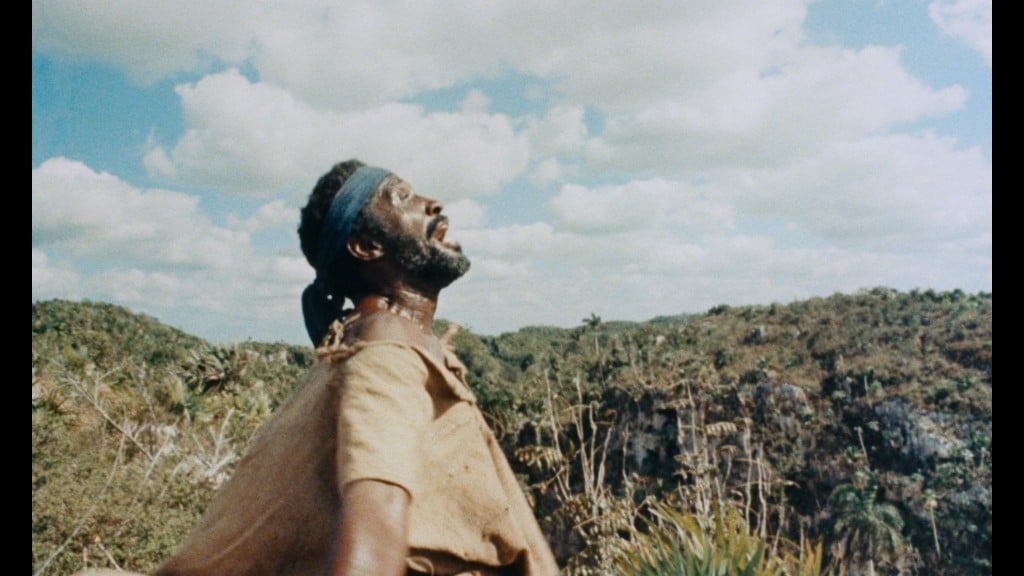
In early June, I slid into my seat in the theater at Wexner Center for the Arts just as a bearded speaker concluded his introduction. “I’d like to welcome someone from the Cohen Collection. After the screening, you can ask him how he smuggled the film into the U.S.,” he said, and paused. “Or actually, maybe don’t talk to him about it.”
It was the first day of the Cuban film series featuring six restored works by director Tomás Gutiérrez Alea, a filmmaker who wrote and directed dozens of features, shorts and documentaries that challenged both Hollywood and stereotypical “Cuban” films. He was also an original member of the Cuban Institute of Cinematographic Art and Industry (ICAIC), started by the Cuban government after the revolution and the epicenter of film in the country.
In those early years, Alea made documentaries showing the revolution in motion. And there was hardly a shortage of historical events taking place. “That incredible caravan which accompanied Fidel [Castro] in his entrance to Havana, the bearded men, the palm fronds, and the vertigo of all the transformations that were happening,” Alea wrote in his book, The Viewer’s Dialectic. “For cinema, it was almost sufficient just to record deeds, seize some fragment directly from reality, and give witness to what was going on in the streets.”
A donation powers the future of local, independent news in Columbus.
Support Matter News
But as the revolution shifted from romantic events to grueling policy changes and democratic processes of community meetings and assemblies, the revolution took on a far more practical and less photogenic stage: actually building socialism. And that’s where Alea’s films thrived. Whereas the revolution once required documentation to stir the minds of the masses, they eventually needed to get creative. Alea accomplished this through fictional reflections on the daily lives of Cubans amid these far more mundane events.
It’s these works, crafted in the seemingly boring years and decades following the initial mystique of the revolution, that were chosen for the series at the Wex. These two eras of film are often viewed as conflicting, and an article in the Wex program guide for the event characterized the director’s works as “contradictory,” owing to his unwavering support of the revolution even as he made films that seemed to criticize it. But I’d argue this perspective stems from a wider misunderstanding of revolution and socialism, an idea that felt ever-present while taking in Alea’s films at the Wex.
Known Knowns
At a press conference in February 2002, former Secretary of Defense Donald Rumsfeld engaged in an impressive act of Olympic philosophizing to cover the lack of evidence that the government of Iraq was hiding weapons of mass destruction. “As we know, there are known knowns; there are things we know we know,” he said. “We also know there are known unknowns; that is to say we know there are some things we do not know. But there are also unknown unknowns – the ones we don’t know we don’t know.”
The same philosophy has been applied to Cuba, a country that since 2017 has been falsely accused of using a futuristic “sonic weapon” to give federal agents headaches – a story that has been decisively debunked but still featured in a segment on “60 Minutes” this year.
Rumsfeld’s words can be applied to the American misunderstandings of Communist countries, especially Cuba. There are known knowns (communism killed one hundred zillion people), known unknowns (anyone’s neighbor could be a CCP spy), and, most importantly, unknown unknowns (secret weapons and a complete lack of understanding on everything from ideology and culture to policies and democracy). Each of these steps is illuminated by Alea’s films and their reception in the U.S. Or, since his movies were effectively banned for years here, the lack thereof.
In the first double feature, Death of a Bureaucrat (1966) and Memories of Underdevelopment (1968), the American audience is, unintentionally (because his films were made for Cubans), spoon fed the known knowns. In Death of a Bureaucrat, the protagonist has just buried his uncle and goes with his aunt to secure his union benefits for the family. All they have to do is produce the union card. But of course, the union card was buried with the uncle out of respect. And so, the young man embarks on what becomes a Kafkaesque, slapstick journey through the bureaucracy of Cuba’s government in an effort to get his uncle exhumed and then reburied. It’s the perfect starter kit for an audience that only knows the horror stories of Soviet bureaucracy.
The main character of Memories of Underdevelopment, Sergio, is a wealthy cynic floating around Havana while his bourgeois friends escape to the U.S. “The revolution,” he says, “although it destroys me, is my revenge on the stupid Cuban bourgeoisie.”
The film harps on two known knowns. First, that capitalists had their property confiscated – a line of thought repeated by the U.S. Senator Marco Rubio, a Cuban American politician who’s never been to Cuba and consistently calls for reparations for the billions “stolen” from capitalists during the revolution. (Curiously, when Cuba attempted to compensate the owners in the 1960s, the U.S. government instructed them to refuse the money.) Secondly, the film suggests that socialist revolutions aren’t fun for naive middle-class romantics – an archetype that’s still alive today (see: the 2016 novel A Gentleman in Moscow, along with the TV series based on the book released in March on Paramount+).
Known Unknowns
In the next two movies of the series, A Cuban Fight Against Demons and The Last Supper, the audience gets the known unknowns, that is, the realities of colonialism and slavery in pre-revolutionary Cuba. These are realities that tend to get lost in the discourse surrounding the support and longevity of the Communist government of Cuba.
A Cuban Fight Against Demons tells the helpless tale of a 17th century port town descending into madness, spurred on by Spanish colonialism and the Catholic church. The Last Supper, in turn, offers an historical microcosm of what was to come, showing slaves rising up against their masters.
“There was no effort to examine the revolution as a popular expression of true Cuban nationalism,” writes Keith Bolender in his 2019 book, Manufacturing the Enemy: The Media War Against Cuba. “The only explanation provided was one that alleged Fidel Castro was a master manipulator. … Consequently, politicians and media refused to understand the historical roots for revolution, as they could not admit it was [the] United States’ hegemony over Cuba that formed much of its base.”
Unknown Unknowns
Despite gaining international praise – it was the first Cuban film nominated for the Academy Award for Best Foreign Language Film and was distributed by Miramax – viewers in America might completely miss the plot in the final film of the series, Strawberry and Chocolate.
The movie is primarily a dialogue piece, unfolding as a kind of debate between the bourgeois Diego, who is also gay, and David, a straight communist student who initially sees Diego as a counter revolutionary.
To the outsider, the movie simply condemns the lagging behind of LGBTQ rights on the island. Diego has to keep his sexuality hidden owing to the homophobia prevalent both among the people and communist officials, who viewed homosexuality as a symptom of American capitalism. But the content of the actual debates between David and Diego reveal how both support the revolution in spite of their different lifestyles and opinions.
“Who says I’m not [a revolutionary]?” Diego asks David during a key debate of the film. Diego explains that he participated in the literacy campaign in 1961, an eight-month long effort in which students and teachers went to villages and homes to effectively abolish illiteracy. “I don’t want Americans or anybody coming here telling us what to do,” he tells David. “I’m a part of this country, like it or not. And I have the right to work for its future.”
This falls in line with the overarching philosophy of Alea, who both critiques and supports the revolution, his films serving as nuanced portraits.
“If filmmakers want to express their world coherently and at the same time respond to the demands their world places on them, they should not go out armed with just a camera and their sensibility but also with solid theoretical criteria,” Alea once wrote.
The director also argued that Cuban film should “contribute in the most efficient way possible to elevating viewers’ revolutionary consciousness and arming them for the entire ideological struggle which we have to carry on against all kinds of reactionary tendencies.”
In this light, his other films take on a new meaning, too.
Learning to Know
In Isaac Saney’s book Cuba: A Revolution in Motion, he writes, “Probably no country has faced a greater and more concerted campaign of disinformation than the Republic of Cuba. … The image of Cuba’s social reality has been so distorted that for most people – both lay and academic – Cuba appears to be an unmitigated ‘hell.’”
That hell tends to repaint the facts and history of the country as they’re laid out in Saney’s book – most notably, his chapter on governance in Cuba, which emphasizes the electoral process and high voter turnout. Although the country suffers from the issues of a third world country, many of which are magnified by the multi-decade long sanctions placed on the island by the U.S., Saney notes that Cuba is often left out of studies of Latin America and the Caribbean because the country is such an outlier with its low inequality and high literacy and age expectancy (all outperforming even the U.S.).
“Critical to this Cuban metamorphosis have been the creation of universal healthcare and education systems and the establishment of comprehensive social security,” Saney writes. “Thus hundreds of schools, hospitals, clinics, industrial complexes, resort facilities and recreational parks were, and continue to be, constructed.”
In the pivotal debate of Strawberry and Chocolate, Diego asks David if communism will one day welcome the LGTBQ community. “Someday there’ll be more understanding for everyone. That’s why it’s a revolution,” David responds. “But it won’t come from heaven. We must fight. Especially in ourselves.”
This internal fight eventually led to what became the “world’s most progressive family code,” which was approved by Cuban voters in 2022 and recognized not only gay marriage but also allows other forms of extended non-traditional family structures and protects against discrimination of people with disabilities.
It was Castro – a boogeyman who actually had to be democratically elected to his position on the National Assembly in every election cycle by more than 50 percent of his constituency – who characterized Cuba neither as heaven nor hell but rather a kind of purgatory. “If we are in purgatory, we are not going back to hell,” he said. “At least we have escaped Satan and are patiently waiting for the moment of reaching heaven.”
After watching Alea’s films at the Wex, most of which aren’t available online, I realized how stimulating these films were intellectually. To seek out and learn the theoretical and political understandings that a Cuban audience already has is an inspiring task for a moviegoer. Alea himself called for a cinema “which would be genuinely and integrally revolutionary, active, mobilizing, stimulating, and effectively popular.”
It’s a call that reverberates across time and space and breaks through any attempt to keep his movies in the dark.
Related Articles

Ohio’s Recovery: The past, present, and future of the overdose crisis
Fewer people are dying from overdose, but the policies and the social determinants of health did not vanish.
Opinion: When unionization isn’t enough
Collective bargaining can protect journalists from arbitrary firings, stagnating wages, and unsafe or exploitative working conditions. But a union contract cannot fix a broken funding model.

On Development: Cars can’t take us where we need to go
The billions of dollars of new road improvements cited in MORPC’s analysis 26 years ago have already been spent, and now we’re still looking at the same challenges with more people and more roads.