
Maggie Smith is content not having all of the answers
The Columbus poet’s new collection, ‘A Suit or a Suitcase,’ confronts more existential concepts such as aging, time, memory, and the durability (or not) of self.
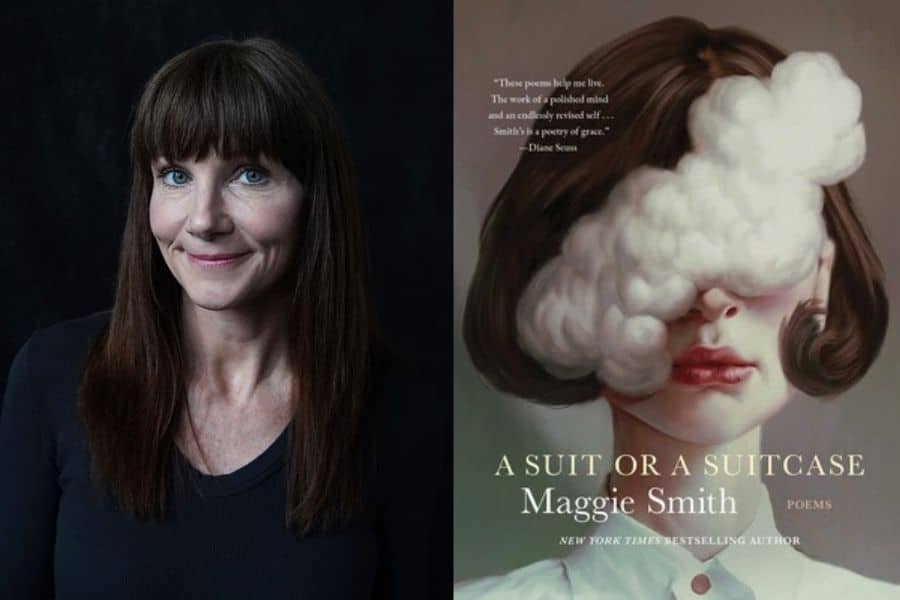
Maggie Smith described the poems populating her collection Goldenrod, from 2021, as “more grounded,” noting how even its name is shared with a plant rooted firmly in the earth. “Even the political poems in that book are of a very specific time and place,” Smith said from the patio of Kittie’s in Bexley on a windy day in late March. “And I think this new book is dealing with time and place, but in a more abstract way.”
Smith’s latest poetry collection, A Suit or a Suitcase, out now, stands as perhaps her most amorphous work to date, building around open-ended verses that confront concepts such as aging, time, memory, and the durability (or not) of self. It’s a shift captured in the poem “In Geologic Time, It Happened Just Seconds Ago,” in which Smith lingers on her younger self, recalling a time on her honeymoon when she wrote “only what I could see.”
A Suit or a Suitcase, in contrast, often finds the poet dwelling on things that can’t be clocked in the moment, but which emerge given reflection over time. Smith recalled having experienced a similar sensation recently in watching her teenage son, Rhett, juggle a soccer ball in the front yard of the family’s home. “And I looked at him, and it was like, I don’t know what happened,” said Smith, who will launch her new collection in conversation with Columbus poet Marcus Jackson at a sold-out Drexel Theatre on Thursday, April 2. “He’s taller than me. His voice sounds like his father’s. I can’t even wear his hand-me-down shoes anymore they’re so big. And I used to carry that kid around the neighborhood … pointing out birds and trees to him. And he’s the same person, but he’s not. And I’m the same person, but I’m not.”
A donation powers the future of local, independent news in Columbus.
Support Matter News
Rhett appears again, and again with requisite soccer ball at his feet, in “To Each Its Own,” a poem in which Smith takes stock of the hurts that have helped to shape her while simultaneously hoping those corners will be softer, more rounded for both her son and her daughter, Violet. “The pain I rode to this place/seems not to know he is here,” she writes. “I have to keep its eyes on me.”
Smith attributed the more existential nature of her latest to a range of factors that stretched from aging to the reality that many of these poems took shape between 2020 and 2025 – a point in time when the pandemic made our surroundings feel less concrete, less easily grasped, less connected.
“It’s funny, because I look at them and I’m like, God, so many of these poems come out of a deep aloneness. And I think there’s an actual aloneness that is very much about being isolated at the beginning of the pandemic, and being divorced, and feeling for a while like I was floating away on my own little island,” Smith said. “But I also think the poems came from what I would call a generative solitude, where life was ramping up in lots of ways, but I still had poems as a place to go to be quiet.”
These effects were further amplified by the poems within A Suit or a Suitcase having taken shape concurrently as Smith penned her memoir, You Could Make This Place Beautiful, which at times necessitated cannibalizing from those verses that captured more concrete thoughts or emotions, leaving behind lines rooted in more unanswerable questions.
“A lot of the italicized sections in the memoir come from poems that date alongside these, but they were more metaphor-based and image-based and concrete in their own way,” Smith said. “And I think those poems that had that level of thinking about time and space and self had a place, and its place was not quite in that book.”
Smith acknowledged that she stepped into this new collection with “tons of questions,” also accepting they were generally of the kind for which there is no answer. Rather, these are topics to be considered, chewed on, and hopefully at least partially digested. Witness “Study,” on which the poet confesses her growing belief that this life stands as “research for a larger project,” or the lengthy “Self Portrait as an Incomplete List of Mysteries,” in which Smith draws a compelling picture of herself via a series of confounding thoughts with which she has been confronted throughout the years. “How are we supposed to live with – endure, tolerate – so many unanswered questions,” she writes in one passage that feels wholly apt falling within this particular collection, “each why a door down a long corridor that stretches, nightmarishly distorting, before our eyes.”
Absent answers, though, there is a sense of comfort with the unknown that emerges as the collection unfolds, which Smith attributed largely to the passage of time. “Even though these themes have been haunting me most of my life, I don’t know that I could have written these poems 20 or 30 years ago, because I didn’t have that time,” she said. “I love most of what aging has done for my life – forget what it has done for my skin – but I feel really good about what it’s done for my life.”
As a younger woman, Smith once wrote a line in her journal that read, “I want to get my life to a pure point and stop,” and when she rediscovered this musing in more recent years, it left her dumbfounded. She briefly wondered if she was then going through a tough patch, or if it could have been written more optimistically, with that distant stop arriving with her surrounded by loved ones on her deathbed at age 98.
Without spoiling the specific line, A Suit or a Suitcase closes not on a pure point, but with a more open-ended acknowledgment the work carries on.
“And in some ways [that line] is aspirational, because I don’t really know how the story ends,” Smith said. “But I think the sentiment there for me is that I trust myself to get there, and to best know what to do in the moment when I do. And so, there’s this sense of comfort with things I don’t yet understand, which feels so much better than just being confused, right? There’s confusion, and then there’s, ‘I don’t have all of the answers, and I’m okay with that.’ And that’s where this book lands.”
Author

Related Articles

Edward Julian Sr. embraces poetry as a means to release and reflect
Ohio’s poet laureate features at Urban Arts Space tonight (Thursday, Sept. 24), appearing as part of the Poetry Festival, which continues through the weekend at Thurber House and the Grange Insurance Audubon Center.
Kathy Fagan takes stock with ‘The Unbecoming’
The poet will celebrate the release of her new collection with a reading at Gramercy Books on Thursday, Sept. 24.

Derf Backderf delves into the past, finds lessons for the present with ‘The Dissidents’
The Cleveland cartoonist will celebrate the release of his sprawling, deeply engaging new book with an appearance at the Wexner Center for the Arts on Wednesday, Sept. 23.