
‘Tenacious’ Tiffany has always been ready for the spotlight. The world is finally catching on.
“We’re the lucky ones to be alive,” said Tiffany Wedekind, who will share her story with a national audience in an upcoming episode of the TLC series ‘One Day in My Body.’ ‘Why would you not take a hold of every opportunity you could knowing it’s all going to be gone someday?’
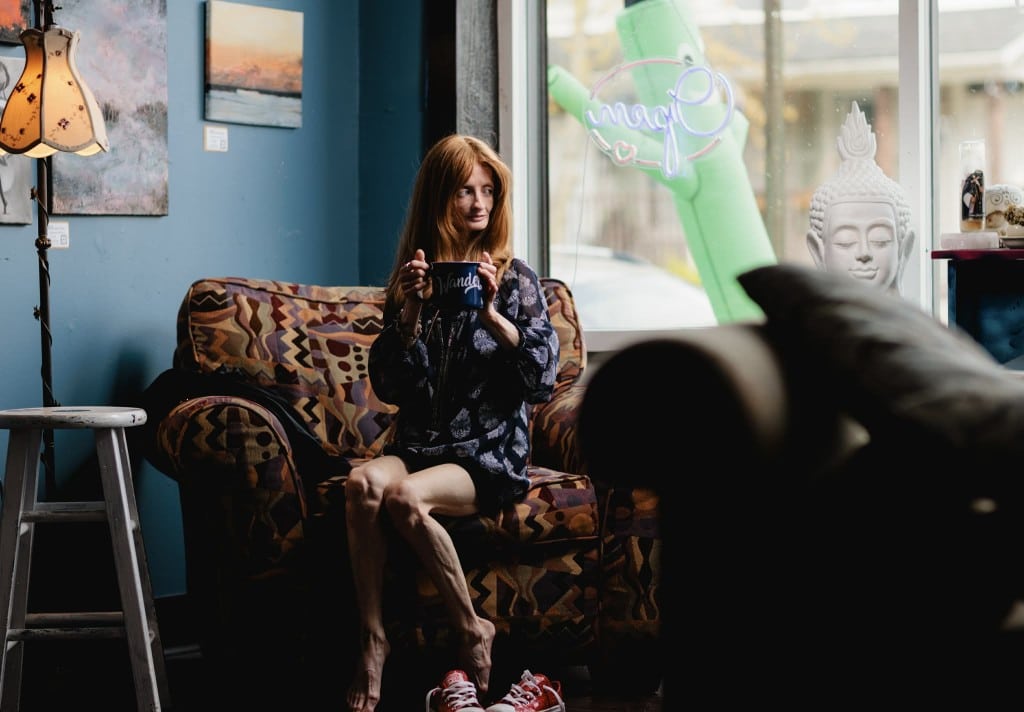
In a recent interview, “Tenacious” Tiffany Wedekind recalled the time as a teenager when she submitted herself for a gig with John Casablancas Model & Talent Management only to be met with immediate rejection by someone in the company’s office.
“She said, ‘You’re not what we’re looking for.’ And I was like, well, watch me,” Wedekind said in early April from Wanderlust Studio, which she opened in June 2019 as a brick and mortar for her line of Recycled Karma candles, gradually expanding the Merion Village space into a boutique, art gallery, and community hub.
If anything, this tenacity has only grown more pronounced in time, with Wedekind attributing everything from her approach to living with progeria – a genetic disease that causes accelerated aging – to having recently overcome a near-death experience to an untraceable inner desire to ring every conceivable drop from this existence.
A donation powers the future of local, independent news in Columbus.
Support Matter News
“I was just born with this infectious, energetic will to survive,” she said. “And I’ve always been that way. Growing up, I didn’t know that I had a disease. I just thought, ‘Well, I’m different and that’s just the way it is, and there’s no explanation for what I am.’ And I was fine with that. Of course, knowing what I have makes it easier to navigate, because, okay, now we have an explanation of why I’m so different. But everyone is different. And that’s been my philosophy. Everybody comes packaged with their own challenges and adventures. And I’ve always been an adventurous spirit. Ever since I was little, I’ve loved to make believe. I’ve loved to make my own reality come to life.”
Most recently, this has materialized in Wedekind’s desire to share her story with a wider audience, which she’ll do with an appearance on the nationally televised TLC series “One Day in My Body,” each episode of which highlights an individual living with a rare medical condition. (Wedekind said her episode is scheduled to air at 9 p.m. on Wednesday, April 22.) “And it’s not like I’m trying to be famous, right?” she said. “I’m just trying to inspire the world by being myself. There’s no gimmick. … I’m the kind of person who believes everything happens for a reason, and it would be a shame for me to waste who I am and not let the world see it.”
Wedekind recently survived a health scare that further calcified this idea within her, the timing of her recovery from multiple surgeries neatly aligning with her TLC debut, which she hopes to manifest into a series of her own at some point in the future. “I mean, now that they’ve seen me…” she said, trailing off into laughter.
Just three months ago, the idea of filming future television productions might have felt impossible. In January, Wedekind came down with a serious respiratory virus, which led to her being hospitalized for a week with an increased heart rate. After she was released, she was home for just four days when she experienced a bloody nose that she described as “pouring like a faucet.” When she found herself unable to staunch the bleeding, she called for an ambulance, which took her to a hospital where doctors packed her nose with cotton and sent her on her way absent any further testing.
“And at that point, I was like, ‘My heart rate has been up, and now my nose is bleeding profusely. I have progeria. I’m scheduled to get my valve replaced,’” said Wedekind, whose heart surgery was scheduled for March with Dr. Arash Arshi, who has served as her cardiologist for nearly a decade. (Aortic stenosis, or narrowing of the heart’s aortic valve, is common in people with progeria and often necessitates valve replacement.) “And they just looked at me like a deer in the headlights, and I was like, what is your plan? What are we doing here?”
Within an hour of returning to her home from the hospital, Wedekind said she began to sweat profusely, describing a heartburn-like sensation that radiated from her chest and down the left side of her face and body. Again she called emergency services, and the same ambulance crew returned, this time taking her to Riverside Hospital, where 30 minutes after arriving, she went into cardiac arrest while in the middle of being administered a CT scan.
“It literally felt like an elephant was crushing me, and I started grabbing at people, saying, ‘I don’t feel right,’” said Wedekind, who relayed the fears that overtook when she later came to in her hospital bed and learned what had happened, recalling the heart attacks experienced by her mom and her late brother, Chad, who was also born with progeria and died in 2011 at age 39. “And I just kept thinking, now I get to experience the horrible part of my disease, which is the medical emergencies and the issues with the heart. And that’s the center of who I am. It runs the whole ship.”
Wedekind described Chad’s death as a clear turning point in her existence. Up until then, she said she hadn’t really grasped the severity of her disease, and in the wake of his passing she took drastic steps to remake her daily existence into something less predictable and far more colorful. And so, she quit her 9-to-5 as the manager at a local salon and got divorced, resolved to live her time absent restriction.
In many ways, Wedekind has already beaten the odds. With progeria, a disease that affects one in 20 million people and commonly includes symptoms such as stunted growth, hair loss, and heart disease, the average age of death is typically around 15 – though modern treatments such as lonafarnib can extend this to nearly 20. Owing to their collective longevity, Wedekind and her brother featured in the American Journal of Medical Genetics when they were in their 30s. And now approaching her 49th birthday, Tiffany is the oldest person known to be living with progeria.
The realities of this weighed on Wedekind as she considered her options in the immediate aftermath of her heart attack, which led Dr. Arshi to advocate the valve replacement planned for March take place immediately in mid-January. “And it was difficult for me to wrap my head around, because I know they do this [surgery] all the time, but they’ve never done it on me,” she said. “And that’s my reality from having the circumstance I have. A lot of people will go, ‘This is what we typically do.’ Okay, well you’re probably not going to do what you typically do when it comes to me. I’m an adult, but I’m also tiny, and that brings about different challenges. … And it’s a lot of pressure on them, too. I mean, I’m the oldest person with progeria, you don’t want to be the one to take me out.”
Dr. Arshi acknowledged the difficulty of the 45-minute procedure in a March interview. “If you’ve met her, you’ll recognize she’s small, and her arteries are small,” he said. “But the catheters we use to replace aortic valves are large, so that led to complications.”
Wedekind’ recovery was further hindered by not having fully recovered from the respiratory virus she contracted in December, which left her body in a further weakened state that necessitated extended post-op care and observation. “Normally this is done as almost an outpatient procedure, where the patient will go to a recovery room … and then get an EKG and ultrasound of the heart the next day, and then go home,” Dr. Arshi said. “In her case, she was so acutely ill that she went to the ICU where there could be more intensive monitoring. And between myself and my vascular team, we were seeing her several times a day, checking in, ordering follow up tests, making sure she was progressing as we were hoping. But honestly, it was a lot of watchful waiting … for her to turn the corner herself.”
In late March, about 10 days before our interview, Wedekind returned for a second procedure where doctors repaired two arteries that they were unable to tend to in the initial operation, emerging from the surgery with an immense sense of gratitude and renewed clarity about how she wants to present her life and story to the world.
“I’m comfortable with sharing who I am, because I’m hoping that it will inspire other people to have gratitude that they’re even here,” she said. “We’re the lucky ones to be alive. There are so many people who aren’t here anymore. … My mom’s not here anymore. My brother’s not here. And there are so many people with my disease who died before they could even graduate high school. So, why would you not take a hold of every opportunity you could knowing it’s all going to be gone someday?”
Author
Related Articles
An Ohio school needs funds. It voted to cut Anduril’s tax bill, anyway
How a factory for AI-powered weapons, a data center, and a needy public school collided in rural Ohio.
Flock is on pause. What about all that other surveillance tech we use?
Columbus has had a contract with Shotspotter, an AI-powered gunshot detection microphone system, since 2018.

If you start from a place of love, you can’t go wrong
A vigil for an unhoused community member who recently died in Newark served as a call to not look away.