
Wexner, redacted
‘Walking between the Wexner Medical Center and the Wexner Center for the Arts all the time [is] just morally exhausting,’ said Murray Katkin, who helped organize an early April protest obscuring the Wexner name from the Ohio State arts center.
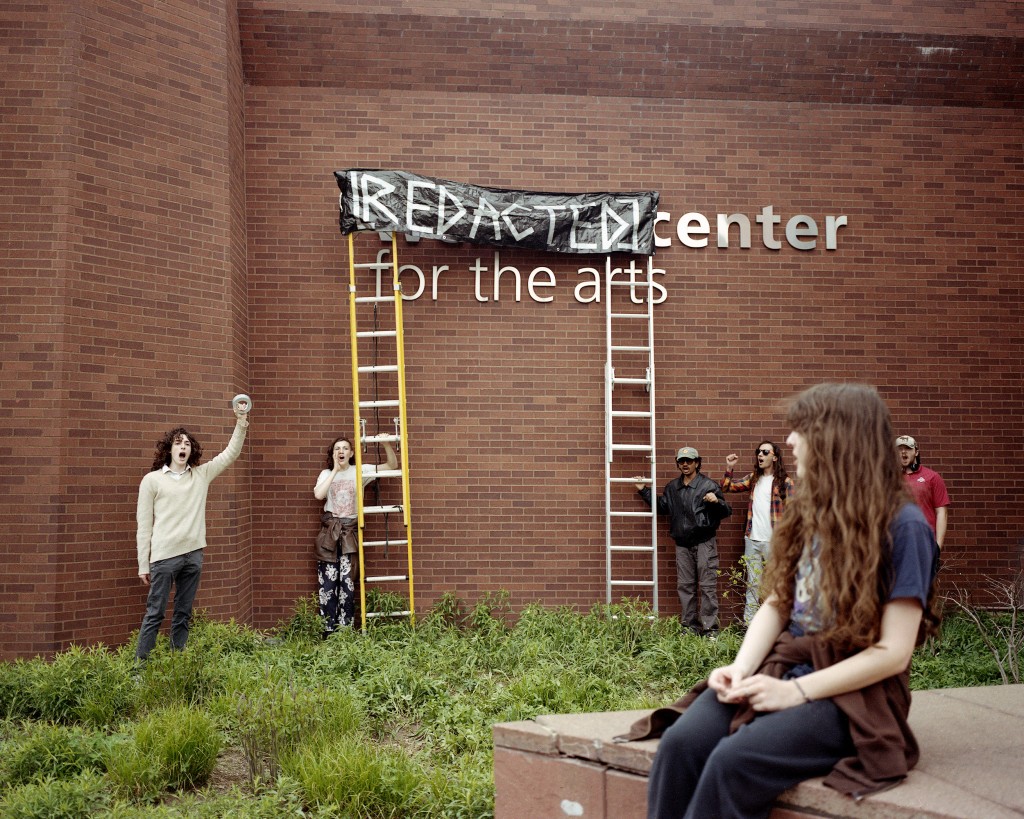
On a Friday afternoon in early April, a group of students at Ohio State University gathered outside the Wexner Center for the Arts to block donor Leslie Wexner’s name from the building.
The group propped up two ladders that held a makeshift sign displaying the word “redacted.” A crowd of students and some members of the faculty chanted, “Whose University? Our University.” Campus police were on the scene.
Third year History student Murray Katkin said that he and his friends organized the demonstration to express their discontent with Wexner’s name being all over campus. “Walking between the Wexner Medical Center and the Wexner Center for the Arts all the time [is] just morally exhausting,” he said.
A donation powers the future of local, independent news in Columbus.
Support Matter News
The university has three entities with the Wexner name on them: the Wexner Medical Center, the Wexner Center for the Arts (named in honor of Harry Wexner, Leslie’s father), and the Les Wexner Football Complex.
A spokesperson for the university responded to the demonstration stating: “We respect our community’s right to speak publicly about issues that are important to them.”
Local billionaire Leslie Wexner has been under scrutiny due to his early financial backing of Jeffrey Epstein, the financier who in 2019 was indicted on federal charges of sex trafficking minors. Wexner was Epstein’s primary client for decades, giving him sweeping power over his finances, including power of attorney.
In February, Wexner gave a five-hour long deposition to the House Oversight Committee claiming he was “duped” by Epstein. Democrats expressed skepticism. Representative Robert Garcia released a statement claiming that “there would be no Epstein Island, no Epstein plane, and no money to traffic women and girls without the wealth of Les Wexner.”
After more than 500 requests were made to remove Wexner’s name from OSU, an advisory committee will assess the request and begin a multi-step review procedure that can result in recommendations being made to the university president. There’s no timeline for the completion of the procedure.
Wexner made his fortune in retail as the founder of The Limited (now Limited Brands). In the 1980s and ’90s, Wexner purchased large plots of land in Central Ohio that he would help develop into the suburb of New Albany and the mall Easton Town Center. In 1985, Wexner donated $10 million to OSU for the future Wexner Center for the Arts, later donating an additional $15 million in 1987. In 2011, Wexner donated $100 million to the university, much of which went to the Medical Center and Cancer Hospital that were named after him. Wexner and his family have donated more than $200 million in total to the university.
Following Epstein’s indictment and the subsequent release of thousands of pages of court documents, calls for Wexner’s name to be removed have grown exponentially. In February, the Ohio Nurses Association and survivors of Dr. Richard Strauss organized a protest outside of the Wexner Medical Center calling for Wexner’s name to be removed from hospital buildings.
“We are legally and ethically obliged to protect children and vulnerable people when harm is suspected,” ONA wrote to university leadership in an email. “That obligation does not disappear when reporting the abuse is uncomfortable, politically inconvenient, or tied to powerful names.”
Protests and petitions have been organized across campus to demand Wexner’s name be removed. In recent months, students have started taping over the letter “W” on signs – a nod to the blocking out of the letter “M” in the leadup to the rival Michigan game.
At the Wexner Center for the Arts demonstration, a soft rain dispersed some of the crowd as the “redacted” sign stood blocking Wexner’s name. “If we want to have a popular university culture in the future that isn’t just pedophile justification,” Katkin said, “we’re gonna have to move beyond Wexner.”
Related Articles

Baladna: Palestine Society of Columbus calls for a boycott of Cameron Mitchell Restaurants
‘So, for us as a board, given that this was happening with a business right here in our backyard, we felt it was our responsibility to take action and make the public aware.’
Local Politics: Drain the swampy Municipal Courthouse
Columbus wants to renovate the Franklin County Municipal Courthouse instead of replacing it. The people who work there say this very wet “derelict” building is beyond repair.
A year after the implementation of SB1, Ohio State students reflect on its impact
‘You’ll see less Black, queer students graduating. You’ll see less Latin students graduate. You’ll see less marginalized identities going through this university successfully.’