
Artist Illya Mousavijad and chef Cristina Martinez bridge continents, cultures with ‘Taste of Exile’
The unique, multisensory exhibition kicks off at No Place Gallery with an immersive dining experience on Friday and Saturday, April 24 and 25.
When renowned Philadelphia chef Cristina Martinez prepares her barbacoa for braise, she’ll occasionally slice off a piece of orange and take a bite, the experience taking her back to her childhood in Capulhuac, Mexico, and to the times when her family prepared what has become her signature dish.
Columbus-based artist Illya Mousavijad had a similarly transportive experience the first time he tasted Martinez’s barbacoa at a makeshift stand outside of her South Philly home more than a decade ago, though his memories whisked him more than 8,000 miles from Mexico and across the Atlantic Ocean to Isfahan, Iran, where as a child he would eat lamb prepared in a similarly slow-cooked manner.
“And when I first had it, I felt like I’m having my grandma’s food,” said Mousavijad, who joined Martinez and her translator for an early April interview. “I come from a different continent and a completely different culture, but that [bite] alone was such an amazing connection. I mean, what piece of language could have done that? What paragraph or poem? What animation or painting could have done that? This was just a bite, and it created a connection between two very different humans from two different parts of the world, two languages, two cultures. And then through that bridge came these other senses of solidarity and connection in terms of our struggles and our stories.”
A donation powers the future of local, independent news in Columbus.
Support Matter News
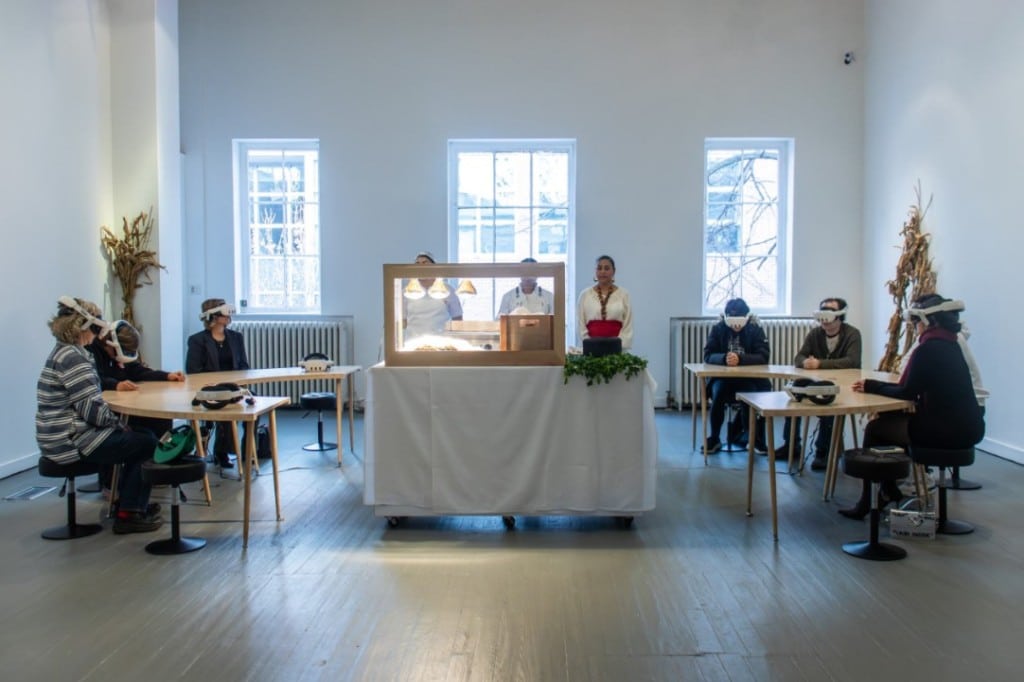
These ideas and more are explored within “Taste of Exile,” a unique, multisensory installation at No Place Gallery that combines virtual reality animations created by Mousavijad with the culinary talents of Martinez, a James Beard Award-winning chef who will prepare and serve a single barbacoa taco to each visitor taking part in an exhibition-opening immersive dining experience on Friday and Saturday, April 24 and 25. (The dining experience is free for attendees, but preregistration is required.)
Mousavijad said he has for years considered how to explore the culinary arts within a larger installation, believing that our society generally doesn’t give enough consideration not only to the skills involved with the pursuit, but also to the various labors required at every stage to bring food from the farm to the plate. Within this undertaking, Mousavijad has also embraced Martinez’s life story as another means to explore concepts of exile and displacement – themes he described as long existent within his work.
“Exile is this space of in-betweenness. For me, it has always been and continues to be a space between a lost home or an inaccessible home and a destination that never fully emerges, or at least a destination that never fully opens to you,” said Mousavijad, who acknowledged that these concepts have taken on a greater intensity amid the war the United States continues to wage against Iran. “My home country is literally going through a war, and then, on the other hand, we also have a travel ban for citizens of my country, among others. We really are stuck. We’re in that limbo space.”
And yet, for Mousavijad, “Taste of Exile” originated as a means to step outside of his own identity politics, as he explained it, fostering a connection with other people and cultures who have endured similar hardships. In doing so, the artist said he always knew whatever expression emerged would need to be multisensory, believing this wrap-around effect essential to conveying the weight of these experiences.
“I respect great writers, but I’m not convinced of words. Like, what am I going to say? A bunch of adjectives. It’s horrific. It’s disheartening. It’s a catastrophe. None of these really sum it up,” said Mousavijad, who invested nearly 1,000 hours into creating the VR animations visitors can step inside of at No Place Gallery beginning next week, including an interactive cornfield. “I think the virtual space is fundamentally exilic. It’s a space that [Iranian American historian] Abbas Milani says, and I’m paraphrasing, creates a situation where you’re living in one place and dreaming in another. … And some parts of it are vivid. And some parts of it rely on the faded memory. And you’re constantly in-between. It really does analogize the experience of constantly feeling alienated in the location you live in.”
When Mousavijad began more intensive conversations with Martinez for the exhibition beginning two or three years ago, the talks took place amid a different presidential administration and with no awareness that an immigration crackdown would take place in the months leading up to the opening. Due in part to these more urgent realities, as he described them, Mousavijad acknowledged there was a brief moment where he weighed aborting the project, relenting only after he began to question if his life and existence would have their fullest meaning absent the follow through.
“I feel very, very vulnerable with what’s going on,” said Mousavijad, who could barely express the sense of overwhelm he felt in first encountering the early April statement released by Donald Trump in which the president threatened Iran with genocide, writing, “A whole civilization will die tonight” if the country did not submit to a deal with US negotiators. “I’m a very agnostic person, but when it comes to these matters, I wish there was a God I could pray to. … It’s really impossible for me to find the words. These are excellent examples to show the limits of language.”
For Martinez, the intensity of this social and political moment is one that has led her back to the soil, her attentions focused on the farmers and laborers who tend to the land, providing the bounty from which she and her colleagues can work their culinary magic. “We have to keep taking care of the farmers. If we don’t take care of the farmers, we chefs will not be able to create dishes,” Martinez said via her translator. “As human beings, we are born to serve, and … every day, I’m fulfilled with the experience of sharing with human beings, with serving human beings.”
The artist echoed this idea, expressing that “love, nourishment and care is really at the center” of the exhibition, with politics factoring in later and drawing out additional dimensions. “All of what immigrants have always done has always been political,” Mousavijad said. “And it’s not that things are more political now. But I think we do live in a unique time of fear, and that renders a lot of what we do, it affects a lot of what we do. … And this doesn’t end with our one or two artistic expressions. This is about our everyday life, every breath.”
Author
Related Articles
Scrawl meets Scrawl
Marcy Mays and Sue Harshe recently joined pioneering Urban Scrawl artist Dan Gerdeman for a conversation ahead of the band’s performance at the Franklinton art event that has been a longtime source of confusion for some of their fans.
‘Immigration: A Journey of Belonging’ seeks deeper understanding
The new group exhibition, open now at the Losinski Gallery at the Main Library, will host a reception from 2-4 p.m. on Saturday, Oct. 3.
Deep conversations pave the way to ‘Chasing the Light’
A couple of years ago, Loren Bucek invited a group of artist friends to her Clintonville home. The gathering soon evolved into regular meetups that shaped the creation of a new exhibition opening this week at McConnell Arts Center.