
‘And when you get caught, and your camp gets swept, you’re right back to square one.’
In interviews, nearly 20 unhoused or formerly unhoused Columbus residents spoke about the things they lost in encampment sweeps and the impact it had on their lives.
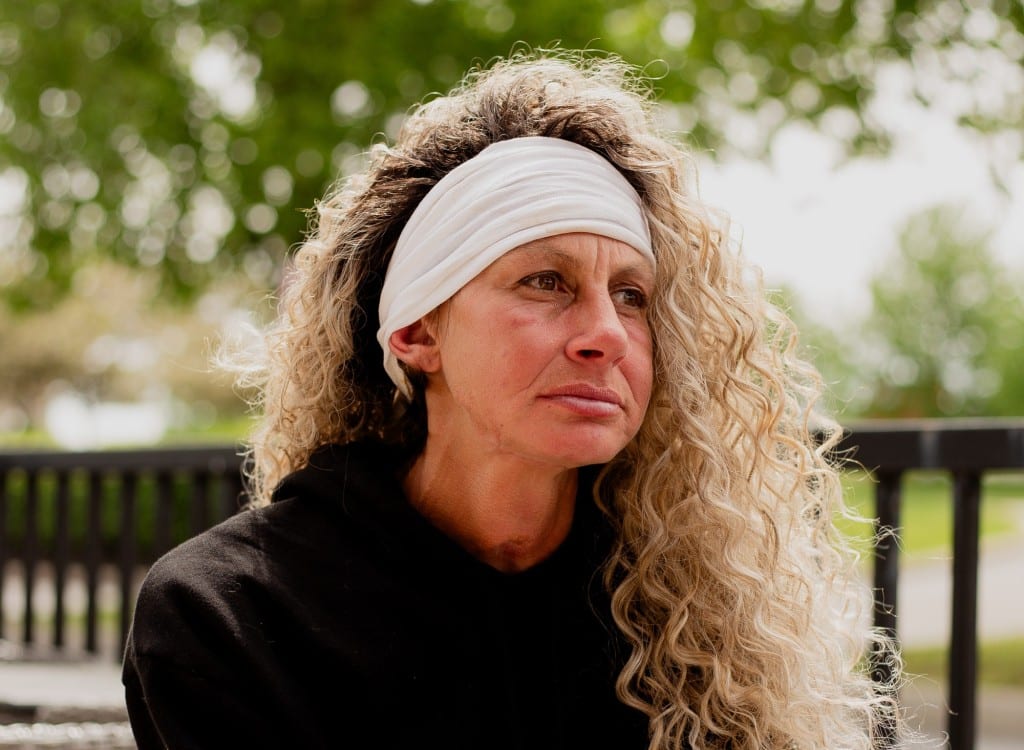
For almost three years, Chastity lived in an unhoused encampment behind Abbey Lane Apartment Homes near the intersection of Morse Road and Cleveland Avenue on the Northeast Side of Columbus. But in late March, Chastity said a crew of more than a dozen swept through with police observers to clear the property, collapsing people’s tents, disposing of their belongings, and whisking away with anything they deemed to be of value.
“I had a little potbelly wood burner that I bought for myself on [Facebook] Marketplace for $200 and they stole it,” Chastity said in mid-April, seated outside of a Starbucks not far from the encampment where she and others were forcibly evicted a month earlier. “My mom and dad are both dead now, but … I had a blanket my mom had given me, and it was folded and on my bed when I left. And when I came back, my tent was slashed, and the blanket was just in the mud, and everybody had stepped on it. … The only clothes I own are two pairs of pants, two hoodies and a tank top now. … I’m just so tired of starting over. … I want to change. I want to do better. I want things in life. I’m 42 years old. I’m tired.”
Critics have long charged that encampment sweeps are both expensive and do nothing to reduce homelessness, with Barbara DiPietro, senior director of policy for National Health Care for the Homeless Council, authoring a December 2022 brief in which she described the practice as “counterproductive, costly, and harmful.” An April 2023 study published in the Journal of the American Medical Association expanded on this notion, concluding that sweeps lead to worse health outcomes for those impacted, linked to an increase in life-threatening infections, hospitalizations, and death.
A donation powers the future of local, independent news in Columbus.
Support Matter News
And yet, the practice has remained in place in Columbus even as the number of people experiencing homelessness across the city has continued to rise. Released last week, the Community Shelter Board’s point-in-time count report recorded 2,587 unhoused people in Franklin County – an increase of 1.2 percent from 2025 and the fourth straight year the number has grown.
Columbus City Councilmember Tiara Ross, chair of the Homeless, Housing, and Building Committee, said she advised on the legalities around camp remediation in her former role in the City Attorney’s Office, which gave her an understanding into the process, but that she had continued to interrogate the policy in her current position. “That is part of my agenda, right, to inquire around what our remediation process looks like,” she said. “And also, to figure out where we can do a better job in having a more people-centered approach to how we are handling camps.”
Emily Myers of the unsheltered advocacy group Heer to Serve put the issue more bluntly. “If everyday people knew that their tax dollars were being paid to forcibly move our neighbors,” she said, “do you think they would support it?”
Columbus has spent $462,828.25 on camp remediations since 2024, according to records provided to Matter News by the Department of Development, including $23,242 to remediate a half-dozen camps in March and April of this year.
Beyond the steep economic and health costs, encampment sweeps can impact the unhoused on more intimate levels, severing ties with the communities they’ve built, upsetting a fragile sense of stability, and robbing them of personal effects that might have held deep sentimental value.
In recent interviews, nearly 20 unhoused or formerly unhoused Columbus residents discussed the impact of the things lost in these forced displacements, from inherited jewelry, baseball card collections, and treasured photos of loved ones to IDs, birth certificates, and social security cards, the absence of which has caused delays for some in their searches for steady employment or permanent supportive housing.
“One time a bulldozer came through and tore up everything, tore up my ID, my social security card, my birth certificate,” said Edward, 46. seated in the living room of an East Side apartment. “And that has made it tough to get a job, which makes it nerve-wracking when you’re trying to make ends meet.”
Others interviewed continued to mourn the lost personal items they said helped them to maintain some connection to their previous lives, with multiple people lamenting the pictures of children, parents, and grandparents scraped up by bulldozers and discarded into dumpsters.
“I lost my marriage license, but you can replace that. It’s the things you can’t replace, like my kids’ baby books, my wedding ring. Those are irreplaceable,” said Amanda, who described the grief that gripped her as she watched her camp get crushed beneath a bulldozer. “It was everything we had worked so hard for, and for it to be seen as a burden, as an eyesore, that was tough. We were just out there trying to survive, trying to keep things dry when it was wet, or warm when it was cold. … And when you get caught, and your camp gets swept, you’re right back to square one, and it’s a never-ending cycle.”
When the city swept her South High Street encampment, Kay Kay, 40, said she lost personal items gifted to her by a best friend who was struggling with severe health problems at the time.
“And we weren’t sure if she was going to make it, and so everything she’d given to me was really extra special,” said Kay Kay, who in the forced relocation also found herself permanently separated from her cat, Trouble. “Still if I see bigger tabbies back there [by the former encampment], I’m like, Trouble? … He was one of the reasons I made it that summer. I was in a bad place mentally and he was my baby, and he was there with me. It was nice to see his face. And at nighttime, I would holler for him, because he would go and visit everybody in the neighborhood, as we called it, hanging out with everybody. But around 10:30, I would holler for him, and I’d hear his little bell coming. And then we’d go to bed, and he’d sleep under the blankets with me every night.”
Jackie, 54, said she lost jewelry she inherited from her grandmother in one sweep, along with handmade trinkets crafted for her by her grandchildren, all of which she kept neatly organized in storage boxes. “And you can see it’s not trash, and that it’s taped up all nice,” said Jackie, speaking from within the sprawling, Far East Side encampment where she now makes her home. “They literally ran over it with a bulldozer, and that killed me. That did kill me.”
With some items, it was less about the monetary value than what these objects had come to symbolize. Chastity, for one, lamented the items gifted to her – a tent, a machete for clearing overgrowth, an axe for chopping wood – that were disposed of in her various forced evictions, going on to detail how those losses negatively impacted her sense of self-worth. “When somebody gives us something, like when somebody gave me my tent, that showed me that somebody thought about me,” she said. “It showed me that I mattered in at least one life. And that’s huge.”
Of the 2,587 unhoused people included in the recent CSB point-in-time count, 1,936 were in transitional housing and 651 were living outside. The people interviewed who spent time living in encampments offered a myriad of reasons for making the decision to live on the land, citing everything from a shortage of available shelter beds to the restrictions placed on people who are able to gain access to the system, including curfews, the requirement for personal belongings to be limited to a single bag, and a ban on pets.
“You got so many rules and regulations to it that you feel like you’re in prison or something,” said Mr. Allen, 62. “I tried it one time, and I just just really didn’t like it at all. You’re sharing bathrooms and there are beds on top of beds, all that stuff. And the environment, it’s like there’s always something negative going on or people arguing and fighting. And me being an older gentleman, it’s not really safe.”
Multiple women interviewed similarly cited security concerns among their reasons for avoiding the shelter system, with Elizabeth, 37, saying that she turned to the camps after she was nearly raped in the bathroom of the Van Buren Center. “It’s just not as protected as they claim it is,” she said.
While acknowledging the many challenges of life in encampments, nearly everyone interviewed cited benefits ranging from the freedom to come and go to the sense of connection that can develop within these communities, which several described in familial terms.
“One thing I could say is that these camps stick together. We may have our fallouts and we may be dysfunctional, but what family ain’t?” said Jessica, 36. “And you will find out that you get more love and support from people on the streets who aren’t family, who aren’t actually blood, than you do your own family. And it’s because they understand you, and they understand what you’re going through. They understand the habit, the substance abuse. They understand your pain and why you’re doing what you’re doing.”
Amanda, 39, joked that the encampment she was formerly part of was so close-knit and self-policing that newcomers “almost had to put in an application and be pre-approved.” “We didn’t want people who were stealing from one another, we didn’t want violence,” she said in mid-April at Columbus Commons, a short walk from her new home downtown. “We didn’t want none of that.”
Councilmember Ross said that camp remediations on city property are triggered by citizen 311 complaints, with residents commonly citing excessive trash or “a certain level of activity that might be happening there,” such as drug use. Generally, once a camp has been earmarked for remediation, notice is supposed to be posted within the camp and residents given enough time to relocate, which often means finding another tract of land located even further on the fringes but still within the same general area. (Camps located on private property, in contrast, can be swept at any time and without warning, based entirely on the discretion of the landowner.)
Even given this notice, however, many interviewed stressed the challenges involved in moving from one piece of land to another absent moving vehicles or assistance. “We’re moving by hand or foot or bike,” said Elizabeth, who also noted how these relocations leave people living on the land more open to theft, since they can’t keep an eye on the possessions left in one camp while moving some belongings into another. “You can’t be two places at once.”
These challenges can be exacerbated by what people interviewed described as a lack of communication, at times, from city officials, who they said would earmark a camp for remediation on a particular day, inform the people living there, and then not show up, creating a situation in which the unhoused residents never knew if or when a camp might be cleared.
“And they would do that all the time, where they’d give us a three-day notice or a 10-day notice, and nothing would happen,” said Loretta, interviewed in late April at the North Side motel where she currently lives with her cat, Princess. “And then when they did come, you weren’t ready, and it was almost like they did it on purpose.”
“And that is something we grappled with a lot, and I certainly used to as a member of the City Attorney’s office, which is the idea that if we’re going to remediate, and you put a date on it, and there is a history or reputation of not coming, then people are not going to believe you’re ever going to come. And why would they go through the trouble of moving when they don’t feel they have to?” said Ross, who added that while the administration has not engaged in discussion on abandoning remediation as a policy, she did want the city to take a closer look at current processes, which she described as “murky.” “We need to think more about the permanency of the signs going up [notifying a camp of an impending remediation], how long an individual gets [to move], and are we considering the holding of a person’s property and what does that look like?”
Multiple people interviewed said they had been present during sweeps in which police were on site running warrant checks on the unhoused camp residents, which led some residents to stay away from the site, abandoning even their most essential belongings in the process.
“And that really is new information to me,” Ross said. “Police are only there in the event that something pops off and they need to intervene, so the idea that they are engaged in the process and running warrants is crazy. … It’s disheartening to know there are officers out there who are taking advantage of an already difficult situation, so I’m writing that down, and we’ll certainly be looking into that and asking questions.”
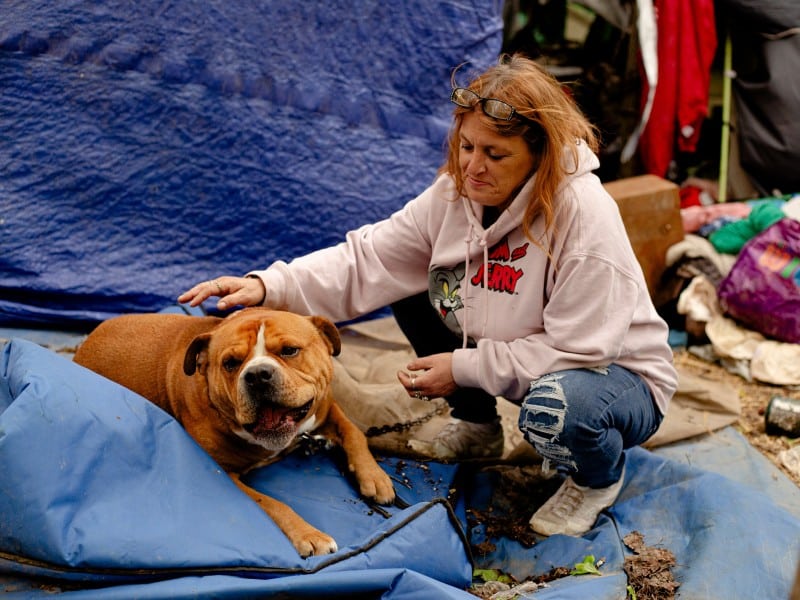
Jackie has been living on the streets since 2019, most recently making her home in a Far East Side encampment where she lives with her two dogs, Bully and Ed, her tent adjacent to 26 to 42 other campers, depending on the day, she said. When Jackie first moved into the camp, hidden behind brush on the other side of an embankment, its population was significantly smaller, and she expressed concern that the growing number of unhoused people living together at the site might soon attract unwanted attention from the city.
“It was just me and two other people at first, and now that everyone has been put out of the little nooks they’d found, we’re all here,” said Jackie, who pushed back on the idea the city wanted unhoused people to be out of sight and out of mind. “We almost wish we were out of sight and out of mind, but when they find a camp, they pick on us, they bully us. … We’re scared to death we’re going to get swept out of here, because we’ve been everywhere and this is the last place.”
Multiple people interviewed said the city’s unhoused are forced daily to navigate a world in which it is clear they are at best an unwanted presence. Nikki, 45, said she’s had to dodge rocks thrown at her by kids from nearby apartment complexes, while Jackie shared that in recent months a gas station adjacent to her camp had removed its outdoor seating and closed off public access to external electric outlets, removing one of the few remaining places where the area’s unhoused could sit and recharge a phone – an essential tool for remaining connected to case workers, family members, and friends. “Some people are so hateful. … They don’t even look at us as human beings; they look at us as cockroaches,” Jackie said. “I’m a grandmother, a mother, a sister, a daughter. I’m all of these things.”
At their core, those interviewed said, encampment sweeps can reinforce the idea that unhoused people are disposable, treating them as a nuisance rather than neighbors and undercutting the reality that more than half of the nation’s population is in effect “one crisis away from homelessness,” according to the U.S. Interagency Council on Homelessness.
“Honestly, at the end of the day, you, him, that person over there, you’re all probably one, maybe two paychecks away from being in a tent next to me,” said Chastity, who has been living on the land since 2018. “One injury is all it takes. One wrong move, one bad choice, that’s all it takes to be my neighbor, asking for a spot in my campground.”
Part of cultivating this larger understanding also involves developing an awareness that not everyone living on the land is doing so by choice. “I want to get out of the woods. I don’t like being out here,” Elizabeth said. “I want a home. I want friends, family, [and] to have something that’s my own again, like I once did.”
Some people’s hands have been forced by a shelter system increasingly overtaxed by an increase in evictions and an expanding affordable housing crisis. The 2026 Gap Report published by the Coalition on Homelessness and Housing in Ohio found a 53,000-unit affordable housing shortfall in Columbus. “And because we have such a shortfall on housing, it creates a bottleneck on a [shelter] system that was never supposed to hold the number of folks it has to in order to meet the need at this moment,” Ross said.
To counter this reality, the city has in recent years begun to expand beyond more traditional homeless shelters, experimenting with options such as refurbished hotels and supportive apartments. But there’s still significant work to be done, with Mr. Allen joining others in calling for an increase in the types of supportive housing options available.
“Some people can’t work anymore, and they get thrown in with the same people that got drug addictions, that got mental health conditions,” he said. “And it should be a situation where those things are being addressed, but they throw us all in the same category, throw us all in the same building, and whatever happens happens. And it’s not a good situation for a lot of people.”
“I don’t think that congregate shelter is a model that works anymore,” Ross said. “And I think we’re starting to ideate around what non-congregate options might look like. … And I personally will be advocating for more of that, particularly as we have more resources coming into our community through the bond dollars that we’re going to receive.”
In February, the city outlined its plans for the $500 million affordable housing bond approved by voters in November, which includes $150 million toward building and preserving affordable housing; $125 million in capital investments aimed at keeping people housed and reducing the duration in which people experience homelessness; $175 million toward land acquisition; and $50 million to “invest in innovation” to do things such as reduce development costs.
Along with these investments, those interviewed said they would like to see Mayor Andrew Ginther and his administration pivot from a policy of enforcing sweeps, embracing a more humane approach to those encampments located on city land. “Instead of just tearing things up, maybe try to find spots that are more agreed upon, or [offer] trash removal, some kind of compromise,’ Kay Kay said.
Failing this, Chastity said she’s doing her best to make herself small, hoping she might evade detection in her current location long enough that she can finally begin to regain a sense of footing. “I figure if I’m by myself and I have the smallest tent possible, maybe they won’t notice me,” she said. “And maybe I can be there a little bit longer, and maybe I’ll be okay, I hope, I pray about it.”
This article includes additional reporting from Heer to Serve and Stop the Sweeps 614, provided thanks to the generous support of the Johnstone Fund.
Author

Related Articles
On Development: Rapid-transit is moving slowly. Maybe we need a new model
Our policies suggest a willingness to spend any amount to add lanes and bigger (towering!) interchanges for major highways, while transit spending is too often regarded as frivolous.

Unpacking Vivek Ramaswamy’s plan to eliminate Ohio’s income tax
The campaign promise comes along with a $9.8 billion dollar budget gap to fund public education, health care, and public safety services across the state, according to a February report released by Innovation Ohio.
Baladna: Palestine Society of Columbus calls for a boycott of Cameron Mitchell Restaurants
‘So, for us as a board, given that this was happening with a business right here in our backyard, we felt it was our responsibility to take action and make the public aware.’