
David Butler makes a stunning return to ‘Whiteland’
The Columbus artist’s thought-provoking new exhibition kicks off at Hammond Harkins Galleries with an opening reception on Saturday, May 9.
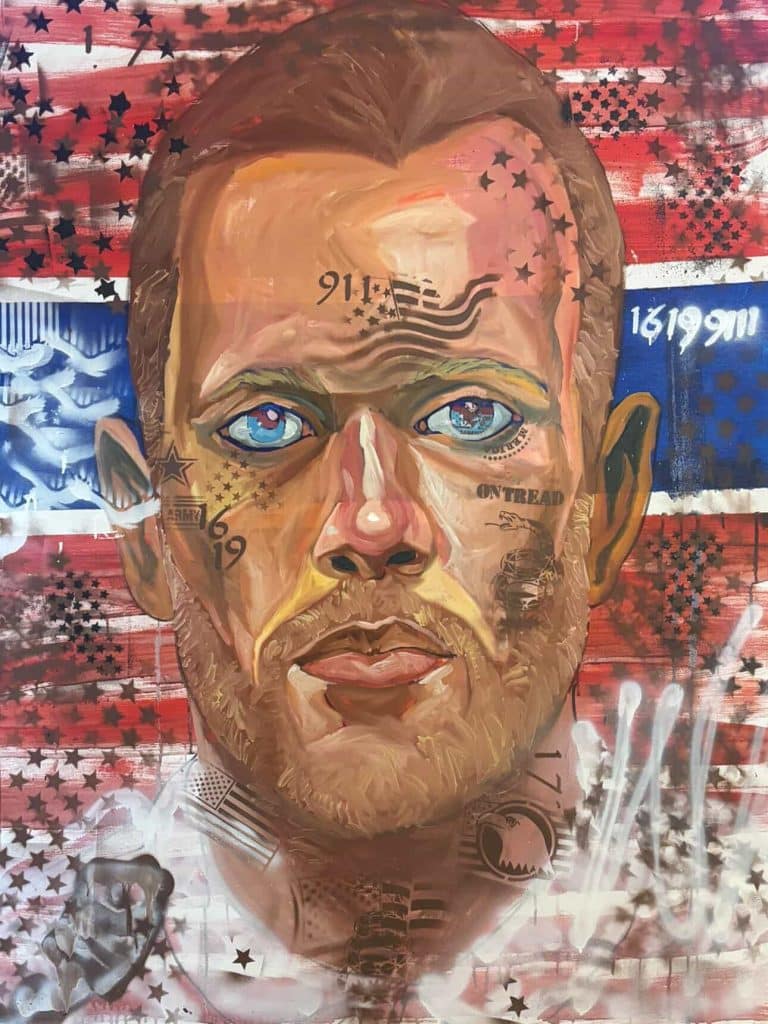
David Butler first visited “Whiteland” in July 2021, curating a group show in which he joined other Columbus artists in interrogating “the concept of whiteness,” as he explained at the time.
“The issue is white people not wanting to come to the grips with the fact that … because of the color of your skin, you have benefited from the system that has been created,” Butler said in an interview at the now-defunct Vanderelli Room in the days ahead of the 2021 opening. “And if you buy into that on any level, it becomes a problem for people who look like me.”
Nearly five years later, Butler is prepared to revisit “Whiteland” in a solo show at Hammond Harkins Galleries, which will kick off with an opening reception from 2-4 p.m. on Saturday, May 9.
A donation powers the future of local, independent news in Columbus.
Support Matter News
The Columbus artist acknowledged that he wasn’t exactly eager to step back into this particular creative space – “I wanted it to be completely done with,” he said in an early May interview at the downtown gallery – but that the current times demanded it. “We got Trump back and the world changed. And it’s become an even bigger conversation, because it’s very clear Project 2025 is a whiteness manifesto,” Butler continued. “This entire administration … is white, hetero-man centered. … It’s like we have all the John Hughes bullies at the helm of our government. It’s like all the ’80s [movie] bullies grew up and became politicians.”
In explaining the forces that led him to again take on this mantle, Butler eventually homed in on a specific moment from the State of the Union address President Donald Trump gave to Congress in March 2025, during which he named Devarjaye “DJ” Daniel, a 13-year-old diagnosed with terminal brain cancer, an honorary Secret Service agent – a move the artist described as “performative,” and which he said reminded of him of how he felt in the wake of the Pride Parade he attended with his then-infant son in June 2017.
“And that was the same Pride Festival where the Black Pride 4 got assaulted, and I remember being in the crowd and holding my son up, and people cheering on my son because he was in the midst of everybody, and I was holding him up like ‘The Lion King,’” Butler said. “And someone took a picture, and it ended up in 614 magazine. And in that same issue where they had my son’s picture, it did not have anything in it about the Black Pride 4. … And everybody was shitting on these four Black people who were fighting for my son’s right to exist. And the juxtaposition of those two things, it’s the same feeling of rage I felt when I saw that father hold up his son at the State of the Union, because I saw my son in both of those moments. And I want to make sure nobody is used as a pawn for this scheme of wealth and whiteness. That’s what I want my role to be in all of this.”
The work on display within “Whiteland” interrogates the concept of whiteness via myriad archetypes, with Butler creating a series of discomforting portraits based on photo amalgamations he generated representing right-wing politicians, podcast bros, police officers who have killed Black men and women, Black media personalities content to collect Trump-endorsed checks to the detriment of their community, and most recently a dead-eyed ICE agent – an image for which Butler uploaded photos of eight masked agents, including those who shot and killed Renee Good and Alex Pretti, respectively. For the resulting painting, he incorporated a face covering that can be raised by visitors to the gallery.
“So, people can come here and do what we’ve wanted to do, which is unmask them,” Butler said.
Taking inspiration from publications such as Busted, which print the mugshots of largely Black and Brown people in free zines offered at corner stores and gas stations, Butler adorned his portraits with facial tattoos created using stencils he purchased from a variety of America First sites. “It’s always Black people. And they always have tats on their faces. And I’ll see people pick up these [zines] like, ‘This is such a ridiculous thing but I love looking at these motherfuckers,’” he said. “And they take this thing like it means something, because they’re looking for those faces. I want you to look for these faces.”
Butler crafted these paintings in his home studio, which also doubles as his children’s playroom – a reality that meant lugging the canvases up daily from his basement and lining them up together in an array that creeped out his partner, Erica. “She hated when I put them all together in a room,” said Butler, who is able to approach the work at more of a remove owing to the fact that the faces aren’t actual people but rather AI-generated constructs.
Earlier in his career, Butler routinely painted the portraits of the Black men and women killed either by police or gun-toting vigilantes, including Trayvon Martin, the teenager murdered by George Zimmerman in 2012. In contrast to the work on display in “Whiteland,” these paintings enacted a heavy emotional toll on the artist. “You’re looking in the eyes of ghosts every day. Of people who should be alive. Of people who should be here, existing in this space,” he told me in 2016. “It’s a hard state to live in when you’re making art, which makes this work kind of toxic for me.”
With this new work, a degree of separation is introduced by centering a person who does not actually exist, because, as Butler explained it, “I don’t want the construct to exist.”
“And this is not me saying, ‘We need to tear down white people,’ and I need that to be clear,” he continued. “It’s about tearing down the construct that says you as a white person should have power over me and my existence by having been born white. I need people to understand all this shit is made up. There were pretty much two things made up to oppress us all: whiteness and religion. And that’s what Christian nationalism is. It’s the whole brand. And what I’m doing here is I’m trying to tear down the brand.”
Author
Related Articles
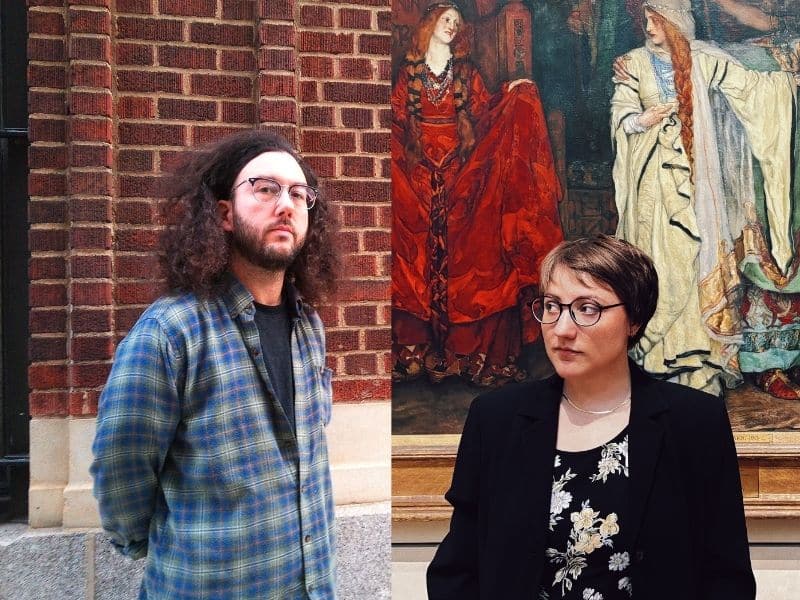
A decade later, Matthew Erman and Lisa Sterle revisit ‘Long Lost’
First released in 2016, the husband-wife duo’s first collaborative series was recently reissued as a graphic novel by Vault Comics. To celebrate, the couple will appear in-person at the Book Loft on Wednesday, Oct. 28.
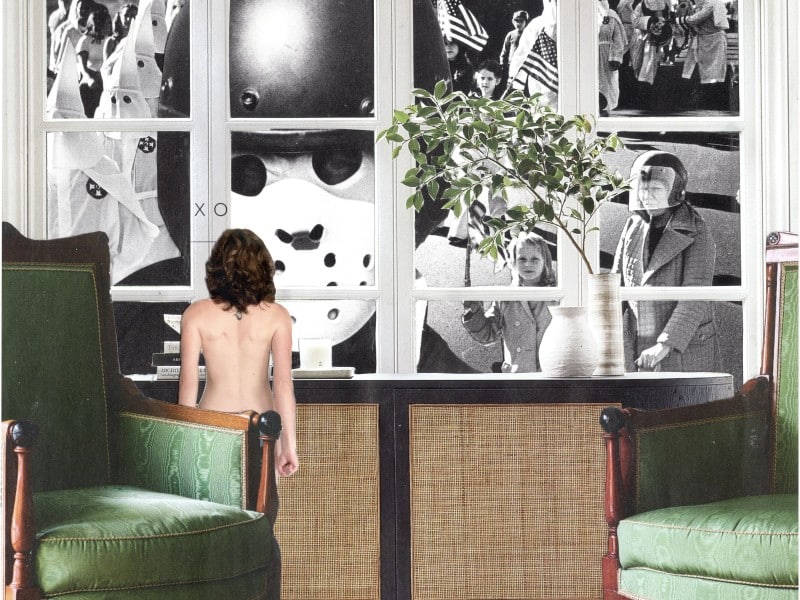
‘Pulp Stiction’ joins the resistance
A deeply compelling new collage exhibition brainstormed and curated by Emily Morgan opens at Hopkins Hall Gallery on Monday, Oct. 26.
Andrea Myers comes full-circle with progressive mural at the Line
The Columbus artist once took drawing classes in the building that now houses the new restaurant and hospitality training center founded by Service!