
Change takes many forms within ‘Metamorphosis’
The new group exhibition at the Riffe Gallery kicks off with an opening reception from 2-4 p.m. on Saturday, Aug. 1.
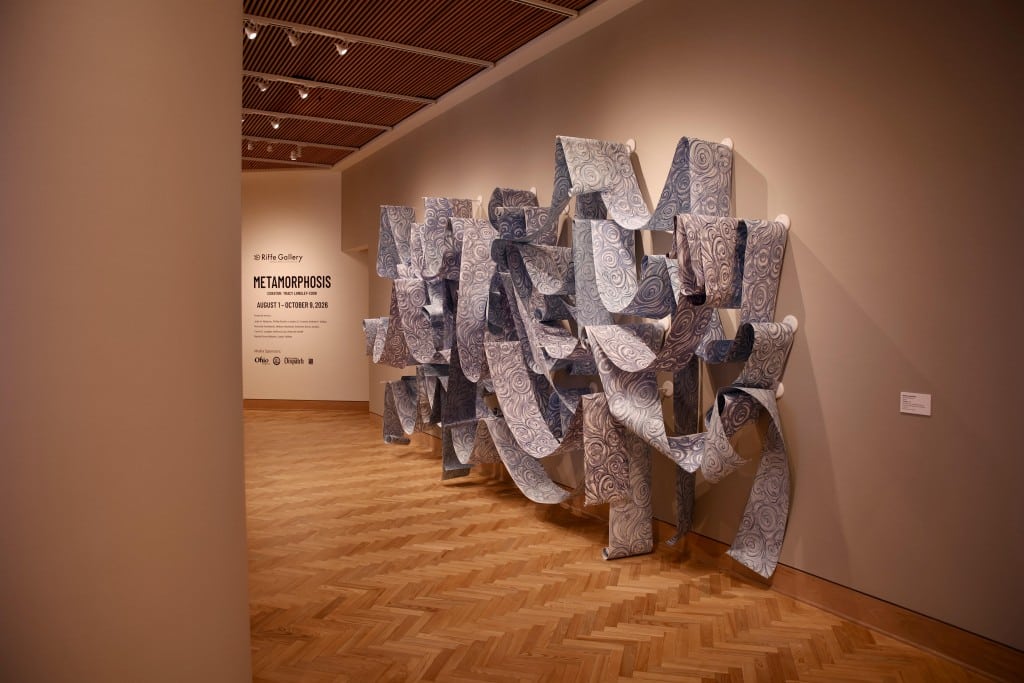
Artist Tracy Longley-Cook has always been enamored with change – a concept intrinsically linked with her photographic practice that began to take on even greater resonance when she reached a point in life when the people closest to her began to pass away.
“And that was a huge transformation,” Longley-Cook said in a late July interview at the Riffe Gallery. “That was sort of a different phase from earlier, when maybe a grandparent died. To have a partner die, or to have a parent die, I realized I was moving into new territory. … And that influenced both my own work and the way I looked at work by other artists.”
The curator said this focus intensified coming out of early Covid, as she became more cognizant of the ways the pandemic had reshaped parts of society. “And then I began thinking of the political landscape, the economic landscape, and my career and moving into the phase where I’m beginning to think of retirement – not that I’m quite there yet,” she said. “So, I was experiencing all of this change for myself and then looking around and seeing it happen in a global way.”
A donation powers the future of local, independent news in Columbus.
Support Matter News
All of these ideas existed front of mind as Longley-Cook developed the group exhibition “Metomorphosis,” which kicks off with an opening reception at the Riffe Gallery from 2-4 p.m. on Aug. 1 and centers on a range of Ohio artists exploring what the curator described as “the liminal space’ between what once was and what could be. “So much of change is … moving into the unknown,” she said. “And that was sort of the crux I was thinking about with this show, gathering all of these artists who are thinking about metamorphosis from a material perspective, from an environmental perspective, from a figurative or body perspective, from an emotional perspective, and from a family history perspective.”
Upon entering the gallery, attendees are greeted by a massive tapestry casually draped into a flowing wave-like form by Athens artist Melissa Haviland, who in the installation instructed the preparatory staff “to keep it random,” Longley-Cook said, enabling the work to take shape intuitively and ensuring that with each showing the pieces takes slightly different form. Moving closer, more details emerge, the fabric screen-printed with a range of domestic furnishings – tableside lamps, chairs, a baby’s crib – to highlight the reality that humans can’t be separated from the physical landscape.
Connections reverberate throughout the gallery, with Haviland’s cascading installation mirrored in the organic folds depicted in Cincinnati artist Melissa Lusk’s intricate weaving and then again in the Justin Teilhet’s ceramic wall hangings, which are painstakingly crafted from individual black tiles that collectively suggest a scaled dragon hide.
Elsewhere, the curator deploys contrast, setting Gretchen Durst Jacob’s vividly colored acrylic paintings directly across from more muted works by Marcelle Hackbardt, whose “Shaping Memory” explores the cognitive and emotional dimensions of Alzheimer’s disease. “And I love how it’s even pushed back into this space,” Longley-Cook said of “Shaping Memory,” which sits in an alcove, of sorts, at the far north end of the gallery, “because it holds a more quiet, meditative, and contemplative atmosphere.”
Other artists took the metamorphosis concept more explicitly, including Andrew Dailey, whose “Tree, Past Tense,” exists in one form now and will continue to evolve over the course of the exhibition, with the Dayton artist planning to visit the gallery on three occasions (from noon-2 p.m. on Aug. 21, Sept. 18, and Oct. 2) to continue with the graphite drawing – done directly on the gallery’s wall – under the watchful eye of Riffe visitors.
“So, this will only live for this exhibition, then it will be painted over,” said Longley-Cook. “It’s making something and committing time and energy into something you know is going to disappear. It’s sort of like a mandala, where the [Tibetan] monks will make these intricate sand patterns, and then they just sort of rake them over. And it really speaks to [Dailey’s] process and also the underlying theme in his work that this is all temporal, that this is all temporary.”
Author
Related Articles
‘Immigration: A Journey of Belonging’ seeks deeper understanding
The new group exhibition, open now at the Losinski Gallery at the Main Library, will host a reception from 2-4 p.m. on Saturday, Oct. 3.
Deep conversations pave the way to ‘Chasing the Light’
A couple of years ago, Loren Bucek invited a group of artist friends to her Clintonville home. The gathering soon evolved into regular meetups that shaped the creation of a new exhibition opening this week at McConnell Arts Center.
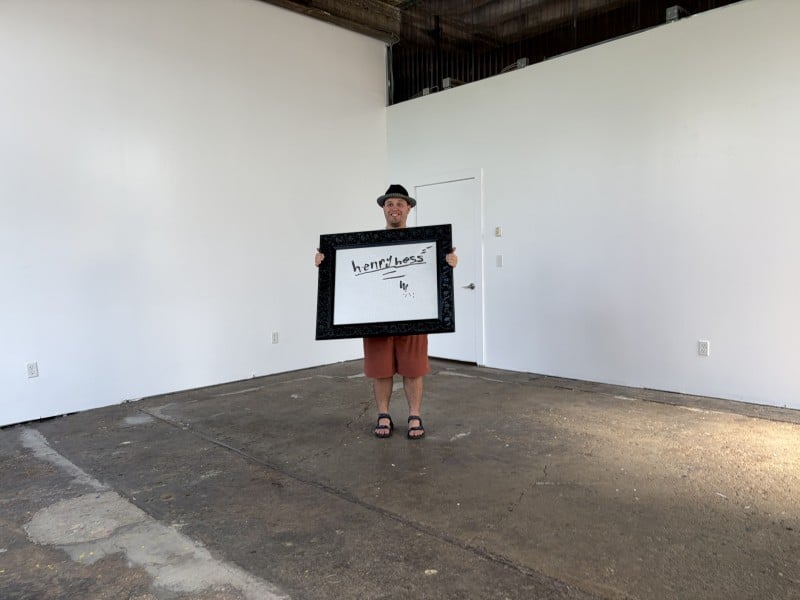
Henry Hess says goodbye to his longtime Chromedge studio
Faced with a rent increase of more than 30 percent, the Hess family opted to move on from the artist’s creative home of the last eight years. And while the next steps remain uncertain, they stressed that Henry would maintain a presence in Franklinton. ‘We’re not going anywhere,’ Sophia Hess said.