
Flock is on pause. What about all that other surveillance tech we use?
Columbus has had a contract with Shotspotter, an AI-powered gunshot detection microphone system, since 2018.
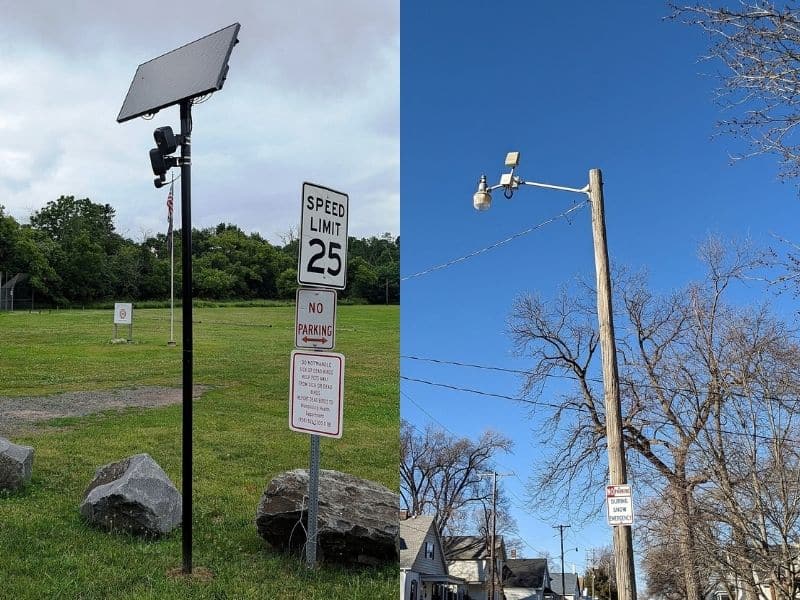
Over the past year, Flock has become a huge point of contention in Columbus. A series of protests, a six-hour-long city council hearing, and evidence of abuse by Columbus police officers and use by federal immigration enforcement agents led Mayor Andrew Ginther to pause the city’s use of the surveillance company’s technology at the beginning of September.
For civil liberty and privacy activists, as well as the hundreds of people who only recently started learning about mass surveillance but decided they don’t like it, that’s a big win. But it doesn’t mean that surveillance in the city is over. Beneath all the Flock commotion, a much more expensive and long-term surveillance tech contract is flying under the radar.
Columbus has had a contract with gunshot detection provider Shotspotter since 2018. Shotspotter, which is run by SoundThinking, Inc., is an AI-powered microphone system trained to pick up on loud sounds, distinguish whether they’re gunshots, and alert police within 60 seconds if so. Suspected gunshots are vetted by a human ear before they’re sent to law enforcement.
A donation powers the future of local, independent news in Columbus.
Support Matter News
CPD has deployed Shotspotter’s acoustic sensors across 12.6 square miles of the city, first in Linden, on the Hilltop, and along Parsons Avenue on the South Side. It later added the Near East Side in 2020 and the Wedgewood Apartments in 2023.
In contrast to Flock, Shotspotter is broadly less invasive. It records audio, not video; it retains sound data for 30 hours, not 30 days. To Gary Daniels, legislative director of the Ohio branch of the American Civil Liberties Union (ACLU), it doesn’t pose the same extent of concern.
“ Gunshot detection was never near the top of privacy concerns, in large part because there are so many other types of surveillance technology that are much worse out there,” Daniels said in an August interview. “ There’s still privacy concerns about gunshot detection. But if our government is intent on mass surveillance, they have much bigger and better technology to accomplish that at this point.”
But that doesn’t mean Shotspotter doesn’t have its issues – issues which Columbus, just a few years ago, was actively debating. A major one is the risk of overpolicing.
“ We know that when ShotSpotter alerts a police officer, when that police officer arrives on site, they’re more likely to be agitated, they’re more likely to be scared, they’re more likely to arrive prepared to shoot,” Dr. Viet Trinh, a historian in the Ohio State University Black Studies department who studies surveillance and policing, told Matter News. “I think that, plus the fact that we know that ShotSpotter is concentrated primarily in Black neighborhoods, in neighborhoods where there are larger numbers of people of color, that creates conditions for unequal policing. I think that ShotSpotter is still a civil liberties violation, but my critique of ShotSpotter is more in the fact that it inadvertently creates dangerous scenarios for both the police and for regular-degular people who are being policed.”
A 2024 analysis by tech outlet WIRED of the leaked locations of more than 25,000 Shotspotter microphones nationwide found that “in aggregate, nearly 70 percent of people who live in a neighborhood with at least one SoundThinking sensor identified in the [yearly census] data as either Black or Latine,” and that “nearly three-quarters of these neighborhoods are majority nonwhite, and the average household earns a little more than $50,000 a year.”
Another critique of Shotspotter relates to inaccuracy.
“It misses a lot,” said Jacob Wourms, campaign and policy manager at CampaignZero, a nationwide advocacy organization that runs a national Cancel Shotspotter campaign. “It’s really good at detecting loud, impulsive sounds, but it’s not good at distinguishing which ones are gunshots and which aren’t. For the same reason that a person is like, ‘I don’t know if that was a firework or a gunshot,’ the tech isn’t good at it either. Shotspotter’s system initially classifies a noise as gunshot or no gunshot, and then a human employee listens to it. SoundThinking, their parent company, advertises this as a two-step process that makes their system better. But it’s the same thing, right? It’s the same thing as one of us sitting on our porch wondering, ‘Is that or isn’t it?’”
Cancel Shotspotter also notes that on at least two occasions, prosecutors have tried to use audio of human speech collected as part of a Shotspotter recording as evidence in court. In one of those cases they were successful.
“It’s always going to be somewhat problematic, because you’re talking about live microphones,” Daniels of the ACLU said. “With surveillance technology, every single time, without exception, it’s ‘Well, we’re going to start for this limited purpose over here. You got nothing to worry about.’ And then as the months and the years go on, we see mission creep. What was once meant to detect just gunshots in a certain area – well, it is after all a microphone picking up things.”
These are concerns that Columbusites have had in recent years, and in some cases continue to have. In 2024, the Columbus Dispatch found that out of 14,209 Shotspotter alerts issued over two years, two percent resulted in arrests. Data obtained from CPD by Matter News also shows that for those same two years, only 18 percent of those alerts even resulted in incident reports.
Violent crime in Columbus has been steadily dropping for the past three years; in none of those years has Ginther attributed success to Shotspotter technology. The most recent case appears to be in 2023, when Ginther said during his State of the City address that, “We’re also using cutting-edge technologies like Shotspotter that can detect gunfire as the trigger is pulled and direct our officers to the scene before a call for service is placed and, ideally, while a suspect is still in the vicinity.”
Matter News previously reported that the city explicitly intended to integrate Flock and Shotspotter tech as part of a wider surveillance network. This past month, Ginther ranked Flock as one of the top factors in reducing homicides, without mentioning Shotspotter.
Flock has cost the city of Columbus $228,000 since 2024, according to city council records. The sum of the cost for all approved Shotspotter contract renewals and expansions sits at $7,020,384.56. In a June hearing, the council unanimously authorized an expenditure of $661,500 for Shotspotter; in that same hearing came one of the first calls for a Flock audit.
But Flock’s contract was paused. Why is Shotspotter apparently receiving less scrutiny, despite its apparent lack of effectiveness and ballooning comparative cost?
“ Generally speaking, when people think that surveillance is making them safer, they’re okay with it,” Wourms said. “The example that we use is TSA, airport security. We’re all pretty okay to take off our shoes and go through detectors because we know it’s keeping us safe when we go 35,000 feet in the air. I think Flock activists have made a really good, very clear, very compelling argument for why Flock is a threat and why it’s a danger. We certainly try to do that with ShotSpotter, but it’s harder to explain why sounds can be a problem.”
Councilmember Melissa Green, who lives on and represents residents of the Hilltop, told Matter News that she has thus far supported Shotspotter for that reason.
“I’ve been around long enough to remember when ShotSpotter first moved onto the Hilltop, and the years of advocacy that so many of our trusted community leaders engaged in to help bring this tool to my District,” Green wrote. “My previous support for ShotSpotter has been rooted in those experiences…I’ve heard not only from our law enforcement partners but also from trusted community advocates here across my District for the last several years about the potential benefits of ShotSpotter, particularly in helping EMS and police respond more precisely to a gunfire incident to render aid to someone who might be injured and recover evidence important to an investigation.”
But Green has been vocal in the Flock debate and indicated that she would vote to end its contract and put bags over its cameras. That conversation, she said, had spurred her to have new concerns about the other surveillance tech Columbus uses.
“After all the dialogue we’ve been having about Flock, I certainly view these types of technologies through a much more critical and nuanced lens,” she wrote. “Questions about ShotSpotter’s data retention, information sharing, police response protocols, and effectiveness are now top-of-mind. The dialogue around Flock cameras has also brought greater attention to concerns not only about what information these tools can collect, but what authority law enforcement believes that information gives them to monitor, approach, question, or detain another person. I’d consider ending any city contract if we determine it is ineffective, being misused, creates unacceptable harm, or cannot be governed appropriately.”
Green said she wanted to establish an independent review committee to evaluate safeguards on new and existing surveillance tech, including both city and public safety staff and external groups like the ACLU. She was one of two councilmembers who responded to a request for comment on whether their thoughts on Shotspotter had changed.
The other was Councilmember Nicholas J. Bankston, who when previously asked whether he would vote down the Flock contract said he was waiting for the whole picture.
“ShotSpotter is one of the many tools used to assist our officers in protecting the well-being of our residents,” Bankston wrote to Matter News in a statement. “The technology has been shown to be an effective way for officers to respond to incidents where gunshots are not immediately reported or reported at all, and I am confident that its efficacy rate and impact will be analyzed as conversations progress…Any and all issues with ShotSpotter that are identified should be evaluated independently of Flock, and I will gladly work alongside my colleagues in that process if that is the direction these conversations go.”
It’s not clear whether conversations will go this way. Though Shotspotter was a bigger national concern a few years ago, discussions around it have died down since then. There are a few reasons for this – one of which is the ever-growing network of different surveillance technologies.
“ I think to some extent, maybe, police have learned not to take the alerts as seriously as they once did,” said Dr. Matthew Guariglia, a senior policy analyst for the Electronic Frontier Foundation, a nonprofit working on digital civil liberties. “Part of the problem has become that ShotSpotter emerged in an era when there were a bunch of different companies creating their own sensors, and now we are living in an age of interoperability where all police technologies speak to each other and end up being fused on one kind of master platform.”
As surveillance tech improves, civil liberties and privacy advocates are increasingly focused on the next big thing, and less sophisticated or less invasive methods fall to the wayside.
“Gunshot detection technology is a bit like red light cameras,” Daniels said. “We used to talk about red light cameras as a potential tool of mass surveillance, but nobody talks about red light cameras anymore in that regard because of the newer, more invasive technologies that have emerged and been adopted since then.”
The other big problem is that regular-degular people don’t know much about surveillance. People’s Justice Project, a community advocacy group in Columbus focused on policing, has been running an anti-surveillance campaign since March of this year. Joey McQueen, a PJP organizer, said Shotspotter has been on their radar in that campaign, but that they focus mostly on getting people to even know about things as pervasive and contentious as Flock.
“Folks were unaware of what Flock was,” McQueen said. “They knew cameras were up, but they didn’t know what they were doing. We have been door-knocking most weekends this summer, and we have hotspotted at different festivals and events throughout Columbus to bring awareness to this issue. Similar to what you’re saying about ShotSpotter, so many people were unaware of Flock and what it was, and the city’s contracts, and just the implications of this technology that was put into place without their consent.”
McQueen said the six-hour-long city council hearing in August, where 55 people signed up to speak on Flock, would have been a “prime time” for the city to discuss its other surveillance tech. Two speakers at that hearing mentioned Shotspotter; no councilmembers did.
“ Right now what I’m seeing is city officials making commentary about public trust,” McQueen said. “This does not reassure us that there is public trust when these types of decisions are being made on our behalf without awareness around it. We’re trying to make [our campaign] broad to make sure that any other technologies that are being used in this way are brought to the forefront. They had the opportunity to do that, and that opportunity was not taken.”
There is the potential, some organizers said, for a successful Flock push to result in more people caring about surveillance and being interested in getting rid of it. The ACLU of Ohio hosted a webinar on how to combat surveillance at the end of August in response to a growing number of inquiries from people around the state; and with a broader distrust of Big Tech and artificial intelligence, knocking Flock off the city’s contract list could lead to a domino effect.
“ Picking off one data stream of a hundred is always worthwhile,” Guariglia said. “That’s part of the reason why people have been so focused on, even as organizers target canceling Flock contracts, never losing sight of the fact that the solution isn’t just to replace Flock with a different company. “It’s not just to get [automatic license plate readers] canceled and ignore the fact that your town also uses facial recognition. The movement has been aware that they need a holistic approach toward going after one target at a time, but never losing sight that it is one small piece of a larger problem.”
Related Articles

Opinion: Flock cameras won’t make us safer. Here’s what will
Flock Safety, the company behind the cameras, obstructs any attempt to establish guardrails, accountability, or transparency. Amazon is no one’s model for corporate responsibility, and even it cut ties with Flock.

‘We were once a school that allowed voices on campus. Now, no voices are allowed.’
Compared with protests at neighboring colleges, the administrative crackdown on the 2024 pro-Palestine encampment at Ohio State stands out for its severity, causing reverberations that continue to this day.
Columbus City Council meets to discuss Flock amid rising public scrutiny
Officials will hold a public hearing at City Hall beginning at 4 p.m. today (Monday, Aug. 10), with anti-Flock protesters planning to stage a 3 p.m. rally ahead of the meeting.