
An Ohio school needs funds. It voted to cut Anduril’s tax bill, anyway
How a factory for AI-powered weapons, a data center, and a needy public school collided in rural Ohio.
This article is provided by Inkstick Media, an award-winning nonprofit newsroom that covers war where it lands: in people’s lives. You can sign up for the Inkstick Media newsletter by clicking here.
On the afternoon of Jan. 16, 2025, just hours after Ohio’s governor announced that the autonomous weapons manufacturer Anduril was setting up a mega-factory near Columbus, the treasurer of a rural school district sent an urgent email to school board members. He asked them to convene at 8 am the following day and vote on whether to grant Anduril more than 30 years of property tax breaks. In Ohio, school boards are allowed to review and veto such deals when the tax abatement is more than 75% of what the company would have otherwise paid to public schools, which rely heavily on property taxes for their funding.
Records obtained from the school district indicate that the local government agreed to cut Anduril’s property taxes by at least $60 million. However, a calculation by Inkstick using figures in separate county records suggests the value is far higher.
A donation powers the future of local, independent news in Columbus.
Support Matter News
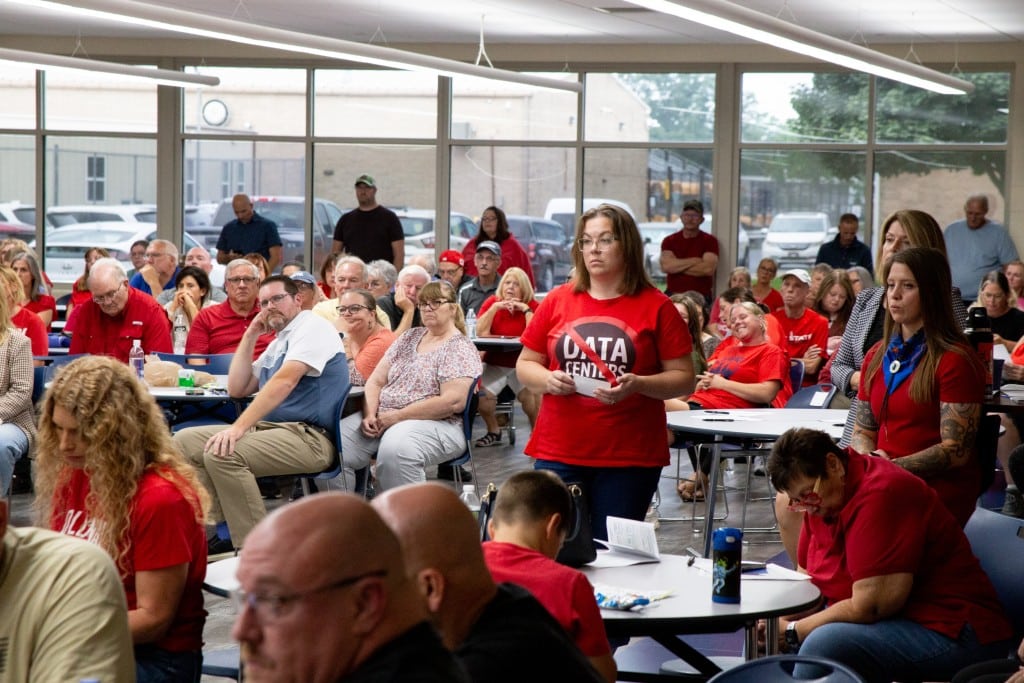
The treasurer’s request to the school board came at a tense time for the district. Students were already facing severe overcrowding and were studying in hallways, closets, and trailers as new housing developments went up around the booming city of Columbus. The school population was projected to grow by a fifth within a decade. The year before the Anduril announcement, the district had lobbied voters to approve a tax hike, paid for by local homeowners, to raise $96 million for new classroom space. They would do so again in the days after approving Anduril’s tax breaks, this time reducing the ask to $74 million. Both times, voters rejected the tax hike. The school board would later acknowledge that “we heard loud and clear from the community that increasing taxes was not a viable path.”
Grandmother Valerie Koker, who has seven kids in the Teays Valley school system, said locals voted down the measures because they were exasperated by their rising cost of living, including a property tax jump after the Covid-19 pandemic that saw homeowners saddled with three- or even four-digit increases to their annual bills. “I don’t think they [the local government] should give tax abatements. I believe that the developer should contribute to the schools,” Koker told Inkstick about her opposition to corporations, data centers, and housing developments receiving tax deals known as economic development incentives.
“I’m very leery as to why they’re coming after homeowners when I believe that there’s other options out there,” Koker said. As a former teacher, she said she understood that the funding needs were real. But she said many locals, like herself, live off fixed incomes and cannot take on more expenses. “There’s a lot of senior citizens,” Koker said. “Seriously, they just can’t afford anymore.”
Anduril has become the leader of the pack of a new cohort of tech firms-turned defense contractors rapidly gaining influence and contracts from the Pentagon. Its own valuation doubled to more than $60 billion over the past year as investors saw the California-based company as a key beneficiary of the Trump administration’s eagerness to ramp up weapons purchases and expand arms manufacturing with a swath of new factories. Anduril says the Ohio mega-plant will be the epicenter for its manufacturing operations, though, for now, most of its planned campus consists of corn and soybeans fields, and its early hires report to a warehouse that the company painted black and put a corporate logo on.
Companies seeking tax breaks in order to establish or expand operations tell state and local governments that such subsidies are, in Anduril’s words, “an essential component of the decision-making process … [to] allow the project to offset a portion of the long-term operational costs.” Without the tax breaks, Anduril’s weapons plant “would not move forward in Ohio,” the company told county officials. But communities across the country have long questioned those claims, and watchdogs have tallied up billions of dollars in annual losses to public schools due to such deals. In places like Texas, North Carolina, and South Carolina, residents have protested in particular when defense contractors, already beneficiaries of federal tax dollars, receive local tax breaks. And public opinion has flipped the script on whether localities need to be “competitive” to attract companies in another increasingly unpopular sector. Lawmakers and governors in more than 10 states, including Ohio, have recently curbed tax breaks for data centers. The shift is playing out in a town called Ashville, near the Anduril plant. There, a proposed power plant for a controversial data center is now offering to forgo tax breaks and voluntarily donate funds to public schools.
At that January morning meeting, the board members unanimously approved slashing Anduril’s property taxes in a staggered period that would continue through 2065. Superintendent Kyle Wolfe expressed his gratitude to the elected officials after the vote.
“Thank you for your time, work and consideration in understanding our school compensation agreement with Project Thor/Anduril,” he wrote. The agreement allows Anduril to instead pay a fixed amount of “payment in lieu of taxes,” called PILOTs, based on the square footage of the growing plant. Doing so could save the company hundreds of millions of dollars. Inkstick Media compared the square footage method used in the contract to the county auditor’s standard commercial and industrial property tax formula, using Anduril self-reported building costs contained in a separate county contract as an estimate of the property’s value once fully constructed, which the company says will occur by 2035.
The value of the tax breaks could vault the total amount of state support for the company to more than $1 billion.
Representatives from the school district, the school board, and Anduril did not respond to Inkstick’s requests for their own accounting of the projected value of Anduril’s property tax breaks or for comment on Inkstick’s estimate.
A school district spokeswoman sent an email to staff on the day the board approved Anduril’s tax breaks. In it, she appeared to recognize that locals may question why they should vote in favor of the tax increase for school buildings, known as a bond, when a multibillion-dollar defense contractor was setting up shop in the district.
“We’re truly grateful for this [Anduril] partnership and the long-term investment in our district,” spokeswoman Julie DeLisio wrote. “However, it’s important to note that these funds will support our schools over time and won’t address the immediate need for funding through the May bond issue.”
Anduril has not yet paid any PILOTs to the Teays Valley school district, according to its treasurer; the school district did not respond to questions on when they will start. School officials declined to answer questions about what formula and estimates were used to produce the $60 million figure included in a list of talking points prepared for a closed-door event in which Anduril executives got to address local officials, including school board members, directly.
Defenders of the property tax cuts say that they attract new businesses to town who will pay higher taxes in the future when the abatement runs out. But the Ohio state legislature recently, in 2021, doubled the length of tax abatements in places like the one Anduril where is setting up shop, called Community Reinvestment Areas, from 15 to 30 years.
The deal is part of a decades-long school funding trend that has shifted the tax burden from businesses to individual Ohioans. According to a report from the Ohio Education Policy Institute, in 1975, businesses paid 53.9% of school property taxes, while home and farm owners paid 46.1%. By 2023, the share had flipped: Residential and farm owners were paying 67.5% and commercial entities just 32.5%. The same report said that Ohio had the eighth-highest property tax rate in the country and that tax abatements like the one Anduril received ballooned by billions over a two-decade period.
Just a few days after the school’s Anduril deal was approved, Superintendent Wolf made a series of community visits to lobby locals to vote in favor of the school’s second attempt at the bond. The first was to the Commercial Point Men’s Club, then with school bus drivers, and finally the Ashville Women’s Civic Club. He came with a list of talking points that said that the school would be forced to rent more trailers to use as classrooms if the bond did not pass. He also suggested property tax rates would decrease soon. When the vote came up in May, 68% of voters still turned it down.
“Tax abatements may have a place when they help a new employer establish itself and create jobs,” said another grandmother, Becky Roe, whose two daughters attended Teays Valley schools and who advocates for public school funding. But she opposed them extending for decades, which she said then can place the burden on locals who end up funding much-needed public services.
Roe expressed particular concern about the growing property tax burden on homeowners. The county recently completed a triennial property-value update. She said her property value is expected to increase by 11.4%, following a more than 34% increase three years ago. “At a time when families are already facing rising costs for necessities such as food and gasoline, many simply do not have the financial capacity to absorb additional increases in property taxes,” she said.
Pari Sabety, the former director of the Ohio Office of Budget and Management, said the decades-long deals were part of a “continuously proliferating tax game.” Under Anduril’s contract, each new property can claim the three decades of tax breaks as they come online through 2035, meaning they could extend through 2065.
“We are going to be dead by the time these things are done,” Sabety said.
In April, the school board members who approved the tax breaks for Anduril received an emailed invitation. It was for an “Anduril Community Event,” which would be held in the Teays Valley High School auditorium. The invitees included elected officials, from county commissioners to a statehouse representative and a US senator. It was also sent to local business leaders, Anduril’s registered lobbyists, and the county’s chamber of commerce. The email described the event as invitation-only and directed attendees to submit questions in advance.
The questions included “What can we as a community do for you?” and “What’s being manufactured?”
At least one school board member attended, according to a sign-in sheet.
For an event that touched on thorny issues — such as autonomous weapons, the ethics and military usefulness of which are widely debated, and tax breaks, which attendees in the audience had a key role in approving — the setup of a panel interview with Anduril executives seemed designed to steer the conversation toward more amenable topics, such as job creation and supporting the military. A list of prompts to the panel, provided to Inkstick, included:
“For those in the room who might be asking, ‘What exactly will Arsenal One be doing, and why does it matter?’ can you talk about how the work being done here will contribute to keeping our service members, and our country, safer?”
And: “Tell me about how you want to partner with local schools to give Pickaway County students the best opportunity to have a future career at Arsenal One.”
The latter question pointed to the main reason that state and local officials have said they support the factory, which is its claim that it will create more than 4,000 manufacturing jobs. Last January, when he announced state support for the plant, Gov. Mike DeWine hailed Anduril’s factory as the “largest single job creation and new payroll project in Ohio’s history.”
But issues around transparency and fine print in the project’s contracts raise questions about those claims.
First, the state body that administers a liquor sales tax used for corporate tax breaks, called JobsOhio, is a private nonprofit that is exempt from public records law, meaning that ordinary Ohioans cannot view annual performance reports for companies that receive taxpayer support. A recent audit by Ohio’s Department of Development found that nearly half of companies receiving state job creation grants did not deliver anywhere near the promised number of jobs and wages and that most failing companies faced no penalties.
At the local level, the contract that lays out Anduril’s property tax breaks is called a Community Reinvestment Area (CRA) Agreement. That agreement describes the 4,008 job creation target as a “Good Faith Estimat[e]” but not a “Material Obligation” for Anduril. The latter category includes an annual payroll amount — some $67,500,000 per year — that does not correspond to a 4,008 employment level, since it would imply an average of less than $17,000 per worker. Similarly, another clause in the agreement requires Anduril to create just one job per 5,000 square feet of facility space that pays at least $50,000. The company projects a campus of between four to six million square feet; a five million square-foot campus would mean the county requires the company to employ just 1,000 people to receive tax breaks. Those lower levels of employment correspond with what Anduril itself envisioned when it published a manifesto, just a few months before it announced it had selected Ohio for its plant, that said its future Arsenal-1 megafactory would employ 1,500 people.
The CRA agreement also grants Anduril breathing room based on whether it continues to be in the good graces of the Pentagon. A clause says that local authorities will take into account “whether the Federal government terminates or substantially reduces significant contracts with [Anduril]” when reviewing its compliance with the deal.
Even with well-known transparency issues and shortcomings of other companies receiving such tax breaks, Sabety, the former state budget official, told Inkstick that promises to create jobs go far in Ohio’s political sphere.
“In Ohio, it’s all about jobs, jobs, jobs. It’s hard to explain how difficult job losses over the past 20 years have been for the state,” said Sabety, citing the North American Free Trade Agreement (NAFTA), coal mine shutdowns, and auto plant closures. “Every single family has one or two people that have been long-term unemployed.”
In a twist, emails revealing a lobbyist intervention on behalf of Anduril suggest that the company may not have actually qualified for the tax abatements when the school board approved them.
Reams of emails between the company’s lobbyist, Levi Gross, and a key state lawmaker, Representative Brian Stewart, includes one dated more than two months after the school board decision. In it, Gross wrote to Stewart, who represents the county Anduril is located in and chairs the powerful House Finance Committee, requesting an amendment he called “our mega project fix for Anduril.”
The legal move addressed the fact that Anduril does not actually own its Ohio properties, which previously would have been a requirement to claim CRA tax breaks. The amended language broadened the category to include properties “owned or operated” by a megaproject, a legal category in Ohio for large corporate developments. Such arrangements to lease properties may be preferable to venture capital-backed firms like Anduril, which often see owning properties as a liability on their balance sheets.
Neither Representative Stewart nor spokespeople for Anduril responded to requests for comment.
his April, the local school funding issue took a new twist. School officials announced that they had found a way to fill the funding gap, one that thrust them into a local political firestorm. The board had approved a proposed donation from a development locals were fighting to keep out of town — a gas-powered energy plant for a data center.
Four local governments in the county, including the same one that welcomed Anduril, had already passed moratoriums on data centers, and a proposed one in the town of Ashville sparked local outrage and a signature-gathering campaign to put it to a local referendum in November.
The donation would be a one-off amount of $77,440,000 to fund the new classroom buildings. The school board also said the company would be prohibited from seeking property tax abatements. In a message to local taxpayers, the school district said that the donation “represents one way to meet that responsibility [to construct new facilities] without placing additional financial burden on our residents.”
Koker, the grandmother, said the proposed donation didn’t seem to be swaying locals to accept the data center and its power plant and that the fight to put the issue to a local ballot was alive and well. It also underscored to her that the school system could extract more funds from corporate developers — when they chose to.
“I think that made the school look really bad” after years of asking locals to pay for the bond, she said. “They have shot themselves in the foot right now because they have accepted the money from the data center.”
This reporting was supported by the Fund for Investigative Journalism.
Related Articles

Inside Ohio’s Revolt Against Data Centers
A colorful crew of activists helped spur moratorium votes in 10 communities next month. Now, they’re aiming for a statewide ban.

Ripped to Shreds is ready to hit the runway
The new resale shop, created in partnership between artist and musician Courtney L. Hall and Used Kids owner Greg Hall (no relation), will celebrate its grand opening on Sunday, Oct. 11.

Two Dollar Radio HQ reopens with an expanded ownership group and a similarly expanded vision for the future
‘I think a big part from opening was to give authorship of the space to people with good ideas, to open the doors to people to try different things.’